Indian Grey Hornbill
Ocyceros birostris
Avilumen editorial team ·

The Indian gray hornbill is a common hornbill found on the Indian subcontinent. It is mostly arboreal and is commonly sighted in pairs. It has grey feathers all over the body with a light grey or dull white belly. The horn is black or dark grey with a casque extending to the point of curvature of the horn.
The Indian gray hornbill (Ocyceros birostris) is a common hornbill found on the Indian subcontinent. It is mostly arboreal and is commonly sighted in pairs. It has grey feathers all over the body with a light grey or dull white belly. The horn is black or dark grey with a casque extending to the point of curvature of the horn. It is one of the few hornbill species found in urban areas in many cities where they are able to make use of large trees in avenues.
Description
The Indian grey hornbill is a medium-sized hornbill, measuring around 61 cm (24 in) in length. The upper parts are greyish brown and there is a slight trace of a pale supercilium. The ear coverts are darker. The flight feathers of the wing are dark brown with a whitish tip. The tail has a white tip and a dark subterminal band. They have a red iris and the eyelids have eyelashes. The casque is short and pointed.
The male has a larger casque on a dark bill, and the culmen and lower mandible are yellowish. The bare skin around the eye is dark in the male, but sometimes pale reddish in females. The female has a more yellowish bill with black on the basal half and on the casque.
The juveniles lack the casque, and the bare skin around the eye is dull orange.
Distribution
The species is found mainly on the plains up to about 2,000 ft (610 m). It is found from the foothills of the Himalayas southwards, bounded to the west by the Indus system and to the east by the Ganges Delta. It may make local movements in the drier western region. It is found even in cities that have old avenue trees. The species has been observed, usually in pairs, in Dharamsala town (Himachal Pradesh) at about 1500 to 1600 masl during summer and in the rainy season (May to September, 2017). and does not overlap much with the Malabar grey hornbill of the Western Ghats.
Over 60 years after disappearing from Gujarat’s Gir forests, the reintroduced Indian Grey Hornbill has achieved four straight years of successful breeding.
Behaviour and ecology
The call is a squealing call somewhat like that of a black kite. The flight is heavy and involves flapping interspersed with glides. They are found in pairs or small groups.
The nesting season is April to June and the clutch varies from one to five very symmetrical white eggs. Indian grey hornbills usually nest in tree hollows on tall trees. An existing hollow may be excavated further to suit. The female enters the nest hollow and seals the nest hole, leaving only a small vertical slit through which the male feeds her. The nest entrance is sealed by the female using its excreta and mud-pellets supplied by the male. While inside the nest, the female moults her flight feathers and incubates the eggs. The male provides the nest inmates with a steady supply of bark pieces to ensure that the excreta is removed from the nest by absorption and adsorption and to help maintain the micro-climate within the nest cavity. The regrowth of the female's feathers coincides with the maturity of the chicks, at which point the nest is broken open.
A study at a nest near Mumbai noted that the key fruiting trees on which the hornbills fed were Streblus asper, Cansjera rheedii, Carissa carandas, Grewia tiliaefolia, Lannea coromandelica, Ficus spp., Sterculia urens and Securinega leucopyrus. They are also known to take molluscs, scorpions, insects, small birds (they have been recorded removing and possibly preying on rose-ringed parakeet chicks) and reptiles in their diet They are known to feed on the fruits of Thevetia peruviana, which are known to be toxic to many vertebrates.
They are almost completely arboreal, but very rarely descend to the ground to pick up fallen fruits, to dust bathe, or to pick up mud pellets to seal the nest cavity during the nesting period. They indulge in various social activities, including bill-grappling and aerial jousting.
Text adapted from Wikipedia · CC BY-SA 4.0
Taxonomy
- Order
- Bucerotiformes
- Family
- Bucerotidae
- Genus
- Ocyceros
- Conservation status
- Least concern
Listen to its call
No recording yet
Illustration gallery
6 illustrations of Ocyceros birostris (Indian Grey Hornbill) in different styles, true to its real plumage. Shown watermarked; the art pack includes the high-resolution originals, ready to print.
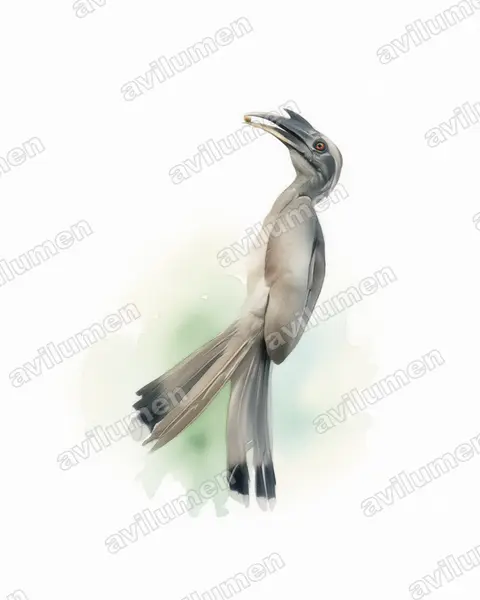
Watercolor 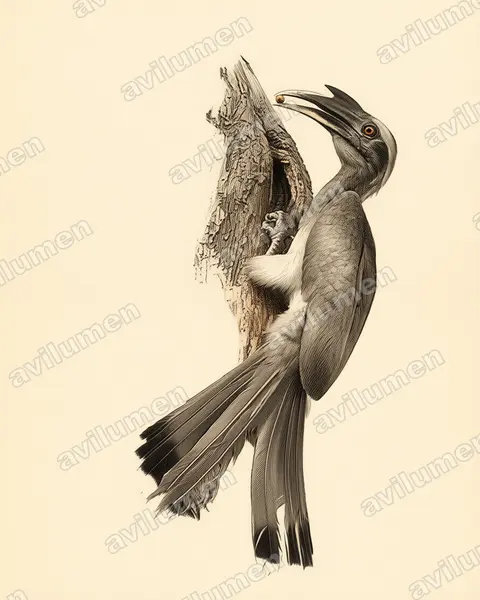
Vintage plate 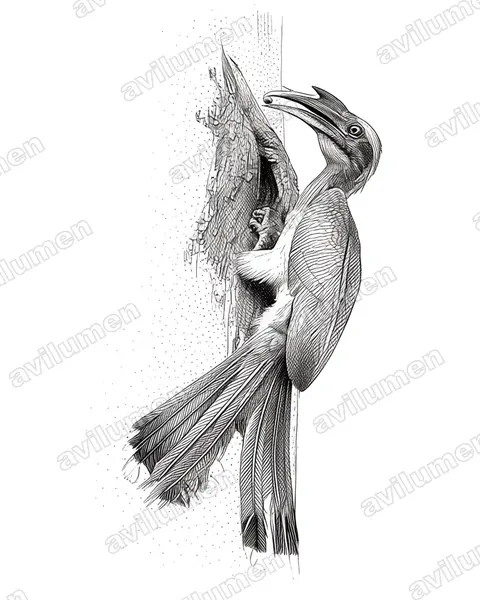
Ink 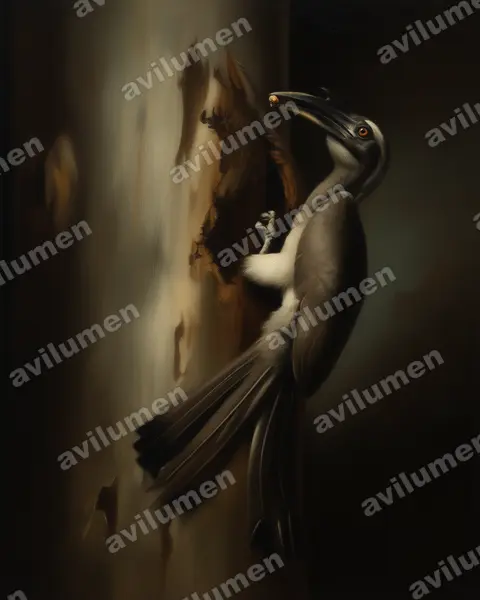
Oil 
Realistic 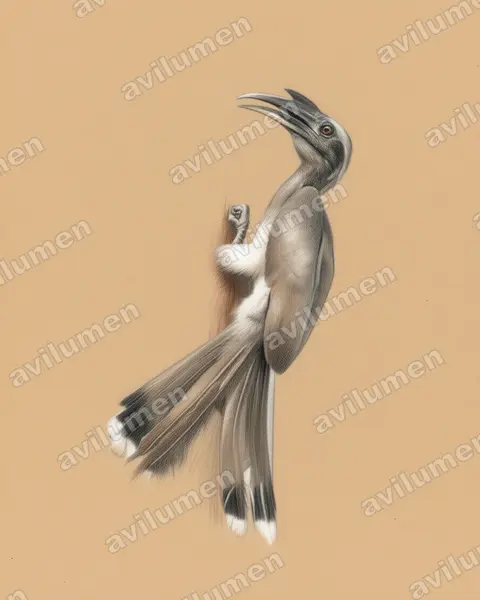
Colored pencil
Illustrations based on the photograph by J.M.Garg (CC BY-SA 3.0), from Wikimedia Commons.
Digital editions
HD Digital Art Pack — Indian Grey Hornbill
Digital download: 6 high-resolution illustrations of the Indian Grey Hornbill (Ocyceros birostris), print-ready. This is a digital file; no animal or physical item is included.
AI Avatar — Indian Grey Hornbill
Generate an avatar fusing your face with the Indian Grey Hornbill (Ocyceros birostris). Delivered digitally in 8K, watermark-free. Digital product; no animals are sold or brokered.
Instant download. No live birds are sold.
Frequently asked questions
- Is Ocyceros birostris (Indian Grey Hornbill) endangered?
- The IUCN Red List places Ocyceros birostris, commonly known as the Indian Grey Hornbill, in the «Least concern» category. «Least concern» means it is not currently threatened.
- What family does Ocyceros birostris (Indian Grey Hornbill) belong to?
- Ocyceros birostris (Indian Grey Hornbill) belongs to the family Bucerotidae, in the order Bucerotiformes.
- What colour is Ocyceros birostris (Indian Grey Hornbill)?
- The plumage of Ocyceros birostris (Indian Grey Hornbill) combines these colours: Grey and White.
More from the same family
 Vulnerable
Rufous-necked Hornbill
Aceros nipalensis
The rufous-necked hornbill is a species of hornbill in Bhutan, northeastern India, especially in Arunachal Pradesh, Indian subcontinent and Southeast Asia. It is locally extinct in Nepal due to hunting and significant loss of habitat. There are less than 10,000 adults left in the wild. With a length of about 117 cm (46 in), it is among the largest Bucerotine hornbills.
from $1.99
 Near threatened
Austen's Brown Hornbill
Anorrhinus austeni
Austen's brown hornbill, also known as the white-throated brown hornbill or brown hornbill, is a medium-sized species of hornbill found in forests from northeastern India to Vietnam and northern Thailand. It is rare throughout its range and is threatened by habitat loss and fragmentation.
from $1.99
 Near threatened
Bushy-crested Hornbill
Anorrhinus galeritus
The bushy-crested hornbill is a bird in the hornbill family. It is found in Brunei, Indonesia, Malaysia, Myanmar, and Thailand. Its natural habitat is subtropical or tropical moist lowland forests.
from $1.99
 Near threatened
Austen's Brwon Hornbill
Anorrhinus tickelli
Tickell's brown hornbill, also known as the rusty-cheeked hornbill, is a species of hornbill found in forests in Burma and adjacent western Thailand. Austen's brown hornbill is sometimes considered as a subspecies of Tickell's brown hornbill.
from $1.99