Malabar Grey Hornbill
Ocyceros griseus
Avilumen editorial team ·

The Malabar gray hornbill is a hornbill endemic to the Western Ghats and associated hills of southern India. They have a large beak but lack the casque that is prominent in some other hornbill species. They are found mainly in dense forest and around rubber, arecanut or coffee plantations. They move around in pairs or small groups, feeding on figs and other forest fruits.
The Malabar gray hornbill (Ocyceros griseus) is a hornbill endemic to the Western Ghats and associated hills of southern India. They have a large beak but lack the casque that is prominent in some other hornbill species. They are found mainly in dense forest and around rubber, arecanut or coffee plantations. They move around in pairs or small groups, feeding on figs and other forest fruits. Their loud cackling and laughing call makes them familiar to people living in the region.
Description
The Malabar grey hornbill is a large bird, but at 45 to 58 cm (18 to 23 in) in length it is still the smallest of the Asian hornbills. It has a 23 cm (9.1 in) tail and pale or yellowish to orange bill. Males have a reddish bill with a yellow tip, while the females have a plain yellow bill with black at the base of the lower mandible and a black stripe along the culmen. They show a broad whitish superciliary band above the eye, running down to the neck. They fly with a strong flap and glide flight and hop around heavily on the outer branches of large fruiting trees. They have brown-grey wings, a white carpal patch and black primary flight feathers tipped with white. The Indian grey hornbill, which is found mainly on the adjoining plains, is easily told apart by its prominent casque, and in flight by the white trailing edge of the entire wing. The Malabar grey hornbill has a grey back and a cinnamon vent. The long tail is blackish with a white tip, and the underparts are grey with white streaks. The long curved bill has no casque. Immature birds have browner upperparts and a yellow bill. Young birds have a dull white or yellow iris.
Their loud calls are distinctive and include "hysterical cackling", "laughing" and "screeching" calls.
Local names
சோலைக் காகா (solai kaka, Tamil, meaning forest crow); சராட்டான் (sarattaan, Kadar); செரியன் ஓங்கல் (seriyan oongal, Muthuvan, meaning small hornbill); ಕಲ್ದಲ್ ಹಕ್ಕಿ (kaldal hakki, Kannada), കോഴിവേഴാമ്പൽ (kozhi vezhambal, Malayalam), chotta peelu or dhanesh in Marathi, and gobre vaayre in Konkani.
Distribution
The species is endemic to the Western Ghats mountain range of India from about Nashik in the north to the southernmost hills[1]. The species has an elevational distribution range from about 50 m near the coast (e.g., Phansad Wildlife Sanctuary, Maharashtra) to around 1,500 m in the mountains. In the southern Western Ghats, Malabar Grey Hornbills were reported in evergreen forests between 500 m and 900 m (sporadically to 1,100 m) elevation in Kalakad – Mundanthurai Tiger Reserve, but frequently up to 1,200 m in the Anamalai Hills further north. In both these sites, the estimated Malabar Grey Hornbill density decreased with elevation, with the population density in rainforest fragments in the Anamalai Hills being additionally positively related to food tree species richness. The species is found mainly in dense forest habitats; the thinner dry forest habitat of the plains is typically occupied by the Indian grey hornbill. The Sri Lanka grey hornbill was included with this species in the past, but is now considered distinct.
Behaviour and ecology
This hornbill is found in small groups mainly in habitats with good tree cover. Being large frugivores, they are important as seed dispersal agents for many species of fruit bearing forest trees. They also feed on small vertebrates and in captivity they will readily take meat.
Breeding
The breeding season is January to May. Being secondary cavity nesters (incapable of excavating their own nests), they find trees with large cavities. A study in the Anaimalai Hills showed that the species preferred nest sites that had large trees. The nest holes were usually found in large trees with hollows caused by heart-rot, where a branch had broken off. Trees of the species Lagerstroemia microcarpa, Terminalia bellirica and Terminalia crenulata were found to hold nearly 70% of all the nests in the Mudumalai area. The species is monogamous, and the same nest sites are used by the pair year after year. The female incarcerates herself within the cavity by sealing its entrance with a cement made from her droppings. The female then lays three or sometimes four white eggs and begins a complete moult of her flight feathers. The entrance to the nest retains a narrow aperture through which the female voids excreta and receives food from the male. The male brings all the food needed for the female and the young. Berries, insects, small rodents and reptiles are included in the diet. Males tap the tree to beckon the female on arriving with food. Berries are regurgitated one at a time and shifted to the tip of the bill before being passed to the female.
Text adapted from Wikipedia · CC BY-SA 4.0
Plumage colours
Distribution

Taxonomy
- Order
- Bucerotiformes
- Family
- Bucerotidae
- Genus
- Ocyceros
- Conservation status
- Vulnerable
Listen to its call
No recording yet
Illustration gallery
6 illustrations of Ocyceros griseus (Malabar Grey Hornbill) in different styles, true to its real plumage. Shown watermarked; the art pack includes the high-resolution originals, ready to print.
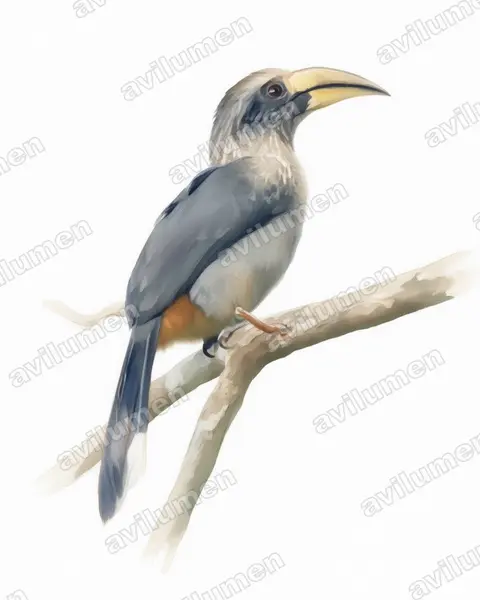
Watercolor 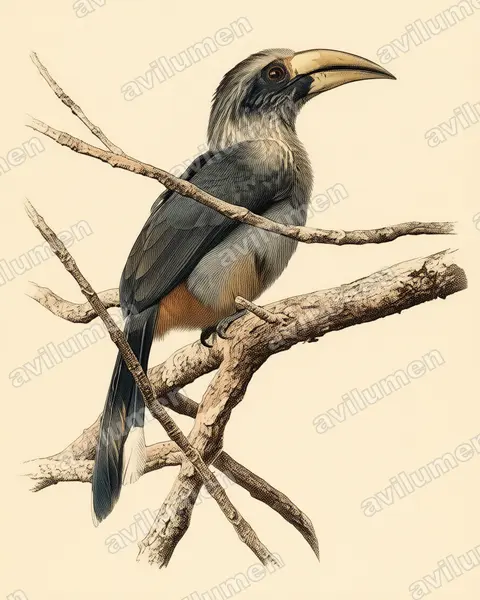
Vintage plate 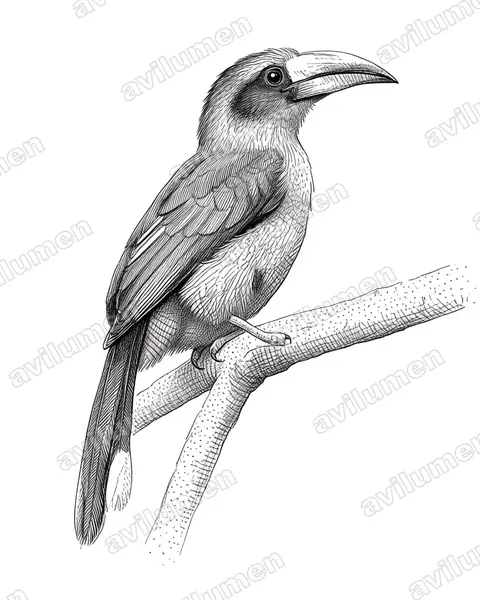
Ink 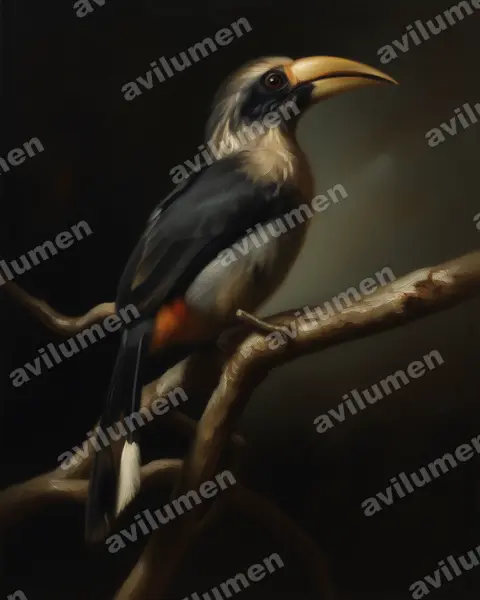
Oil 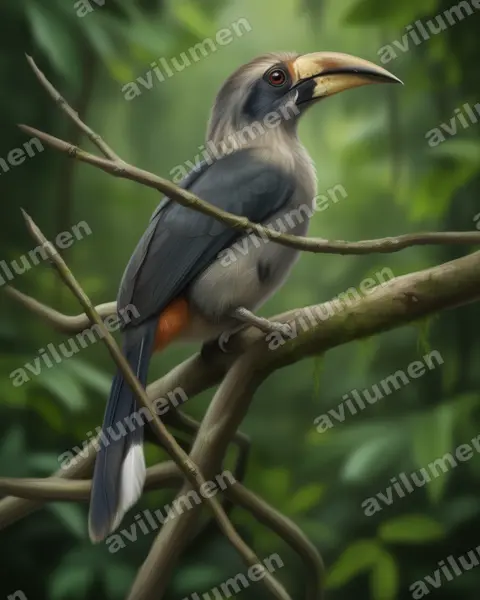
Realistic 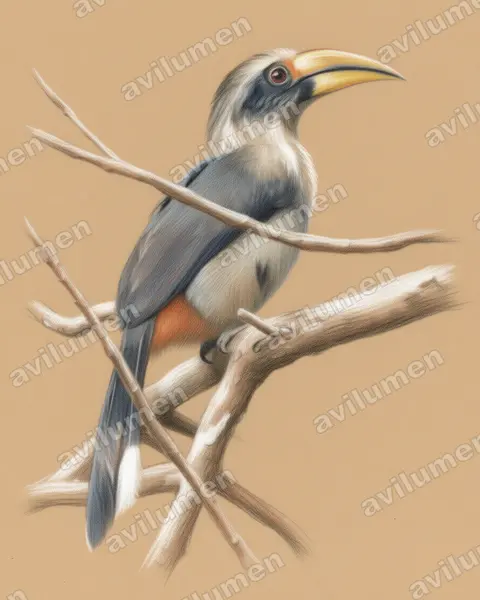
Colored pencil
Illustrations based on the photograph by derivative work: Snowmanradio (talk) Ocyceros_griseus_-India-6.jpg: Lip Kee Yap (CC BY-SA 2.0), from Wikimedia Commons.
Digital editions
HD Digital Art Pack — Malabar Grey Hornbill
Digital download: 6 high-resolution illustrations of the Malabar Grey Hornbill (Ocyceros griseus), print-ready. This is a digital file; no animal or physical item is included.
AI Avatar — Malabar Grey Hornbill
Generate an avatar fusing your face with the Malabar Grey Hornbill (Ocyceros griseus). Delivered digitally in 8K, watermark-free. Digital product; no animals are sold or brokered.
Instant download. No live birds are sold.
Frequently asked questions
- Is Ocyceros griseus (Malabar Grey Hornbill) endangered?
- The IUCN Red List places Ocyceros griseus, commonly known as the Malabar Grey Hornbill, in the «Vulnerable» category. «Vulnerable» means it faces a high risk of extinction in the medium term.
- What family does Ocyceros griseus (Malabar Grey Hornbill) belong to?
- Ocyceros griseus (Malabar Grey Hornbill) belongs to the family Bucerotidae, in the order Bucerotiformes.
- What colour is Ocyceros griseus (Malabar Grey Hornbill)?
- The plumage of Ocyceros griseus (Malabar Grey Hornbill) combines these colours: Grey.
More from the same family
 Vulnerable
Rufous-necked Hornbill
Aceros nipalensis
The rufous-necked hornbill is a species of hornbill in Bhutan, northeastern India, especially in Arunachal Pradesh, Indian subcontinent and Southeast Asia. It is locally extinct in Nepal due to hunting and significant loss of habitat. There are less than 10,000 adults left in the wild. With a length of about 117 cm (46 in), it is among the largest Bucerotine hornbills.
from $1.99
 Near threatened
Austen's Brown Hornbill
Anorrhinus austeni
Austen's brown hornbill, also known as the white-throated brown hornbill or brown hornbill, is a medium-sized species of hornbill found in forests from northeastern India to Vietnam and northern Thailand. It is rare throughout its range and is threatened by habitat loss and fragmentation.
from $1.99
 Near threatened
Bushy-crested Hornbill
Anorrhinus galeritus
The bushy-crested hornbill is a bird in the hornbill family. It is found in Brunei, Indonesia, Malaysia, Myanmar, and Thailand. Its natural habitat is subtropical or tropical moist lowland forests.
from $1.99
 Near threatened
Austen's Brwon Hornbill
Anorrhinus tickelli
Tickell's brown hornbill, also known as the rusty-cheeked hornbill, is a species of hornbill found in forests in Burma and adjacent western Thailand. Austen's brown hornbill is sometimes considered as a subspecies of Tickell's brown hornbill.
from $1.99