Bearded mountaineer
Oreonympha nobilis
Avilumen editorial team ·

The bearded mountaineer is a species of hummingbird in the "coquettes", tribe Lesbiini of subfamily Lesbiinae. It is endemic to Peru.
The bearded mountaineer (Oreonympha nobilis) is a species of hummingbird in the "coquettes", tribe Lesbiini of subfamily Lesbiinae. It is endemic to Peru.
Taxonomy and systematics
The ornithologist John Gould described the species in 1869, from a specimen collected by Henry Whitely at Tinta District in Peru, and placed it in its own genus Oreonympha. He recognised a kinship with Oxypogon and Ramphomicron. A study of mitochondrial DNA of hummingbirds shows it to be most closely related to the bearded helmetcrests (Oxypogon sp.) and the rufous-capped thornbill (Chalcostigma ruficeps). The other member of the genus Chalcostigma lay outside the group, suggesting the genus might need revising in the future. In addition, the South American Classification Committee (SACC) of the American Ornithological Society is considering a proposal to merge both Oreonympha and Chalcostigma into Oxypogon.
The SACC, the International Ornithological Committee (IOC), and the Clements taxonomy recognize two subspecies, the nominate O. n. nobilis and O. n. albolimbata. However, BirdLife International's Handbook of the Birds of the World (HBW) treats these taxa as separate species, the eastern and western mountaineers respectively.
Description
The bearded mountaineer is 14 to 16.5 cm (5.5 to 6.5 in) long including the approximately 2.3 cm (0.91 in) long bill. It weighs about 7 to 9 g (0.25 to 0.32 oz). Adult males of the nominate subspecies have a deep purplish blue forecrown and crown with a narrow black stripe in the middle. The face is bronzy black with a narrow white band at the back. Its gorget is long and narrow, emerald green under the chin and the rest purplish with a bluish tip. The nape, back, and rump are bronzy to bronzy brown. The tail is long and deeply forked; the feathers are bronzy with increasing amounts of white from the innermost to outermost. The center of the breast is white, the sides of the breast and flanks brownish, and the undertail coverts are bronzy brown. The adult female is similar to the male but duller overall and dingier underneath. Its gorget is smaller and mostly white and the tail less deeply forked. Both sexes have black bills and legs. Juveniles are duller than the adults, with a scaly green crown, a dull brown throat, and a yellow mandible.
Males of subspecies O. n. albolimbata has white bands on either side of the crown and its tail is much more coppery. The female has white extending from the same white bands of the crown through the lores to the gorget.
Distribution and habitat
The "eastern" nominate subspecies of bearded mountaineer is found in the departments of Apurímac and Cuzco of south-central Peru, in the drainages of the Urubamba and upper Apurímac rivers. The "western" subspecies O. n. albolimbata is found in Peru's departments of Huancavelica, Ayacucho, and Apurímac, in the drainages of the Mantaro, Pampas, and Chalhuanca rivers.
The species inhabits dry Andean valleys characterized by rocky and scrubby hillsides and open woodland. It occurs in a variety of native plant communities but also is regularly found in tree tobacco (Nicotiana) and Eucalyptus even along roads and in towns. In elevation it ranges from 2,500 to 3,900 m (8,200 to 12,800 ft).
Movement
The bearded mountaineer is resident throughout it range.
Feeding
The bearded mountaineer feeds on nectar, primarily that of Agave, cacti, Nicotiana, and Eucalyptus. It feeds both by hovering with an almost vertical stance and tail flicking, but also clings to flowers with open wings. It also eats small arthropods. It is submissive to most other hummingbirds.
Breeding
The bearded mountaineer's breeding phenology has not been documented, though an early author suggest that it might breed in caves above rivers.
Vocalization
The bearded mountaineer's vocalizations include "a descending, squeaky series followed by a rich chatter: swee swee chew-chew-chew [and] also a dry dzzrt."
Status
The IUCN uses HBW taxonomy and so treats the subspecies separately as species. Both are assessed as being of Least Concern. Both have restricted ranges; their population numbers are unknown but believed to be stable. The species as a whole is described as uncommon to locally common. Human plantings of Eucalyptus and tree tobacco may be beneficial if native vegetation is lost.
Text adapted from Wikipedia · CC BY-SA 4.0
Where it lives
Plumage colours
Distribution

Taxonomy
- Order
- Apodiformes
- Family
- Trochilidae
- Genus
- Oreonympha
- Conservation status
- Least concern
Listen to its call
No recording yet
Illustration gallery
6 illustrations of Oreonympha nobilis (Bearded mountaineer) in different styles, true to its real plumage. Shown watermarked; the art pack includes the high-resolution originals, ready to print.
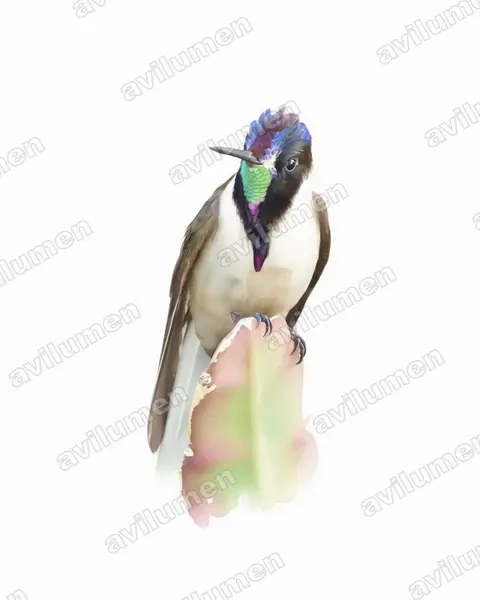
Watercolor 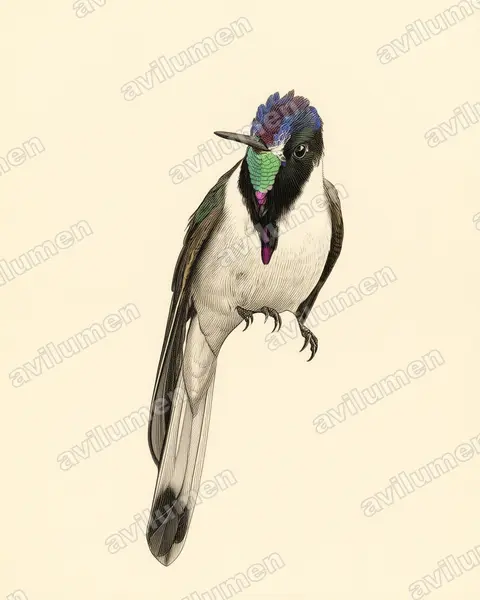
Vintage plate 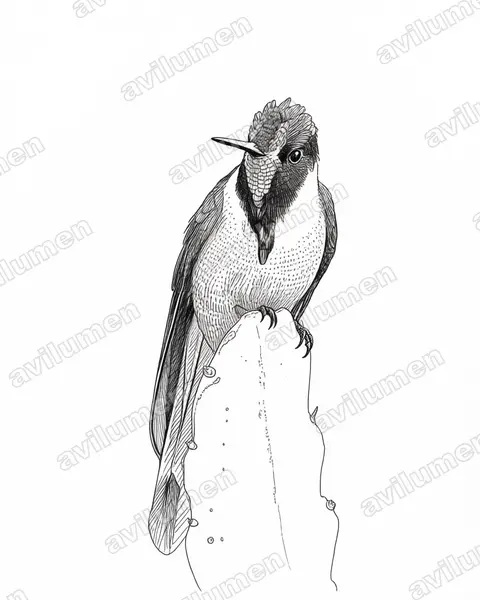
Ink 
Oil 
Realistic 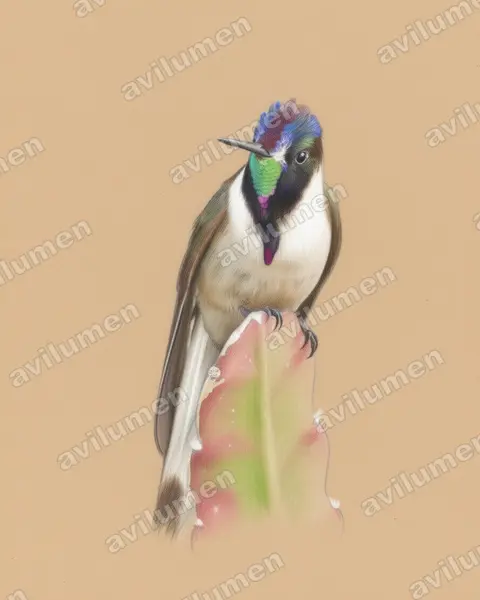
Colored pencil
Illustrations based on the photograph by thibaudaronson (CC BY-SA 4.0), from Wikimedia Commons.
Digital editions
HD Digital Art Pack — Bearded mountaineer
Digital download: 6 high-resolution illustrations of the Bearded mountaineer (Oreonympha nobilis), print-ready. This is a digital file; no animal or physical item is included.
AI Avatar — Bearded mountaineer
Generate an avatar fusing your face with the Bearded mountaineer (Oreonympha nobilis). Delivered digitally in 8K, watermark-free. Digital product; no animals are sold or brokered.
Instant download. No live birds are sold.
Frequently asked questions
- Is Oreonympha nobilis (Bearded mountaineer) endangered?
- The IUCN Red List places Oreonympha nobilis, commonly known as the Bearded mountaineer, in the «Least concern» category. «Least concern» means it is not currently threatened.
- Where does Oreonympha nobilis (Bearded mountaineer) live?
- Oreonympha nobilis (Bearded mountaineer) is found in South America.
- What family does Oreonympha nobilis (Bearded mountaineer) belong to?
- Oreonympha nobilis (Bearded mountaineer) belongs to the family Trochilidae, in the order Apodiformes.
- What colour is Oreonympha nobilis (Bearded mountaineer)?
- The plumage of Oreonympha nobilis (Bearded mountaineer) combines these colours: Green.
More from the same family
 Least concern
Emerald-chinned Hummingbird
Abeillia abeillei
The emerald-chinned hummingbird is a species of hummingbird in the "emeralds", tribe Trochilini of subfamily Trochilinae.
from $1.99
 Least concern
Speckled hummingbird
Adelomyia melanogenys
The speckled hummingbird is a species of hummingbird. It is the only member of the genus Adelomyia. It inhabits Neotropical montane cloud forests at elevations of 1,000–2,500 meters and is confined to the Andes of Argentina, Bolivia, Peru, Ecuador, Colombia and Venezuela; as well as to some isolated montane forests in western Ecuador and Venezuela.
from $1.99
 Vulnerable
Purple-backed sunbeam
Aglaeactis aliciae
The purple-backed sunbeam is a bird species in the family Trochilidae. It is found only in Peru.
from $1.99
 Near threatened
White-tufted sunbeam
Aglaeactis castelnaudii
The white-tufted sunbeam is a species of hummingbird in the family Trochilidae. It is found only in Peru. Its natural habitats are subtropical or tropical moist montane forest and subtropical or tropical high-altitude shrubland.
from $1.99