Southern giant hummingbird
Patagona gigas
Avilumen editorial team ·

The southern giant hummingbird is one of two species in the genus Patagona and the second largest hummingbird species, after its close relative the northern giant hummingbird.
The southern giant hummingbird (Patagona gigas) is one of two species in the genus Patagona and the second largest hummingbird species, after its close relative the northern giant hummingbird.
Taxonomy
It and the sympatric northern giant hummingbird (P. peruviana) were once considered the same species, i.e., the giant hummingbird, though some researchers have already classified them as different species or subspecies in the past. Genomic analysis supports the separation of the two species which shows that they diverged between 2.1 and 3.4 million years ago, in the late Pliocene. Williamson and colleagues attributed the binomial name Patagona chaski to the northern giant hummingbird in 2024, but this taxon was already described as Patagona peruviana by Adolphe Boucard in 1893, so P. chaski is a junior synonym of P. peruviana.
Description
Its mass is in the range of 17–31 g (0.60–1.09 oz), making it approximately twice as heavy as the next largest hummingbird. It has a wingspan of 21.5 cm (8.5 in), with a body length of 23 cm (9.1 in).
The two subspecies are visually distinguishable. P. g. peruviana is yellowish brown overall and has white on the chin and throat, where P. g. gigas is more olive green to brown and lacks white on the chin and throat.
Distribution, habitat, and migration
The giant hummingbird is widely distributed throughout the length of the Andes on both the east and west sides. Its seasonal migration loop is estimated at 8,300 km (5,200 mi) over the Central Andean Plateau, involving an altitude change of about 4,100 m (13,500 ft) over a three week period.
It typically inhabits the higher altitude scrubland and forests that line the slopes of the Andes during the summer and then retreats to similar, lower altitude habitats in winter months.
The species persists through a large altitude range, with specimens retrieved from sea level up to 4,600 m (15,100 ft). They have shown to be fairly resilient to urbanisation and agricultural activities; however, the removal of vegetation limits their distribution in dense city areas and industrial zones. The giant hummingbird migrates in summer to the temperate areas of South America, reaching as low as 44° S. Correspondingly, it migrates north to more tropical climates in winter (March–August), though not usually venturing higher than 28° S.
P. g. peruviana occurs from Ecuador to the southeastern mountains of Peru and P. g. gigas from northern Bolivia and Chile to Argentina. Contact between these previously accepted subspecies is most likely to occur around the eastern slopes of the north Peruvian Andes.
Ecology
P. gigas is the predominant pollinator of the cactus species Oreocereus celsianus.
Cultural significance
The giant hummingbird holds significant value for some of the aboriginal inhabitants of the Andes. The people of Chiloé Island believe that if a woman captures a hummingbird then they will gain great fertility from it. This species is a likely inspiration to the people of the Nazca culture who created the Nazca hummingbird geoglyph.
Status
The range of the giant hummingbird is sizable, estimated at 1,200,000 km2 (460,000 sq mi), with total numbers of about 65,000 estimated in Peru. The species is classified by the International Union for Conservation of Nature as being of Least Concern.
Text adapted from Wikipedia · CC BY-SA 4.0
Where it lives
Plumage colours
Distribution

Taxonomy
- Order
- Apodiformes
- Family
- Trochilidae
- Genus
- Patagona
- Conservation status
- Least concern
Listen to its call
No recording yet
Illustration gallery
6 illustrations of Patagona gigas (Southern giant hummingbird) in different styles, true to its real plumage. Shown watermarked; the art pack includes the high-resolution originals, ready to print.
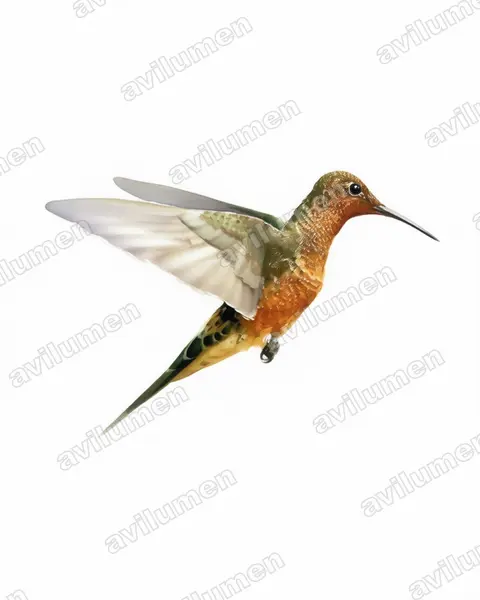
Watercolor 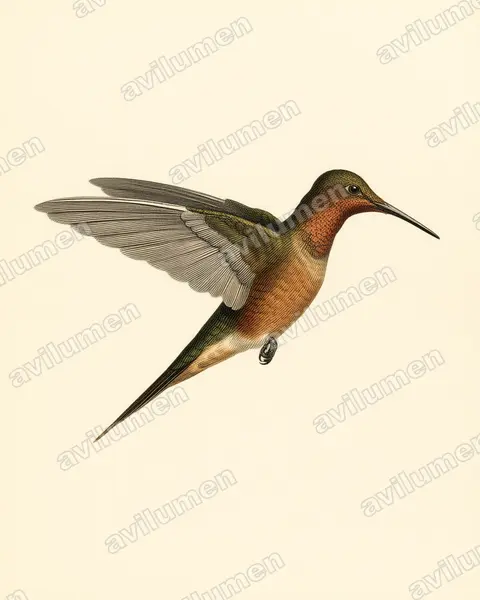
Vintage plate 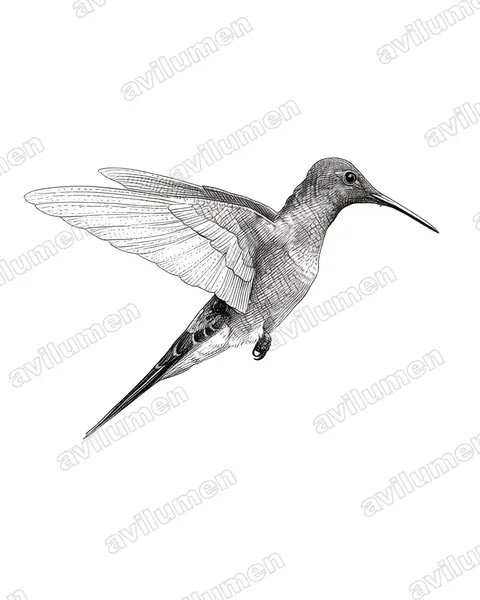
Ink 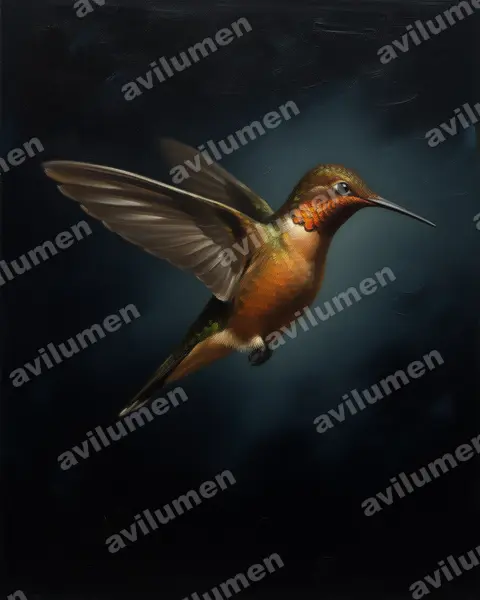
Oil 
Realistic 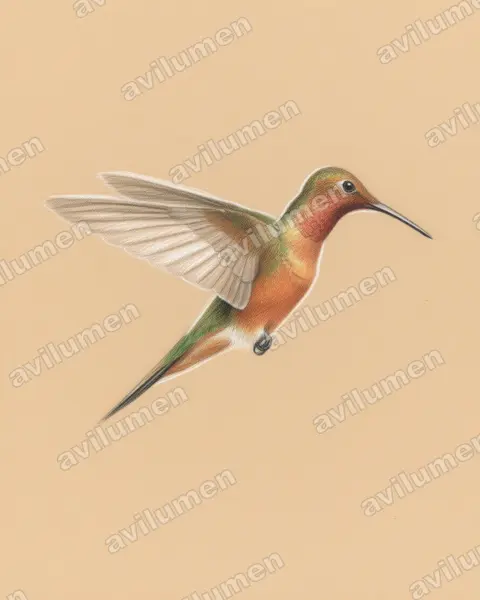
Colored pencil
Illustrations based on the photograph by Arturo Nahum (CC BY-SA 2.5), from Wikimedia Commons.
Digital editions
HD Digital Art Pack — Southern giant hummingbird
Digital download: 6 high-resolution illustrations of the Southern giant hummingbird (Patagona gigas), print-ready. This is a digital file; no animal or physical item is included.
AI Avatar — Southern giant hummingbird
Generate an avatar fusing your face with the Southern giant hummingbird (Patagona gigas). Delivered digitally in 8K, watermark-free. Digital product; no animals are sold or brokered.
Instant download. No live birds are sold.
Frequently asked questions
- Is Patagona gigas (Southern giant hummingbird) endangered?
- The IUCN Red List places Patagona gigas, commonly known as the Southern giant hummingbird, in the «Least concern» category. «Least concern» means it is not currently threatened.
- Where does Patagona gigas (Southern giant hummingbird) live?
- Patagona gigas (Southern giant hummingbird) is found in South America.
- What family does Patagona gigas (Southern giant hummingbird) belong to?
- Patagona gigas (Southern giant hummingbird) belongs to the family Trochilidae, in the order Apodiformes.
- What colour is Patagona gigas (Southern giant hummingbird)?
- The plumage of Patagona gigas (Southern giant hummingbird) combines these colours: Green.
More from the same family
 Least concern
Emerald-chinned Hummingbird
Abeillia abeillei
The emerald-chinned hummingbird is a species of hummingbird in the "emeralds", tribe Trochilini of subfamily Trochilinae.
from $1.99
 Least concern
Speckled hummingbird
Adelomyia melanogenys
The speckled hummingbird is a species of hummingbird. It is the only member of the genus Adelomyia. It inhabits Neotropical montane cloud forests at elevations of 1,000–2,500 meters and is confined to the Andes of Argentina, Bolivia, Peru, Ecuador, Colombia and Venezuela; as well as to some isolated montane forests in western Ecuador and Venezuela.
from $1.99
 Vulnerable
Purple-backed sunbeam
Aglaeactis aliciae
The purple-backed sunbeam is a bird species in the family Trochilidae. It is found only in Peru.
from $1.99
 Near threatened
White-tufted sunbeam
Aglaeactis castelnaudii
The white-tufted sunbeam is a species of hummingbird in the family Trochilidae. It is found only in Peru. Its natural habitats are subtropical or tropical moist montane forest and subtropical or tropical high-altitude shrubland.
from $1.99