Stork-billed Kingfisher
Pelargopsis capensis
Avilumen editorial team ·

The stork-billed kingfisher, is a tree kingfisher which is widely but sparsely distributed in the tropical Indian subcontinent and Southeast Asia, from India to Indonesia. These kingfishers are large and have a heavy bill. The head is brown and the chin is paler coloured. The sexes are similar in coloration. This is found mostly in streams and ponds in lowland areas with tree cover.
The stork-billed kingfisher (Pelargopsis capensis), is a tree kingfisher which is widely but sparsely distributed in the tropical Indian subcontinent and Southeast Asia, from India to Indonesia. These kingfishers are large and have a heavy bill. The head is brown and the chin is paler coloured. The sexes are similar in coloration. This is found mostly in streams and ponds in lowland areas with tree cover. This kingfisher is sendentary throughout its range.
Taxonomy
The first formal description of the stork-billed kingfisher was by the Swedish naturalist Carl Linnaeus in 1766 in the 12th edition of his Systema Naturae. He coined the binomial name Alcedo capensis. Linnaeus based his description on Mathurin Jacques Brisson's "Le martin-pescheur du Cap de Bonne Espérance". Brisson believed his specimen had come from the Cape of Good Hope region of South Africa. The species does not occur in Africa and it was suggested that the specimen had been obtained on the Indonesian island of Java. The specimen is now known to have come from near Chandannagar in West Bengal, India. Linnaeus's specific epithet capensis denotes the Cape of Good Hope. The current genus Pelargopsis was introduced by the German zoologist Constantin Gloger in 1841.
Thirteen subspecies are recognised:
P. c. capensis (Linnaeus, 1766) – Nepal through India to Sri Lanka
P. c. osmastoni (Baker, ECS, 1934) – Andaman Islands
P. c. intermedia Hume, 1874 – Nicobar Islands
P. c. burmanica Sharpe, 1870 – Myanmar to Indochina and south to north Malay Peninsula
P. c. malaccensis Sharpe, 1870 – central and south Malay Peninsula, Riau Archipelago and Lingga Islands
P. c. cyanopteryx (Oberholser, 1909) – Sumatra, Bangka Island and Belitung Island
P. c. simalurensis Richmond, 1903 – Simeulue Island (off the west coast of the island of Sumatra in Indonesia)
P. c. sodalis Richmond, 1903 – Banyak, Nias, Batu and Mentawai Islands (off the west coast of Sumatra)
P. c. innominata (van Oort, 1910) – Borneo
P. c. javana (Boddaert, 1783) – Java
P. c. floresiana Sharpe, 1870 – Bali to Flores (Lesser Sunda Islands)
P. c. gouldi Sharpe, 1870 – north Philippines
P. c. gigantea Walden, 1874 – central and south Philippines
The insular forms nesoeca on the Nias and Batu Islands as well as isoptera on Mentawai Island are here subsumed within sodalis. Prior to the change of type locality to Chandannagar, the birds in India were placed in the subspecies gurial but this race is now synonymized with the nominate race capensis.
Description
It is a very large kingfisher, measuring 35 cm (14 in) in length. The adult has a green back, blue wings and tail, and olive-brown head. Its underparts and neck are buff. The very large bill and legs are bright red. The flight of the stork-billed kingfisher is laboured and flapping, but direct. Sexes are similar. There are 13 races or subspecies, differing mostly in plumage detail, but P. c. gigantea of the Sulu Archipelago in the Philippines has a white head, neck and underparts.
Habits
The stork-billed kingfisher lives in a variety of well-wooded habitats near lakes, rivers, or coasts. It perches quietly whilst seeking food, and is often inconspicuous despite its size. It is territorial and will chase away eagles and other large predators. This species hunts fish, frogs, crabs, rodents and young birds. They were also recorded feeding on fruits.
They are largely sedentary but capable of dispersal and may move in search of water during dry weather.
Adults dig their nests in river banks, decaying trees, or tree termite nests. Both members of the pair take part in next excavation. They initially strike the soil in flight to loosen soil and after creating a perch they cling and peck to excavate the hole. A clutch of two to five round white eggs is typical. The eggs are about 34 to 39 mm long and about 29 to 32 mm wide.
The call of this noisy kingfisher is a low and far reaching peer-por-por repeated about every 5 seconds, as well cackling ke-ke-ke-ke-ke-ke.
Text adapted from Wikipedia · CC BY-SA 4.0
Taxonomy
- Order
- Coraciiformes
- Family
- Alcedinidae
- Genus
- Pelargopsis
- Conservation status
- Least concern
Listen to its call
No recording yet
Illustration gallery
6 illustrations of Pelargopsis capensis (Stork-billed Kingfisher) in different styles, true to its real plumage. Shown watermarked; the art pack includes the high-resolution originals, ready to print.
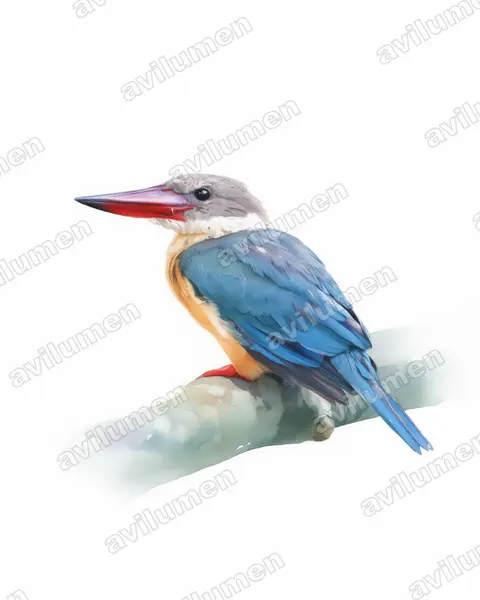
Watercolor 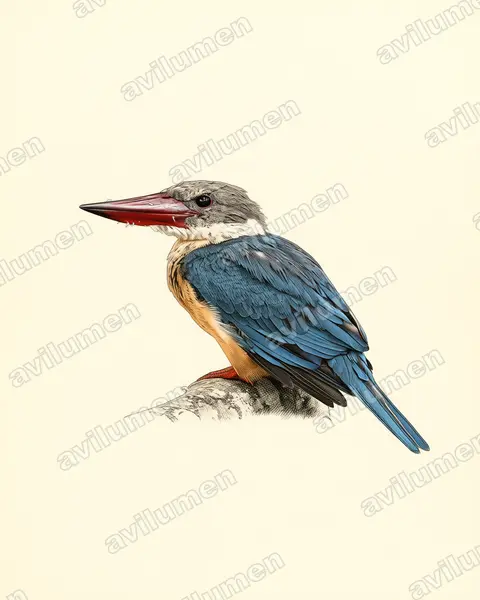
Vintage plate 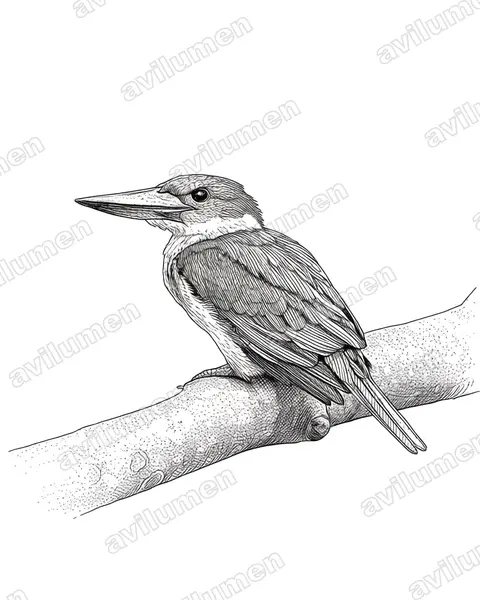
Ink 
Oil 
Realistic 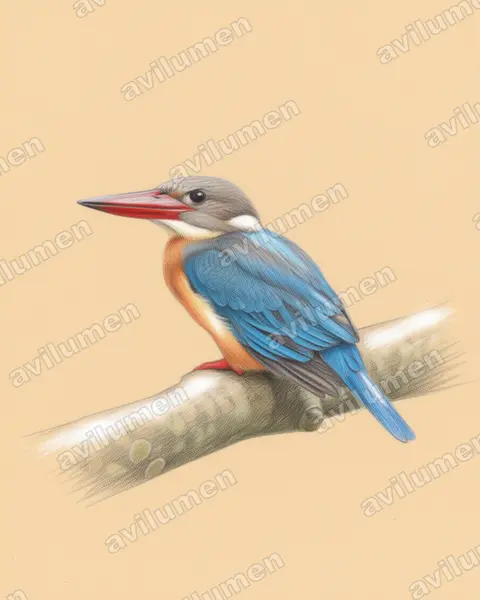
Colored pencil
Illustrations based on the photograph by Lip Kee from Singapore, Republic of Singapore (CC BY-SA 2.0), from Wikimedia Commons.
Digital editions
HD Digital Art Pack — Stork-billed Kingfisher
Digital download: 6 high-resolution illustrations of the Stork-billed Kingfisher (Pelargopsis capensis), print-ready. This is a digital file; no animal or physical item is included.
AI Avatar — Stork-billed Kingfisher
Generate an avatar fusing your face with the Stork-billed Kingfisher (Pelargopsis capensis). Delivered digitally in 8K, watermark-free. Digital product; no animals are sold or brokered.
Instant download. No live birds are sold.
Frequently asked questions
- Is Pelargopsis capensis (Stork-billed Kingfisher) endangered?
- The IUCN Red List places Pelargopsis capensis, commonly known as the Stork-billed Kingfisher, in the «Least concern» category. «Least concern» means it is not currently threatened.
- What family does Pelargopsis capensis (Stork-billed Kingfisher) belong to?
- Pelargopsis capensis (Stork-billed Kingfisher) belongs to the family Alcedinidae, in the order Coraciiformes.
- What colour is Pelargopsis capensis (Stork-billed Kingfisher)?
- The plumage of Pelargopsis capensis (Stork-billed Kingfisher) combines these colours: Brown and Blue.
More from the same family
 Least concern
Moustached Kingfisher
Actenoides bougainvillei
The moustached kingfisher, also called Bougainville moustached kingfisher, is a species of bird in the family Alcedinidae. It is endemic to Bougainville Island in Papua New Guinea. An estimated 1,300–7,000 mature individuals are left.
from $1.99
 Near threatened
Rufous-collared Kingfisher
Actenoides concretus
The rufous-collared kingfisher is a species of bird in the family Alcedinidae. It is found in Brunei, Indonesia, Malaysia, Myanmar, and Thailand. Its natural habitats are subtropical or tropical moist lowland forest and subtropical or tropical moist montane forest. It is threatened by habitat loss.
from $1.99
 Least concern
Hombron's Kingfisher
Actenoides hombroni
The blue-capped kingfisher, also known as Hombron's kingfisher, is a species of bird in the family Alcedinidae endemic to the Philippines and found only on Mindanao. It is one of the most colorful kingfishers in the country having a dark blue cap and wings with rufous spots, a striped rufous belly, white chin and red bill.
from $1.99
 Least concern
Spotted Wood Kingfisher
Actenoides lindsayi
The spotted wood kingfisher or spotted kingfisher is a species of bird in the family Alcedinidae. It is endemic to the Philippines found on the islands of Luzon, Catanduanes, Marinduque, Negros and Panay where its natural habitat is tropical moist lowland forests.
from $1.99