Green Hermit
Phaethornis guy
Avilumen editorial team ·

The green hermit is a large hummingbird that is a resident breeder from southern Central America south to northern South America
The green hermit (Phaethornis guy) is a large hummingbird that is a resident breeder from southern Central America (Costa Rica and Panama) south to northern South America (north-eastern Venezuela and Trinidad, and the northern Andes of eastern Peru)
Description
It is 13.5 cm (5.3 in) long and weighs 6.3 g (0.22 oz). The male is mainly dark green with a blue-green rump. It has a dark mask through the eye, with buff stripes above and below this, and down the centre of the throat. The central feathers of the tapered tail are—for large hermit—relatively short and white-tipped, and are wiggled in display at the communal leks. The reddish bill is long and decurved. The female is sooty gray (rather than green) below, with an even longer bill and a much longer tail. The call of this species is a loud zurk, and the males' lekking "song" is a repeated swark.
Distribution and habitat
The nominate subspecies Phaethornis guy guy is found in Venezuela and Trinidad. The western P. g. apicalis of the American Cordillera is slightly smaller and the sexes more similar.
This hermit inhabits forest undergrowth, usually near water, and prefers hilly areas. It seems to favor primary rainforest and wet premontane forest, and though it tolerates some amount of habitat destruction (e.g. subsistence farmland) it will try to avoid secondary forest as long as better habitat is available. In the Colombian Cordillera Oriental, it has been recorded at altitudes from 650–1,750 m (2,130–5,740 ft) ASL. Habitat there usually has a canopy height of around 25 m (82 ft) and is dominated by trees such as Elaeagia (Rubiaceae) or palms; there is usually plentiful undergrowth and/or epiphytes and hemiepiphytes (e.g. Clusiaceae).
Feeding
The food of this species is nectar, taken from a wide variety of flowers, and some small insects; it prefers flowers 30–50 mm long by 2–7 mm wide, though it will occasionally visit flowers up to 75 mm long and 20 mm wide or as short as 15 mm. At Monteverde (Costa Rica), preferred foodplants include yellow jacobinia (Justicia umbrosa) and Razisea spicata (Acanthaceae), Pitcairnia brittoniana (Bromeliaceae), spiral ginger (Costus barbatus, Costaceae), Drymonia conchocalyx and D. rubra (Gesneriaceae), Heliconia tortuosa (Heliconiaceae), and Malvaviscus palmanus (Malvaceae). Less commonly visited flowers were mostly Gesneriaceae, Heliconiaceae (such as Heliconia bihai), Acanthaceae (such as Pachystachys coccinea) and Zingiberales, but also certain Bromeliaceae (such as Tillandsia fasciculata) Campanulaceae (such as Centropogon surinamensis), Ericaceae and Rubiaceae.
Breeding
As noted above, males assemble at leks for courtship. In the Colombian Cordillera Oriental, active leks were observed between September and November, but neither in August nor in December, indicating a distinct breeding season. The green hermit lays one egg in a conical nest suspended under a large leaf, usually over water. Incubation is 17–18 days, and fledging another 21 to 23 days.
Text adapted from Wikipedia · CC BY-SA 4.0
Where it lives
Distribution

Taxonomy
- Order
- Apodiformes
- Family
- Trochilidae
- Genus
- Phaethornis
- Conservation status
- Least concern
Listen to its call
No recording yet
Illustration gallery
6 illustrations of Phaethornis guy (Green Hermit) in different styles, true to its real plumage. Shown watermarked; the art pack includes the high-resolution originals, ready to print.
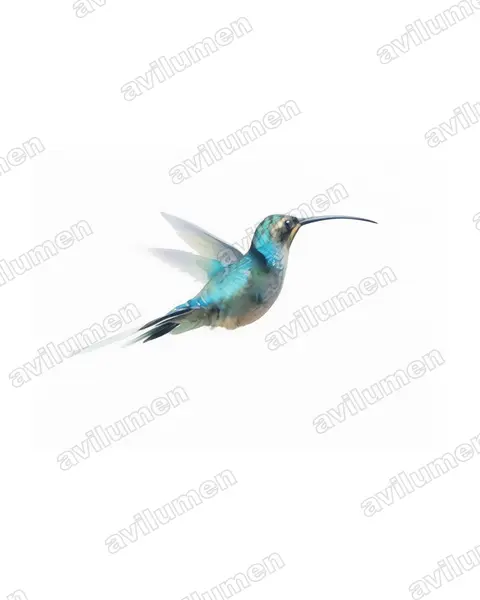
Watercolor 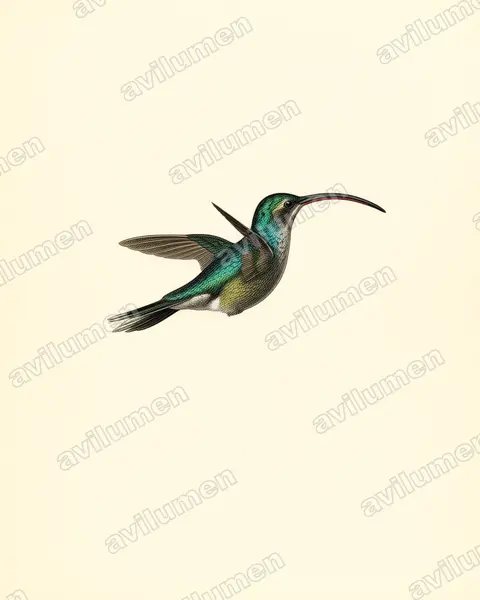
Vintage plate 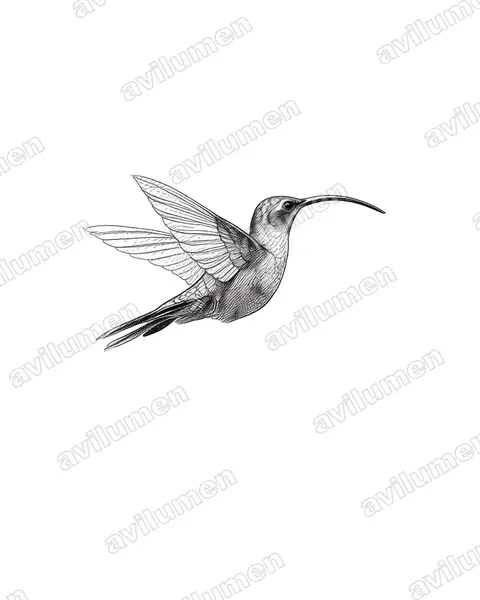
Ink 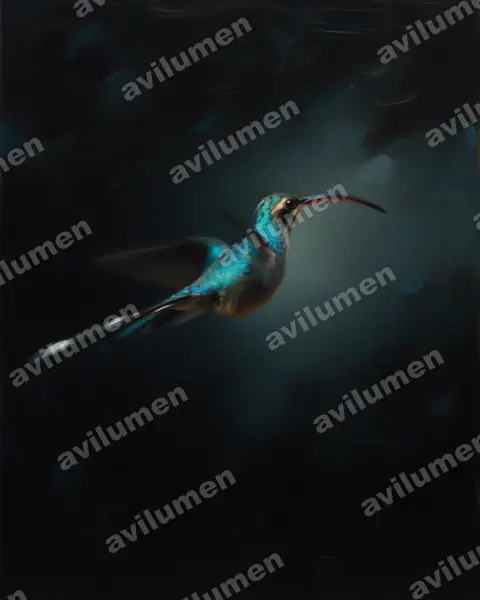
Oil 
Realistic 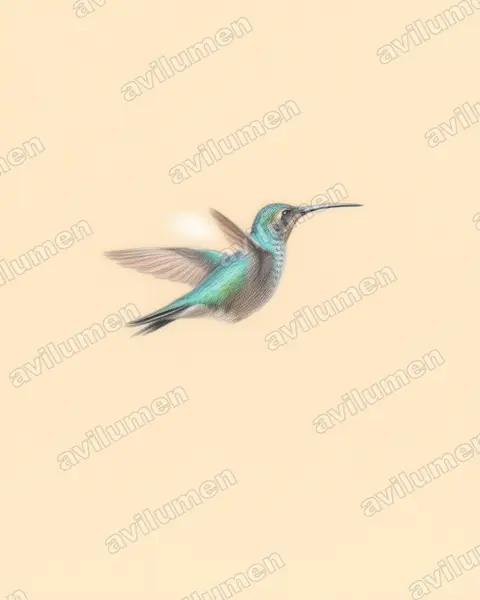
Colored pencil
Illustrations based on the photograph by Eric Chan from Hollywood, United States (CC BY 2.0), from Wikimedia Commons.
Digital editions
HD Digital Art Pack — Green Hermit
Digital download: 6 high-resolution illustrations of the Green Hermit (Phaethornis guy), print-ready. This is a digital file; no animal or physical item is included.
AI Avatar — Green Hermit
Generate an avatar fusing your face with the Green Hermit (Phaethornis guy). Delivered digitally in 8K, watermark-free. Digital product; no animals are sold or brokered.
Instant download. No live birds are sold.
Frequently asked questions
- Is Phaethornis guy (Green Hermit) endangered?
- The IUCN Red List places Phaethornis guy, commonly known as the Green Hermit, in the «Least concern» category. «Least concern» means it is not currently threatened.
- Where does Phaethornis guy (Green Hermit) live?
- Phaethornis guy (Green Hermit) is found in South America.
- What family does Phaethornis guy (Green Hermit) belong to?
- Phaethornis guy (Green Hermit) belongs to the family Trochilidae, in the order Apodiformes.
- What colour is Phaethornis guy (Green Hermit)?
- The plumage of Phaethornis guy (Green Hermit) combines these colours: Green and Blue.
More from the same family
 Least concern
Emerald-chinned Hummingbird
Abeillia abeillei
The emerald-chinned hummingbird is a species of hummingbird in the "emeralds", tribe Trochilini of subfamily Trochilinae.
from $1.99
 Least concern
Speckled hummingbird
Adelomyia melanogenys
The speckled hummingbird is a species of hummingbird. It is the only member of the genus Adelomyia. It inhabits Neotropical montane cloud forests at elevations of 1,000–2,500 meters and is confined to the Andes of Argentina, Bolivia, Peru, Ecuador, Colombia and Venezuela; as well as to some isolated montane forests in western Ecuador and Venezuela.
from $1.99
 Vulnerable
Purple-backed sunbeam
Aglaeactis aliciae
The purple-backed sunbeam is a bird species in the family Trochilidae. It is found only in Peru.
from $1.99
 Near threatened
White-tufted sunbeam
Aglaeactis castelnaudii
The white-tufted sunbeam is a species of hummingbird in the family Trochilidae. It is found only in Peru. Its natural habitats are subtropical or tropical moist montane forest and subtropical or tropical high-altitude shrubland.
from $1.99