Hooded Parrot
Psephotellus dissimilis
Avilumen editorial team ·

The hooded parrot is a species of parrot native to the Northern Territory in Australia. It is found in savannah and open woodland and is one of two extant species in its genus that breed in termite mounds. It has declined from much of its original range.
The hooded parrot (Psephotellus dissimilis) is a species of parrot native to the Northern Territory in Australia. It is found in savannah and open woodland and is one of two extant species in its genus that breed in termite mounds. It has declined from much of its original range.
Taxonomy
One of three species known as antbed parrots, the hooded parrot is closely related to (and sometimes considered a subspecies of) the golden-shouldered parrot (Psephotellus chrysopterygius). A genetic study revealed its ancestors most likely diverged from ancestors of the latter species in the late Miocene or early Pliocene at the conclusion of the 'Hill Gap'.
Norwegian naturalist Robert Collett described the hooded parrot in 1898. Its species name is the Latin word dissimilis "different" and either refers to its sexual dimorphism or its different appearance from its closest relative. Black-hooded parrot is an alternative name.
Description
The hooded parrot is a medium-sized parrot, up to 26 cm (10 in) long, weighing 50 to 60 g (1.8 to 2.1 oz). The male has a black head, bluish-grey beak, dark-brown irises, and its wings have a yellow patch. Its upper-parts are brown, its lower parts are turquoise blue, its back is brown, the tail is olive green tipped pale blue, and its legs are pink-grey. The female is a dull-green parrot with a grey-brown head and pink undertail coverts. Juveniles are similar to the female.
The male hooded parrot can be distinguished from the similar looking male golden-shouldered parrot mainly by the absence of a pale frontal band, a larger yellow patch on the wings, and absence of the red on the abdomen. The female is very similar to the female Yellow-shouldered parrot being identified by the absence of a pale frontal band and an absence of red on the abdomen.
Distribution and habitat
An Australian endemic, the hooded parrot inhabits to semi-arid areas of northeast Northern Territory, and is separated from the golden-shouldered parrot by the Carpentarian faunal barrier.
Though this species has disappeared from most of its original range, it remains common in protected areas. The hooded parrot is evaluated as Least Concern on IUCN Red List of Threatened Species.
Behaviour
The diet consists mainly of seeds, berries and vegetables.
The hooded parrot digs cavities in termite mounds. It generally chooses conical termite mounds, only successful in flat two dimensional mounds if it digs at the edge rather than on the face of the mound. Excavation takes around three weeks. The tunnel is roughly horizontal and around 50 to 80 cm (20 to 31 in) long.
Breeding takes place once or twice a year between April and August. The female lays four or five white, slightly shiny eggs that are 21 mm (0.83 in) long by 19 mm (0.75 in) wide.
The hooded parrot has a close ecological relationship with the moth species Trisyntopa neossophila. The female moth lays eggs in the parrot nesting cavity, so that the eggs hatch at the same time as the baby hooded parrots. The moth larvae live in small tunnels at the base of the cavity and emerge to eat the dark material of parrot feces, leaving the white uric acid deposits. They build a silk layer across the base of the cavity to protect themselves from chicks. They pupate in the cavity walls once the juvenile parrots leave the nest.
The goanna species Varanus tristis has been recorded raiding nests for eggs.
The termite mounds are vulnerable to damage by cattle in cattle-breeding areas, which threatens nesting sites. A flock of 28 immature birds perished after drinking water contaminated with tar at a tar spill by the side of the road.
Aviculture
The hooded parrot breeds readily in captivity but it can be aggressive, which precludes keeping it in a mixed aviary with other parrot species. It became much more popular in captivity in Australia in the 1980s. A yellow mutation has been bred.
Cited text
Lendon, Alan H. (1973). Australian Parrots in Field and Aviary. Angus & Robertson. ISBN 978-0-207-12424-2.
Text adapted from Wikipedia · CC BY-SA 4.0
Taxonomy
- Order
- Psittaciformes
- Family
- Psittaculidae
- Genus
- Psephotellus
- Conservation status
- Least concern
Listen to its call
No recording yet
Care guide
Budgie, Conure and Parakeet Care Guide
How to care for budgies, conures, parrotlets, ringnecks and other parakeets: diet, cage setup, health, behavior, breeding and legal status for owners.
Read the guide →Illustration gallery
6 illustrations of Psephotellus dissimilis (Hooded Parrot) in different styles, true to its real plumage. Shown watermarked; the art pack includes the high-resolution originals, ready to print.
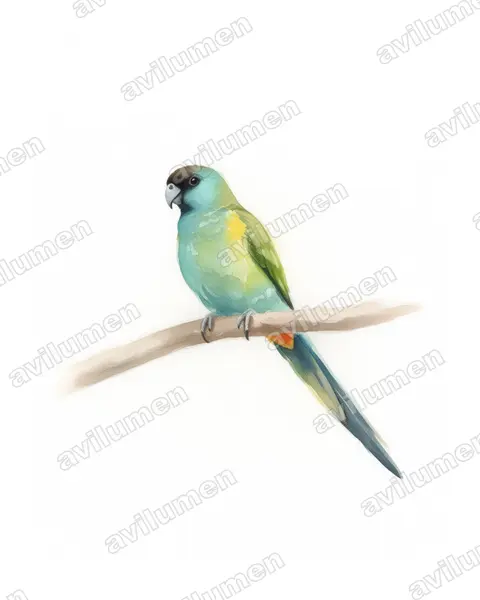
Watercolor 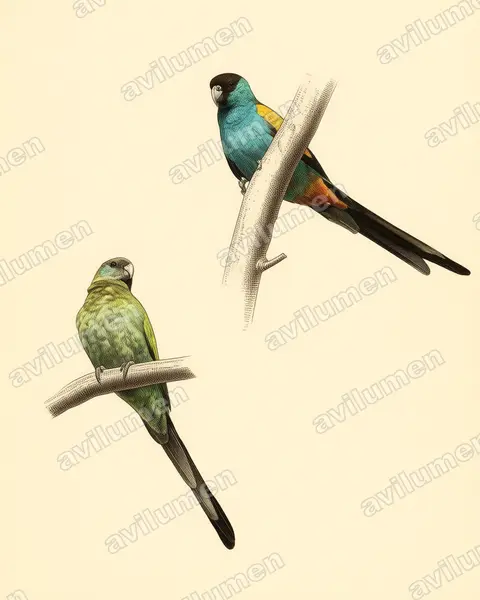
Vintage plate 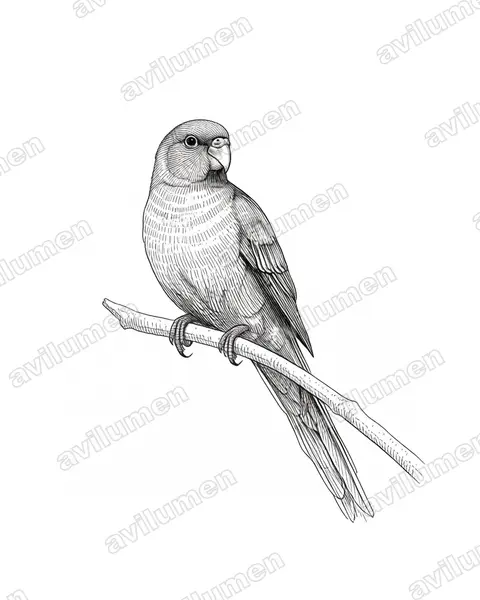
Ink 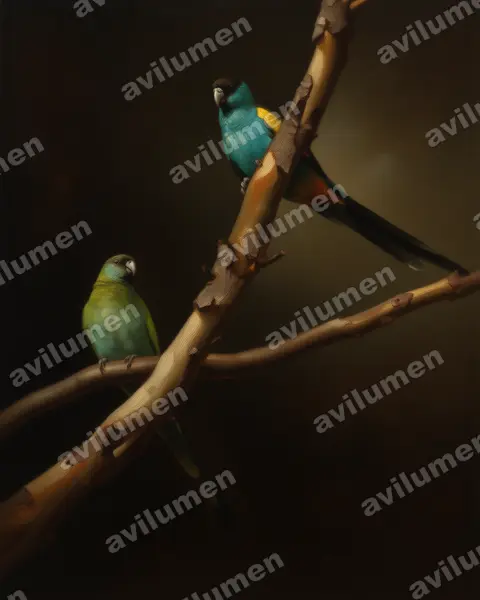
Oil 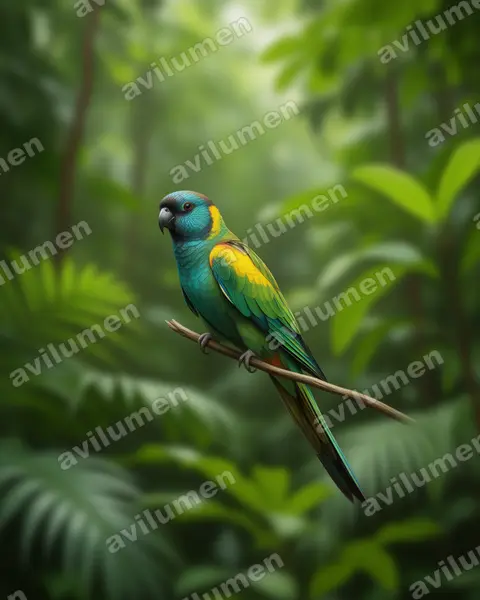
Realistic 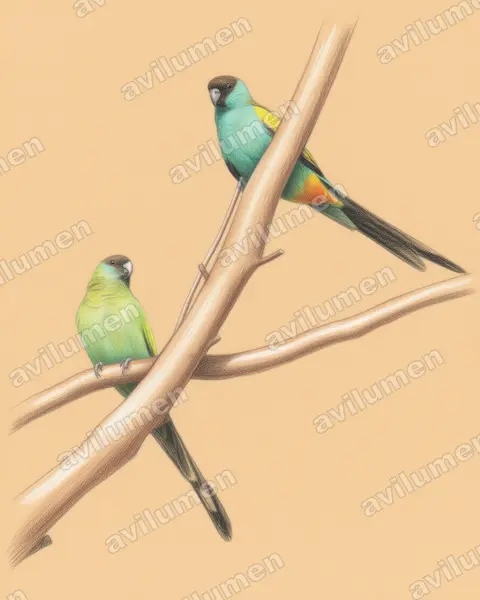
Colored pencil
Illustrations based on the photograph by birdphotosneill (CC BY 2.0), from Wikimedia Commons.
Digital editions
HD Digital Art Pack — Hooded Parrot
Digital download: 6 high-resolution illustrations of the Hooded Parrot (Psephotellus dissimilis), print-ready. This is a digital file; no animal or physical item is included.
AI Avatar — Hooded Parrot
Generate an avatar fusing your face with the Hooded Parrot (Psephotellus dissimilis). Delivered digitally in 8K, watermark-free. Digital product; no animals are sold or brokered.
Instant download. No live birds are sold.
Frequently asked questions
- Is Psephotellus dissimilis (Hooded Parrot) endangered?
- The IUCN Red List places Psephotellus dissimilis, commonly known as the Hooded Parrot, in the «Least concern» category. «Least concern» means it is not currently threatened.
- Where does Psephotellus dissimilis (Hooded Parrot) live?
- Psephotellus dissimilis (Hooded Parrot) is found in Australia.
- What family does Psephotellus dissimilis (Hooded Parrot) belong to?
- Psephotellus dissimilis (Hooded Parrot) belongs to the family Psittaculidae, in the order Psittaciformes.
- What colour is Psephotellus dissimilis (Hooded Parrot)?
- The plumage of Psephotellus dissimilis (Hooded Parrot) combines these colours: Green and Yellow.
More from the same family
 Least concern
Grey-headed Lovebird
Agapornis canus
The gray-headed lovebird or Madagascar lovebird is a small species of parrot of the lovebird genus. It is a mainly green parrot. The species is sexually dimorphic and only the adult male has grey on its upper body. They are native on the island of Madagascar and are the only lovebird species which are not native on the African continent. They are the smallest of the lovebird species.
from $1.99
 Near threatened
Fischer's Lovebird
Agapornis fischeri
Fischer's lovebird is a small parrot species of the genus Agapornis. They were originally discovered in the late 19th century. They are named after the 19th century German explorer of East Africa Gustav Fischer.
from $1.99
 Near threatened
Lilian's Lovebird
Agapornis lilianae
Lilian's lovebird, also known as the Nyasa lovebird, is a small African parrot species of the lovebird genus. It is mainly green and has orange on its upper chest and head. It is 13 cm (5 inches) long and is the smallest parrot on mainland Africa. In captivity, it is uncommon and difficult to breed.
from $1.99
 Extinct
Agapornis longipes
Agapornis longipes
Agapornis longipes is an extinct species of lovebird that lived in what is now Gauteng, South Africa during the Early Pleistocene epoch, about 2.5–1.38 million years ago. The fossilized remains of this bird were first discovered in the Kromdraai fossil site and reported in 1969 by T.N. Pocock, though the species would not be named until decades later in 2024.
from $4.99