Magnificent riflebird
Ptiloris magnificus
Avilumen editorial team ·

The magnificent riflebird is a species of passerine bird in the birds-of-paradise family Paradisaeidae.
The magnificent riflebird (Ptiloris magnificus) is a species of passerine bird in the birds-of-paradise family Paradisaeidae.
Magnificent riflebirds are widely distributed throughout lowland rainforests of western New Guinea and the northern Cape York Peninsula of Australia. A relatively common species throughout its range, it is evaluated as a species of Least Concern on the IUCN Red List of Threatened Species. It is listed on Appendix II of CITES.
Taxonomy
The magnificent riflebird was formally described in 1819 by the French ornithologist Louis Vieillot under the binomial name Falcinellus magnificus. It is now placed in the genus Ptiloris that was introduced in 1825 by the English naturalist William Swainson. The common name "riflebird" comes from the likeness of their black velvety plumage to the uniform of the British Army Rifle Brigade.
Two subspecies are recognised:
P. m. alberti Elliot, DG, 1871 – north Cape York Peninsula, Australia
P. m. magnificus (Vieillot, 1819) – west and central New Guinea
Description
This riflebird is a medium-sized bird, being up to 34 cm (13 in) long. The male is velvet-black bird-of-paradise with elongated black filamental flank plumes, an iridescent blue-green crown, a wide, triangle-shaped breast shield, and on central tail feathers. It has a black curved bill, yellow mouth, blackish feet and a dark brown iris. The female is brownish with dark spots and buff bars below with a white brow. The immature male resembles the male but with less tail plumes.
Behaviour
The diet of the magnificent riflebird consists mainly of fruits and a variety of invertebrates such as spiders, millipedes, etc. Males are polygamous and perform solitary courtship displays on a 'dancing perch'. During these displays, the male fully extends his wings and raises his tail; he jerks upward while swinging his head from side to side, showing off his metallic blue-green breast shield, and producing a distinctive "woosh" sound as he flaps his wings. Multiple females will observe these displays, and, if satisfied with the performance, reward the male with mating rights. Females subsequently build nests, incubate, brood, and feed young without male assistance.
Text adapted from Wikipedia · CC BY-SA 4.0
Taxonomy
- Order
- Passeriformes
- Family
- Paradisaeidae
- Genus
- Ptiloris
- Conservation status
- Least concern
Listen to its call
No recording yet
Illustration gallery
6 illustrations of Ptiloris magnificus (Magnificent riflebird) in different styles, true to its real plumage. Shown watermarked; the art pack includes the high-resolution originals, ready to print.
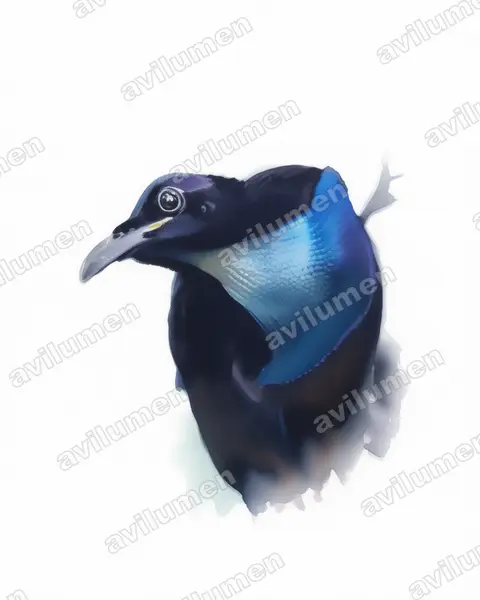
Watercolor 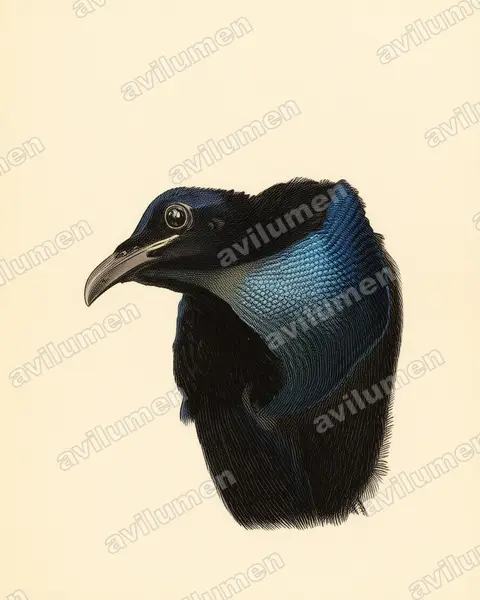
Vintage plate 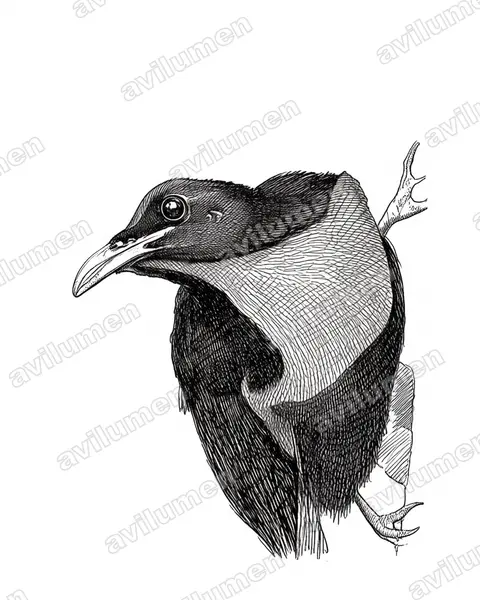
Ink 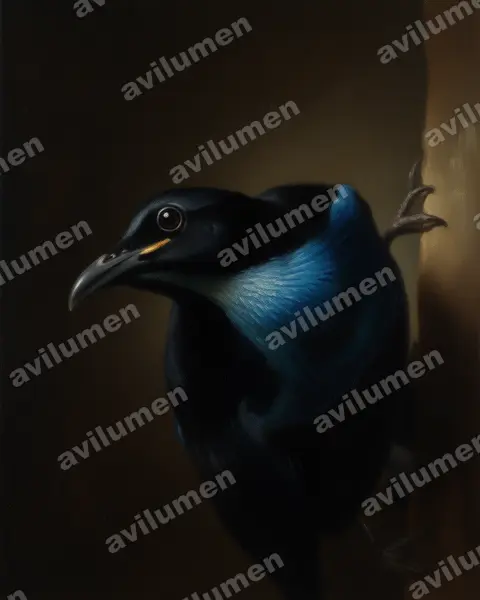
Oil 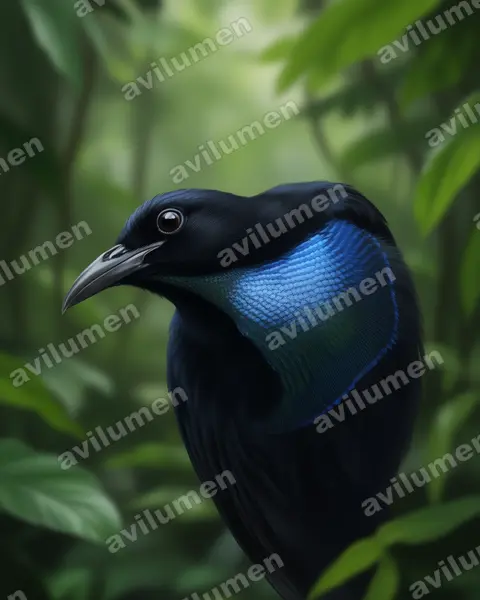
Realistic 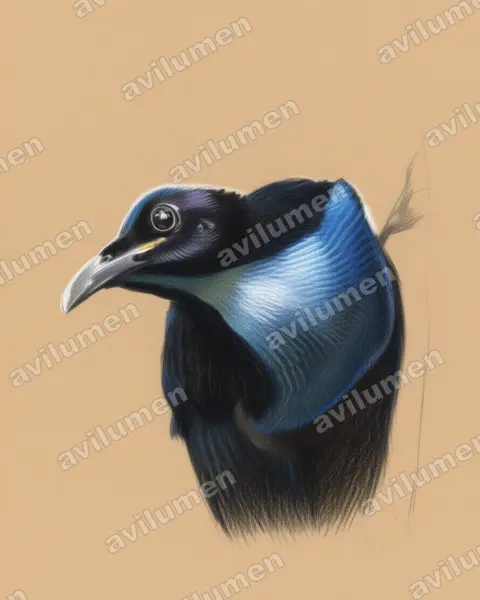
Colored pencil
Illustrations based on the photograph by osaingre (CC BY-SA 4.0), from Wikimedia Commons.
Digital editions
HD Digital Art Pack — Magnificent riflebird
Digital download: 6 high-resolution illustrations of the Magnificent riflebird (Ptiloris magnificus), print-ready. This is a digital file; no animal or physical item is included.
AI Avatar — Magnificent riflebird
Generate an avatar fusing your face with the Magnificent riflebird (Ptiloris magnificus). Delivered digitally in 8K, watermark-free. Digital product; no animals are sold or brokered.
Instant download. No live birds are sold.
Frequently asked questions
- Is Ptiloris magnificus (Magnificent riflebird) endangered?
- The IUCN Red List places Ptiloris magnificus, commonly known as the Magnificent riflebird, in the «Least concern» category. «Least concern» means it is not currently threatened.
- What family does Ptiloris magnificus (Magnificent riflebird) belong to?
- Ptiloris magnificus (Magnificent riflebird) belongs to the family Paradisaeidae, in the order Passeriformes.
- What colour is Ptiloris magnificus (Magnificent riflebird)?
- The plumage of Ptiloris magnificus (Magnificent riflebird) combines these colours: Black and Green.
More from the same family
 Least concern
Ribbon-tailed Astrapia
Astrapia mayeri
The ribbon-tailed astrapia, also known as Shaw Mayer's astrapia, is a species of bird-of-paradise.
from $1.99
 Least concern
Arfak astrapia
Astrapia nigra
The Arfak astrapia is a species of astrapia, a group of birds found in the birds-of-paradise family Paradiseidae.
from $1.99
 Least concern
Huon Astrapia
Astrapia rothschildi
The Huon astrapia, also known as Rothschild's astrapia, Huon bird-of-paradise, or Lord Rothschild's bird-of-paradise, is a species of bird-of-paradise belonging to the genus Astrapia. Like most of its congeners, A. rothschildi is a rather elusive member of its genus and family.
from $1.99
 Least concern
Splendid Astrapia
Astrapia splendidissima
The splendid astrapia is a species of bird in the family Paradisaeidae, native to the montane forests of New Guinea. Males are known for their iridescent plumage and elaborate courtship displays, including branch-hopping, tail-flicking, and frog-like calls; they may also display in leks.
from $1.99