Choco Toucan
Ramphastos brevis
Avilumen editorial team ·

The Choco toucan is a near-passerine bird in the family Ramphastidae, the toucans, toucanets, and aracaris. It is found in Colombia and Ecuador.
The Choco toucan (Ramphastos brevis) is a near-passerine bird in the family Ramphastidae, the toucans, toucanets, and aracaris. It is found in Colombia and Ecuador.
Taxonomy and systematics
The Choco toucan was long treated as a subspecies of the yellow-throated toucan (R. ambiguus) but vocal differences and other characteristics led to their being split. It and the channel-billed toucan (R. vitellinus) are sister species. The Choco toucan is monotypic.
Description
The Choco toucan is 46 to 48.5 cm (18 to 19 in) long and weighs 365 to 482 g (13 to 17 oz). The sexes are alike though the female's bill is shorter than the male's. Their bill's maxilla is mostly yellow with some green on the culmen and a black triangle at its base. Their mandible is black, sometimes with a yellow tip. Their crown and nape are black with a maroon tinge; their upperparts and tail are black except for white uppertail coverts. Bare yellow-green to olive green skin surrounds their eye. Their throat and breast are yellow with a narrow red band below the breast. Their belly is black and their undertail coverts red. The plumage is almost identical to that of the "chestnut-mandibled" subspecies of yellow-throated toucan (R. a. swainsonii), with which there is a range overlap, but their voices separate them.
Distribution and habitat
As suggested by its common name, the Choco toucan is restricted to the humid Chocó region from northwestern Colombia to southwestern Ecuador. It mostly inhabits lowland and foothill forest but also occurs in pastures and plantations with fruiting trees that adjoin forest. In elevation it is found up to about 1,550 m (5,100 ft).
Movement
The Choco toucan does not have a migratory pattern, but pairs and groups move up- and downslope while foraging.
Feeding
The Choco toucan forages mostly in the forest canopy. Its diet is not known in detail but is mainly fruits and probably includes insects and small vertebrates. It has been noted following army ant swarms, probably to feed on prey disturbed by them.
Breeding
The Choco toucan's breeding season appears to be mostly between June and August though it might begin much earlier in Colombia. Pairs display to each other by swinging their heads back and forth while vocalizing. Nothing else is known about their breeding biology.
Vocal and non-vocal sounds
The Choco toucan is one of the "croaker" group of toucans. Its call is "a steadily repeated series of croaking 'kreeork' notes, sometimes speeded up into a 'kriik'." It also clacks its bill and makes grating sounds with a closed bill.
Status
The IUCN has assessed the Choco toucan as being of Least Concern. It has a large range, but its population size is not known and is believed to be decreasing. No immediate threats have been identified. It is considered uncommon to locally common in Ecuador, and occurs in at least one protected area in each of that country and Colombia. It is hunted for food and traditional medicine practices. It "[r]equires study in order to determine its requirements, and to ascertain whether its present conservation status needs to be reassessed."
Text adapted from Wikipedia · CC BY-SA 4.0
Where it lives
Distribution

Taxonomy
- Order
- Piciformes
- Family
- Ramphastidae
- Genus
- Ramphastos
- Conservation status
- Least concern
Listen to its call
No recording yet
Care guide
Toucan and Aracari Care Guide: Diet and Housing
How to care for toucans and aracaris: low-iron diet, iron storage disease (hemochromatosis), aviary setup, health, behavior and CITES legal status.
Read the guide →Illustration gallery
6 illustrations of Ramphastos brevis (Choco Toucan) in different styles, true to its real plumage. Shown watermarked; the art pack includes the high-resolution originals, ready to print.
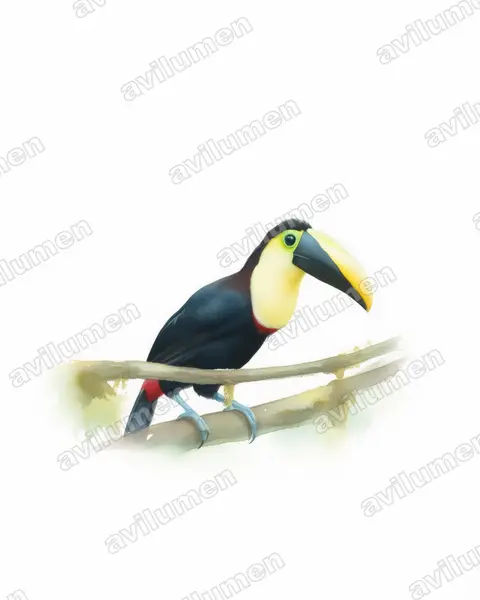
Watercolor 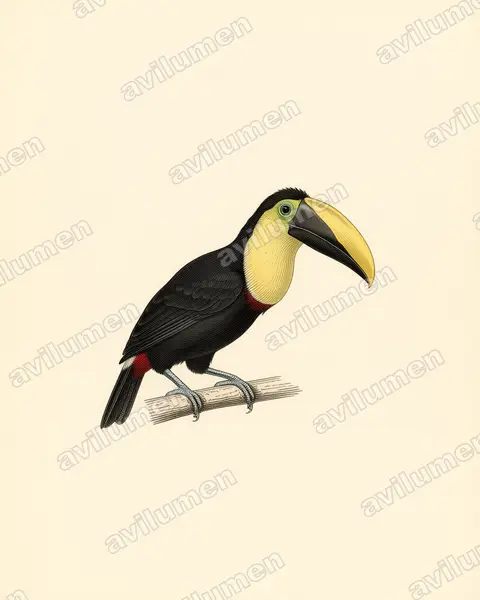
Vintage plate 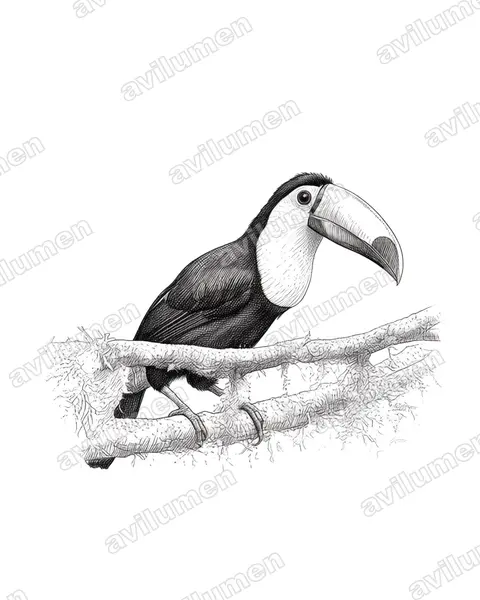
Ink 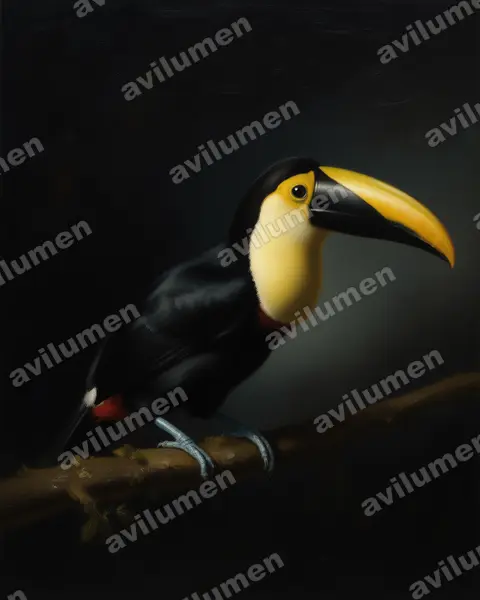
Oil 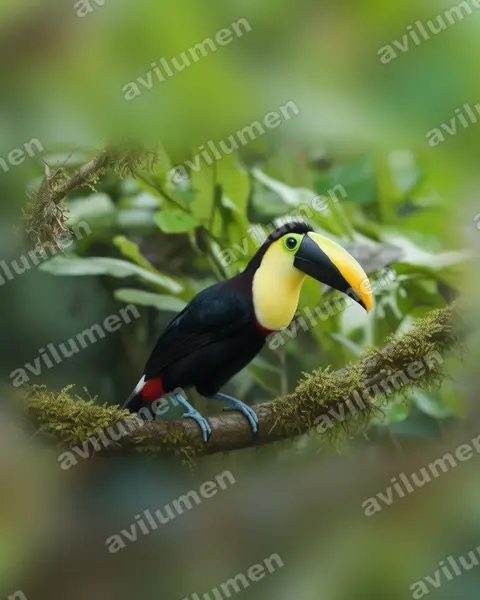
Realistic 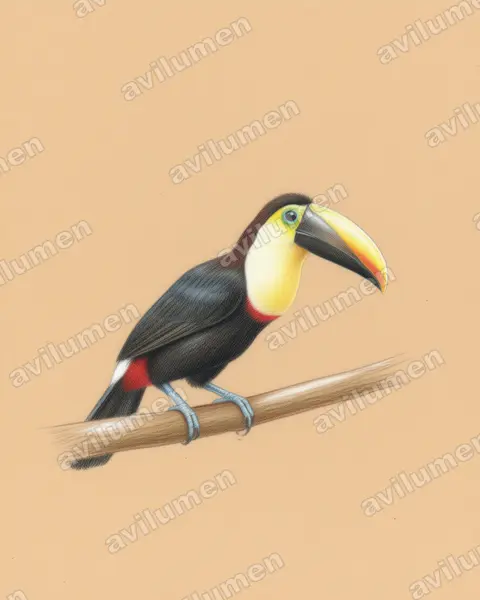
Colored pencil
Illustrations based on the photograph by Patty McGann (CC BY 2.0), from Wikimedia Commons.
Digital editions
HD Digital Art Pack — Choco Toucan
Digital download: 6 high-resolution illustrations of the Choco Toucan (Ramphastos brevis), print-ready. This is a digital file; no animal or physical item is included.
AI Avatar — Choco Toucan
Generate an avatar fusing your face with the Choco Toucan (Ramphastos brevis). Delivered digitally in 8K, watermark-free. Digital product; no animals are sold or brokered.
Instant download. No live birds are sold.
Frequently asked questions
- Is Ramphastos brevis (Choco Toucan) endangered?
- The IUCN Red List places Ramphastos brevis, commonly known as the Choco Toucan, in the «Least concern» category. «Least concern» means it is not currently threatened.
- Where does Ramphastos brevis (Choco Toucan) live?
- Ramphastos brevis (Choco Toucan) is found in South America.
- What family does Ramphastos brevis (Choco Toucan) belong to?
- Ramphastos brevis (Choco Toucan) belongs to the family Ramphastidae, in the order Piciformes.
- What colour is Ramphastos brevis (Choco Toucan)?
- The plumage of Ramphastos brevis (Choco Toucan) combines these colours: Black and Yellow.
More from the same family
 Least concern
Hooded Mountain Toucan
Andigena cucullata
The hooded mountain toucan is a species of bird in the toucan family Ramphastidae. It is found in Bolivia and Peru.
from $1.99
 Near threatened
Grey-breasted Mountain Toucan
Andigena hypoglauca
The grey-breasted mountain toucan is a least-concern species of bird in the toucan family, Ramphastidae. It is found in South American countries such as Colombia, Ecuador and Peru.
from $1.99
 Near threatened
Plate-billed Mountain Toucan
Andigena laminirostris
The plate-billed mountain toucan is a species of bird in the family Ramphastidae. It is native to the west slope of Ecuador and extreme southern Colombia, where it lives in the high-altitude humid mountain forests of the Andes.
from $1.99
 Least concern
Black-billed Mountain Toucan
Andigena nigrirostris
The black-billed mountain toucan is a species of bird in the toucan family Ramphastidae. It is found in Colombia, Ecuador, Peru, and Venezuela.
from $1.99