Purple-backed thornbill
Ramphomicron microrhynchum
Avilumen editorial team ·

The purple-backed thornbill is a species of hummingbird in the "coquettes", tribe Lesbiini of subfamily Lesbiinae. It is found in Bolivia, Colombia, Ecuador, Peru, and Venezuela.
The purple-backed thornbill (Ramphomicron microrhynchum) is a species of hummingbird in the "coquettes", tribe Lesbiini of subfamily Lesbiinae. It is found in Bolivia, Colombia, Ecuador, Peru, and Venezuela.
Taxonomy and systematics
The purple-backed thornbill shares its genus with the black-backed thornbill (R. dorsale). It has these four subspecies:
R. m. andicola Simon (1921)
R. m. microrhynchum Boissonneau (1840)
R. m. albiventre Carriker (1935)
R. m. bolivianum Schuchmann (1984)
Subspecies R. m. andicola and R. m. albiventre "are doubtfully distinct from [the] nominate."
Description
The purple-backed thornbill is 8 to 9 cm (3.1 to 3.5 in) long and weighs about 3.5 g (0.12 oz). Both sexes have a black bill, the shortest of any hummingbird. Males of the nominate subspecies have metallic violet-purple upperparts with a white spot behind the eye. Their gorget is iridescent golden green, the underparts bronzy green, and the undertail coverts coppery with tawny fringes. The tail is moderately long, forked, and dark purple. Nominate females have shining green upperparts, and like the male, a white spot behind the eye. Their underparts are white with green dots except on the belly. The tail is shorter than the male's and less forked, bronzy purple, and the outer pair of feathers have white tips.
Males of subspecies R. m. andicola have a green-bordered golden gorget and more rufous undertail coverts. R. m. albiventre is very similar to the nominate, but with lighter margins on the male's undertail coverts and smaller spots on the female's underparts. Males of R. m. bolivianum have metallic violet upperparts, dark green underparts, and grayish white undertail coverts.
Distribution and habitat
The subspecies of purple-backed thornbill are found thus:
R. m. andicola, Andes of western Venezuela, especially Mérida state
R. m. microrhynchum, Andes of Colombia, Ecuador, and Cajamarca in northwestern Peru
R. m. albiventre, Andes' eastern slope in Peru from Huánuco south to Apurímac and Cuzco
R. m. bolivianum, Andes of Cochabamba Department in central Bolivia
The purple-backed thornbill inhabits the edges of humid montane forest, Polylepis forest, páramo, and the transitions between them. R. m. bolivianum also occurs well below the treeline in shrubby areas. In elevation the species ranges from 1,700 to 3,600 m (5,600 to 11,800 ft).
Movement
The purple-backed thornbill moves from lower to higher elevations in the wet season.
Feeding
The purple-backed thornbill forages for nectar from mid-level to the canopy, primarily by trap-lining. It has often been observed "robbing" nectar from holes in flowers made by Diglossa flowerpiercers. It has been recorded taking nectar from a wide variety of flowering plants, shrubs, and trees. In addition it feeds on insects caught on the wing and gleaned from flowers.
Breeding
The purple-backed thornbill's breeding season has not been fully defined but appears to span from May possibly to December. It builds a cup nest of fine plant fiber with moss and lichens on the outside on a horizontal branch. The clutch size is two eggs and the incubation period 16 days.
Vocalization
The purple-backed thornbill's song is "a continuous series of quiet scratchy notes interspersed by short buzzes or dry trills." Its calls include "a short dry rattle 'trrr'..., a scratchy 'krr-kit', and a long twittering rattle."
Status
The IUCN has assessed the purple-backed thornbill as being of Least Concern. It has a large range but its population size is unknown and believed to be decreasing. It is generally uncommon throughout its range. It occurs in several protected areas but outside of them its habitat is under severe threat of deforestation.
Text adapted from Wikipedia · CC BY-SA 4.0
Where it lives
Plumage colours
Distribution

Taxonomy
- Order
- Apodiformes
- Family
- Trochilidae
- Genus
- Ramphomicron
- Conservation status
- Least concern
Listen to its call
No recording yet
Illustration gallery
6 illustrations of Ramphomicron microrhynchum (Purple-backed thornbill) in different styles, true to its real plumage. Shown watermarked; the art pack includes the high-resolution originals, ready to print.
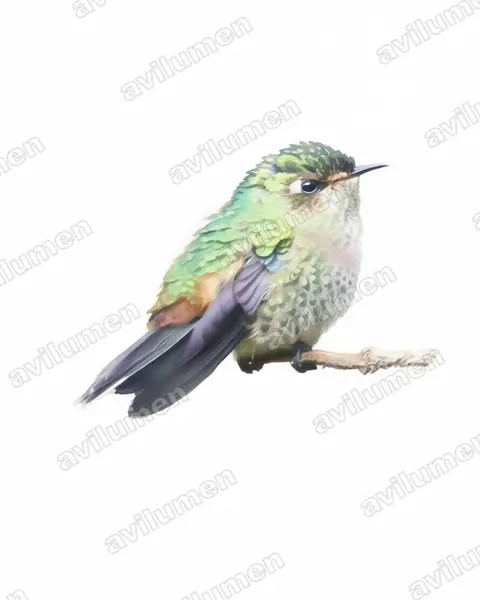
Watercolor 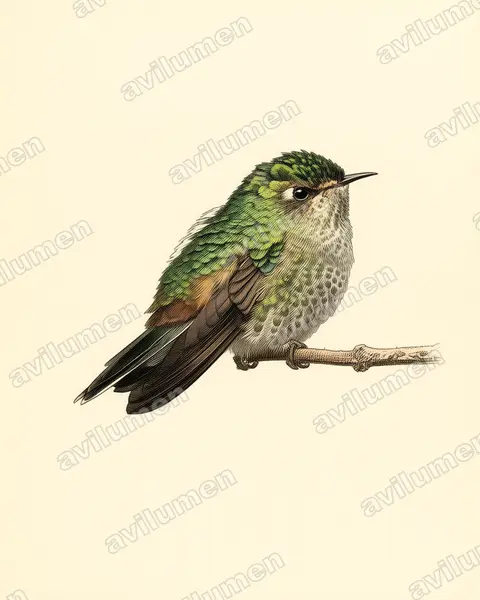
Vintage plate 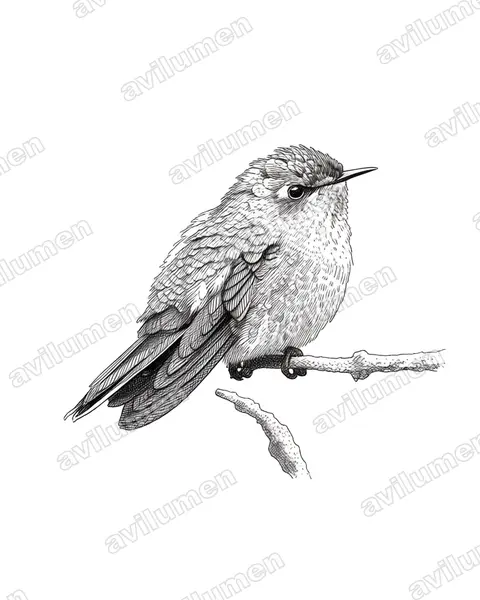
Ink 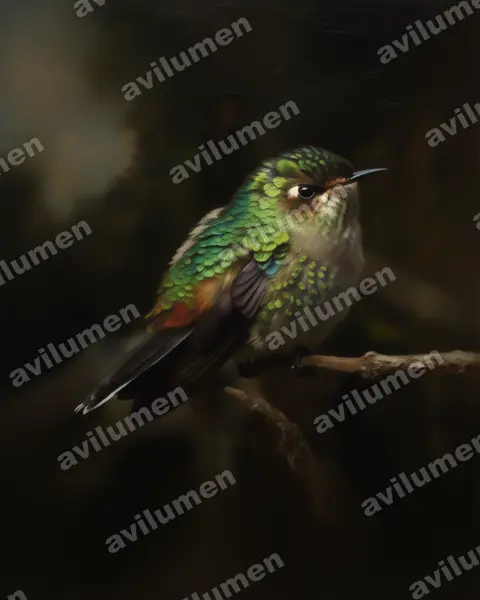
Oil 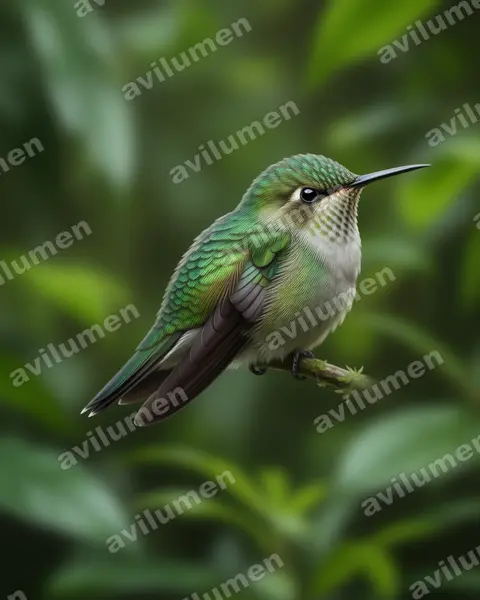
Realistic 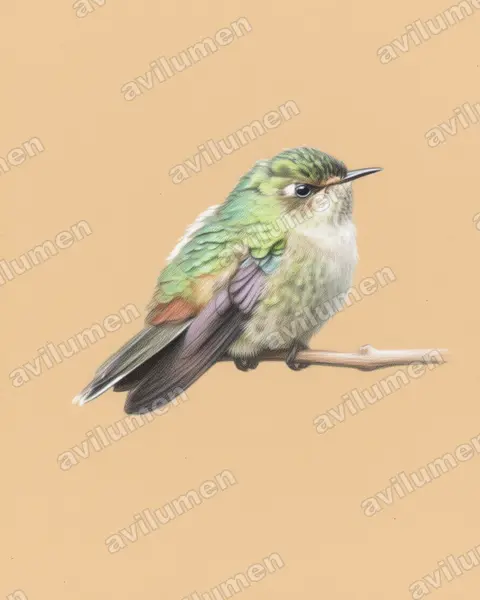
Colored pencil
Illustrations based on the photograph by Ron Knight from Seaford, East Sussex, United Kingdom (CC BY 2.0), from Wikimedia Commons.
Digital editions
HD Digital Art Pack — Purple-backed thornbill
Digital download: 6 high-resolution illustrations of the Purple-backed thornbill (Ramphomicron microrhynchum), print-ready. This is a digital file; no animal or physical item is included.
AI Avatar — Purple-backed thornbill
Generate an avatar fusing your face with the Purple-backed thornbill (Ramphomicron microrhynchum). Delivered digitally in 8K, watermark-free. Digital product; no animals are sold or brokered.
Instant download. No live birds are sold.
Frequently asked questions
- Is Ramphomicron microrhynchum (Purple-backed thornbill) endangered?
- The IUCN Red List places Ramphomicron microrhynchum, commonly known as the Purple-backed thornbill, in the «Least concern» category. «Least concern» means it is not currently threatened.
- Where does Ramphomicron microrhynchum (Purple-backed thornbill) live?
- Ramphomicron microrhynchum (Purple-backed thornbill) is found in South America.
- What family does Ramphomicron microrhynchum (Purple-backed thornbill) belong to?
- Ramphomicron microrhynchum (Purple-backed thornbill) belongs to the family Trochilidae, in the order Apodiformes.
- What colour is Ramphomicron microrhynchum (Purple-backed thornbill)?
- The plumage of Ramphomicron microrhynchum (Purple-backed thornbill) combines these colours: Green.
More from the same family
 Least concern
Emerald-chinned Hummingbird
Abeillia abeillei
The emerald-chinned hummingbird is a species of hummingbird in the "emeralds", tribe Trochilini of subfamily Trochilinae.
from $1.99
 Least concern
Speckled hummingbird
Adelomyia melanogenys
The speckled hummingbird is a species of hummingbird. It is the only member of the genus Adelomyia. It inhabits Neotropical montane cloud forests at elevations of 1,000–2,500 meters and is confined to the Andes of Argentina, Bolivia, Peru, Ecuador, Colombia and Venezuela; as well as to some isolated montane forests in western Ecuador and Venezuela.
from $1.99
 Vulnerable
Purple-backed sunbeam
Aglaeactis aliciae
The purple-backed sunbeam is a bird species in the family Trochilidae. It is found only in Peru.
from $1.99
 Near threatened
White-tufted sunbeam
Aglaeactis castelnaudii
The white-tufted sunbeam is a species of hummingbird in the family Trochilidae. It is found only in Peru. Its natural habitats are subtropical or tropical moist montane forest and subtropical or tropical high-altitude shrubland.
from $1.99