Blyth's Hornbill
Rhyticeros plicatus
Avilumen editorial team ·

Blyth's hornbill, also known as the Papuan hornbill, is a large hornbill inhabiting the forest canopy in Wallacea and Melanesia. Its local name in Tok Pisin is kokomo.
Blyth's hornbill (Rhyticeros plicatus), also known as the Papuan hornbill, is a large hornbill inhabiting the forest canopy in Wallacea and Melanesia. Its local name in Tok Pisin is kokomo.
Previously, this hornbill was placed in the genus Aceros. It has often been lumped with the plain-pouched hornbill (R. subruficollis), and sometimes considered to include the Narcondam hornbill (R. narcondami) and the wreathed hornbill (R. undulatus) as subspecies.
The common name commemorates Edward Blyth (1810–1873), English zoologist and curator of the museum of the Asiatic Society of Bengal.
Description
Up to 91 cm (36 in) in length, the adult male has mainly black plumage with a golden or orange-buff head, white throat and a white tail. Its irises are reddish brown, and the eye is surrounded by naked pale blue skin. The female is a smaller, mainly black bird with a white throat and tail. Both sexes have a very large horn-coloured bill and casque. Young birds of both sexes resemble the male. Adults have up to eight folds on the pale casque, depending on age, while young birds have none.
In flight, the sound of its wings is loud and distinctive, a rushing noise that has been compared to the sound of steam escaping from a steam locomotive. It has a range of far-reaching, guttural grunting and laughing calls.
Subspecies
Various subspecies have been described across its range:
R. p. plicatus (Forster, 1781) – South Moluccas
R. p. ruficollis (Vieillot, 1816) – North Moluccas and West Papua, eastwards to the Southern Highlands and Simbu Province, Papua New Guinea
R. p. jungei Mayr, 1937 – Eastern New Guinea, west as far as the Fly River region
R. p. dampieri Mayr, 1934 – Bismarck Archipelago
R. p. harterti Mayr, 1934 – Bougainville and Buka Islands
R. p. mendanae Hartert, 1924 – Solomon Islands from Choiseul to Guadalcanal and Malaita
Distribution and ecology
The Papuan hornbill occurs throughout lowland forests, from sea level up to 1,200–1,500 m ASL, in the Moluccas, New Guinea, the Bismarck Archipelago, and as far east as the Solomon Islands. It is the only hornbill species native to New Guinea, and one of the largest flying birds of the region. There have also been rare reported sightings on the Saibai and Boigu Islands in the Torres Strait, Queensland, Australia.
Its diet consists mainly of fruits, especially figs, occasionally supplemented with insects and other small animals.
The Papuan hornbill nests in a large tree hollow in the rainforest, from at least 18 m (59 ft) up to 30 m (98 ft) above the ground. The female is restricted to the nest cavity throughout the incubation and nestling period, being largely sealed inside by plastering up the entrance with a mixture of fruit pulp and rotten wood, leaving only a narrow aperture through which the male feeds her. The clutch size is about two eggs.
Status and relationship with humans
Still widespread throughout its large range, the Papuan hornbill is assessed as least concern on the IUCN Red List of Threatened Species. However, it is subject to hunting pressure by some tribal groups, who use its feathers in headdresses, its bill as a personal adornment, and the lower mandible as a spear point. As a consequence, it is becoming rarer in some areas of New Guinea. On the other hand, this species has withstood tens of millennia of human hunting pressure. So as long as sufficient habitat is preserved, it is unlikely that hunting alone will prove a significant threat unless population increases include concomitant increases in hunting pressures.
Text adapted from Wikipedia · CC BY-SA 4.0
Taxonomy
- Order
- Bucerotiformes
- Family
- Bucerotidae
- Genus
- Rhyticeros
- Conservation status
- Least concern
Listen to its call
No recording yet
Illustration gallery
6 illustrations of Rhyticeros plicatus (Blyth's Hornbill) in different styles, true to its real plumage. Shown watermarked; the art pack includes the high-resolution originals, ready to print.
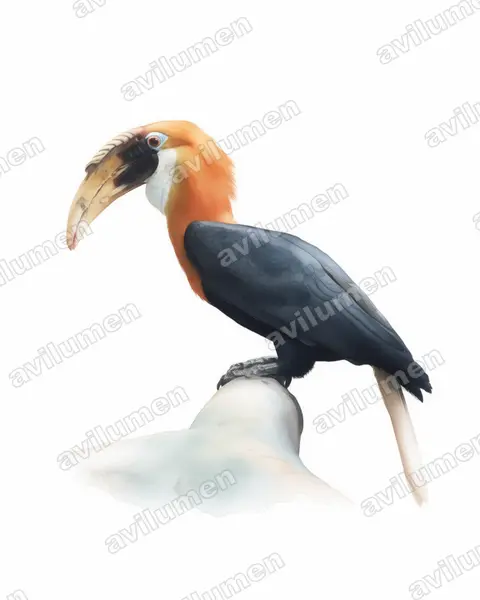
Watercolor 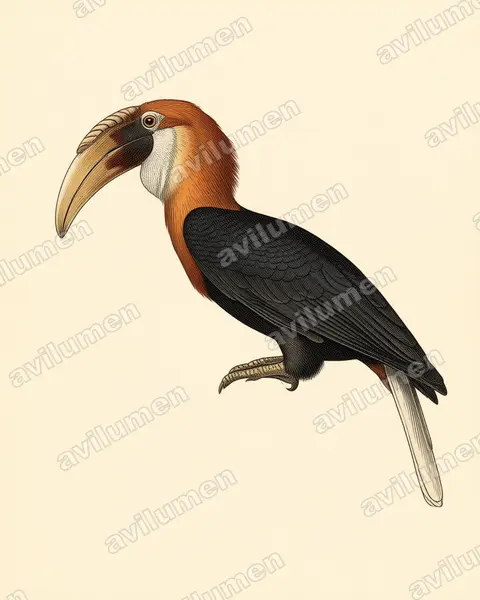
Vintage plate 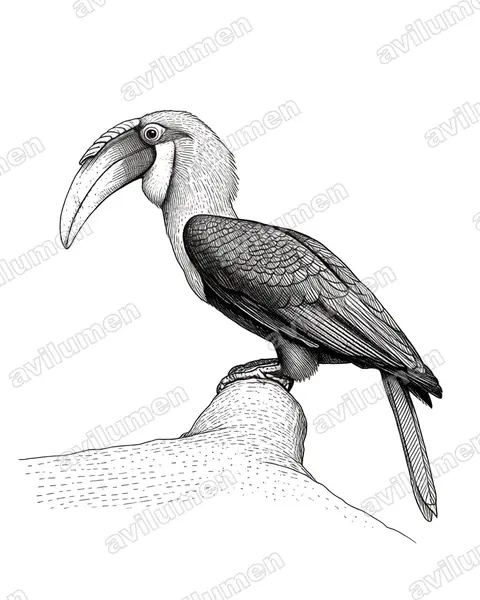
Ink 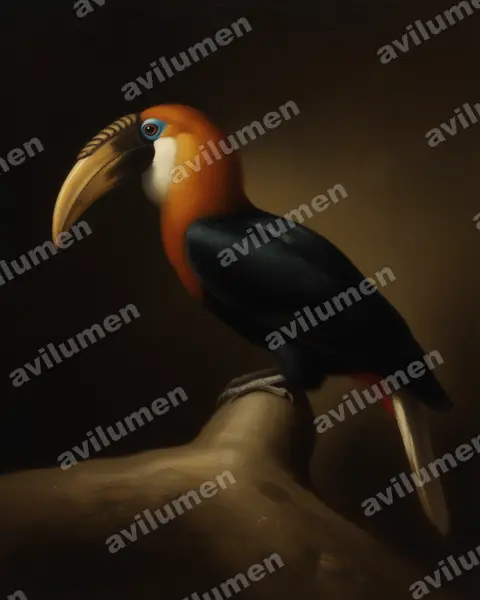
Oil 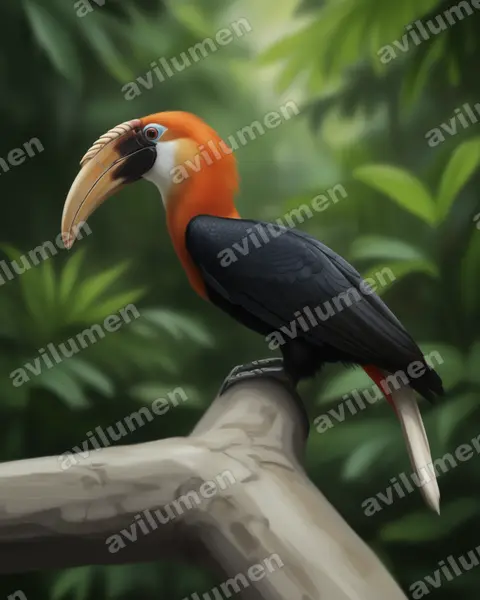
Realistic 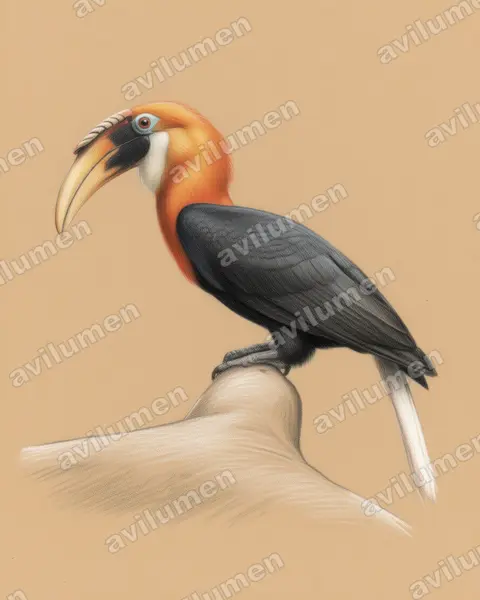
Colored pencil
Illustrations based on the photograph by Rhyticeros_plicatus_-Lincoln_Park_Zoo-8a.jpg: Stephen Hanafin derivative work: Snowmanradio (talk) (CC BY-SA 2.0), from Wikimedia Commons.
Digital editions
HD Digital Art Pack — Blyth's Hornbill
Digital download: 6 high-resolution illustrations of the Blyth's Hornbill (Rhyticeros plicatus), print-ready. This is a digital file; no animal or physical item is included.
AI Avatar — Blyth's Hornbill
Generate an avatar fusing your face with the Blyth's Hornbill (Rhyticeros plicatus). Delivered digitally in 8K, watermark-free. Digital product; no animals are sold or brokered.
Instant download. No live birds are sold.
Frequently asked questions
- Is Rhyticeros plicatus (Blyth's Hornbill) endangered?
- The IUCN Red List places Rhyticeros plicatus, commonly known as the Blyth's Hornbill, in the «Least concern» category. «Least concern» means it is not currently threatened.
- Where does Rhyticeros plicatus (Blyth's Hornbill) live?
- Rhyticeros plicatus (Blyth's Hornbill) is found in Indonesia.
- What family does Rhyticeros plicatus (Blyth's Hornbill) belong to?
- Rhyticeros plicatus (Blyth's Hornbill) belongs to the family Bucerotidae, in the order Bucerotiformes.
- What colour is Rhyticeros plicatus (Blyth's Hornbill)?
- The plumage of Rhyticeros plicatus (Blyth's Hornbill) combines these colours: Black.
More from the same family
 Vulnerable
Rufous-necked Hornbill
Aceros nipalensis
The rufous-necked hornbill is a species of hornbill in Bhutan, northeastern India, especially in Arunachal Pradesh, Indian subcontinent and Southeast Asia. It is locally extinct in Nepal due to hunting and significant loss of habitat. There are less than 10,000 adults left in the wild. With a length of about 117 cm (46 in), it is among the largest Bucerotine hornbills.
from $1.99
 Near threatened
Austen's Brown Hornbill
Anorrhinus austeni
Austen's brown hornbill, also known as the white-throated brown hornbill or brown hornbill, is a medium-sized species of hornbill found in forests from northeastern India to Vietnam and northern Thailand. It is rare throughout its range and is threatened by habitat loss and fragmentation.
from $1.99
 Near threatened
Bushy-crested Hornbill
Anorrhinus galeritus
The bushy-crested hornbill is a bird in the hornbill family. It is found in Brunei, Indonesia, Malaysia, Myanmar, and Thailand. Its natural habitat is subtropical or tropical moist lowland forests.
from $1.99
 Near threatened
Austen's Brwon Hornbill
Anorrhinus tickelli
Tickell's brown hornbill, also known as the rusty-cheeked hornbill, is a species of hornbill found in forests in Burma and adjacent western Thailand. Austen's brown hornbill is sometimes considered as a subspecies of Tickell's brown hornbill.
from $1.99