Guianan toucanet
Selenidera piperivora
Avilumen editorial team ·

The Guianan toucanet, or Guyana toucanet is a near-passerine bird in the toucan family Ramphastidae. It is found in Brazil, French Guiana, Guyana, Suriname, and Venezuela.
The Guianan toucanet, or Guyana toucanet (Selenidera piperivora) is a near-passerine bird in the toucan family Ramphastidae. It is found in Brazil, French Guiana, Guyana, Suriname, and Venezuela.
Taxonomy and systematics
The Guianan toucanet was originally described as Ramphastos piperivorus It was later named Selenidera culik but following early 21st century scholarship achieved its current (2022) binomial Selenidera piperivora.
The Guianan toucanet is monotypic.
Description
The Guianan toucanet is 33 to 35 cm (13 to 14 in) long. Males weigh 129 to 159 g (4.6 to 5.6 oz) and females 132 to 165 g (4.7 to 5.8 oz). Males and females have the same bill pattern but the female's bill is shorter. The bill has a yellowish line at its base. Both the maxilla and mandible are mostly black with red bases; the red extends further on the mandible. Both sexes have bare blue skin around the eye and a tuft of yellow feathers behind the blue. Males are black on the crown, nape, throat, breast and belly. They have a gold "collar" on their upper back; the rest of their upperparts are green. Their tail is green with chestnut tips to the feathers. Their undertail coverts are red. Adult females have a black cap and chestnut nape and upper back with only a hint of yellow collar. Their underparts are gray to green-gray with a green-yellow belly. Immatures are similar to adults but duller overall and with their plumage and bill patterns less distinct.
Distribution and habitat
The Guianan toucanet is found from extreme southeastern Venezuela east through the Guianas into northern Brazil and south to the Amazon River between the Rio Negro and the Amazon's mouth in the state of Amapá. It inhabits moist forest including gallery forest in savannas and favors primary forest over selectively logged areas. In elevation it usually occurs up to 600 m (2,000 ft) but is found as high as 900 m (3,000 ft) in Venezuela and Suriname.
Movement
The Guianan toucanet is believed to be a year-round resident throughout its range.
Feeding
The Guianan toucanet's diet is mostly fruit, and it also takes insects. There is some evidence of coevolution with the Oenocarpus bacaba palm. It usually forages in pairs or small groups, and usually from the forest's mid level to the sub-canopy.
Breeding
The Guianan toucanet breeds between March and May in Venezuela and the Guianas and from April to July in Brazil. Males courtship-feed females. It nests in woodpecker holes, sometimes evicting the maker. The clutch size is two or three eggs. The incubation time in captivity is about 16 days but is unknown in the wild; the time to fledging is not known.
Vocalization
The Guianan toucanet has a wide variety of vocalizations but uses them infrequently. Its song is a "slow series of guttural, frog-like 'arrouk' notes". Its basic call is a "rattle, 'trrrr-trrrr-trrrr...', joined with rising squawk, rooster-like at times, 'kaaaaaaiiiiii'". It also makes "various soft rattles and other calls, some aggressive, others used in courtship feeding and at [the] nest."
In captivity
The Guianan toucanet is sometimes kept in aviculture as a breeder bird or a pet.
Status
The IUCN has assessed the Guianan toucanet as being of Least Concern. It has a large range, and though its population size is not known it is believed to be stable. No immeditate threats have been identified. It is considered common in much of its range.
Text adapted from Wikipedia · CC BY-SA 4.0
Where it lives
Distribution

Taxonomy
- Order
- Piciformes
- Family
- Ramphastidae
- Genus
- Selenidera
- Conservation status
- Least concern
Listen to its call
No recording yet
Care guide
Toucan and Aracari Care Guide: Diet and Housing
How to care for toucans and aracaris: low-iron diet, iron storage disease (hemochromatosis), aviary setup, health, behavior and CITES legal status.
Read the guide →Illustration gallery
6 illustrations of Selenidera piperivora (Guianan toucanet) in different styles, true to its real plumage. Shown watermarked; the art pack includes the high-resolution originals, ready to print.
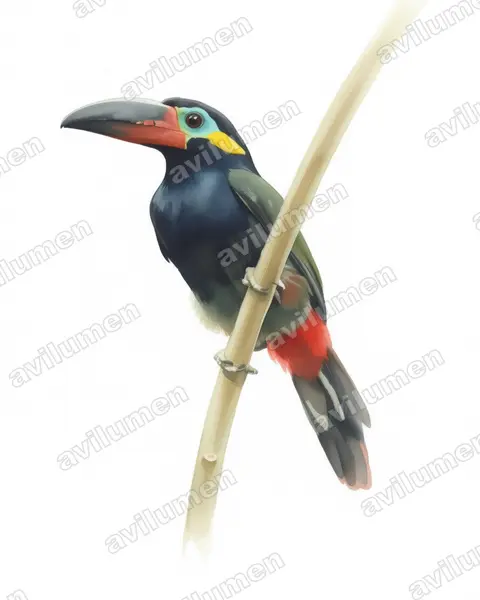
Watercolor 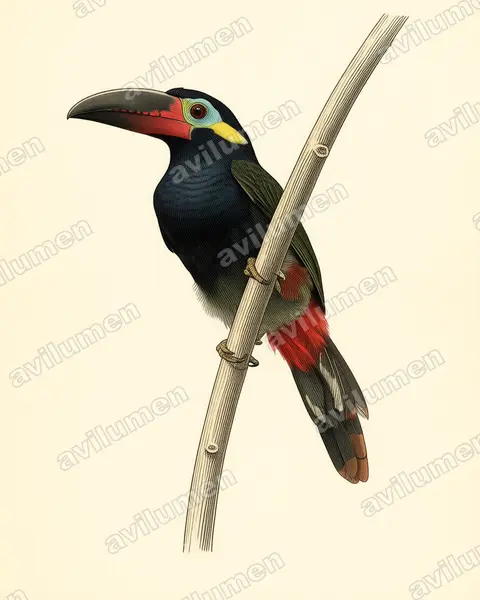
Vintage plate 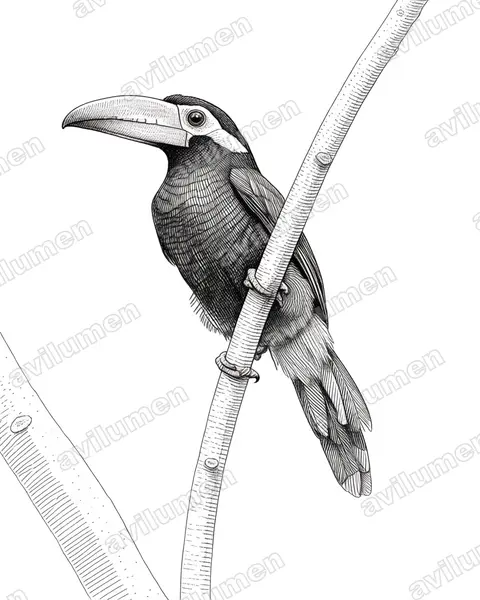
Ink 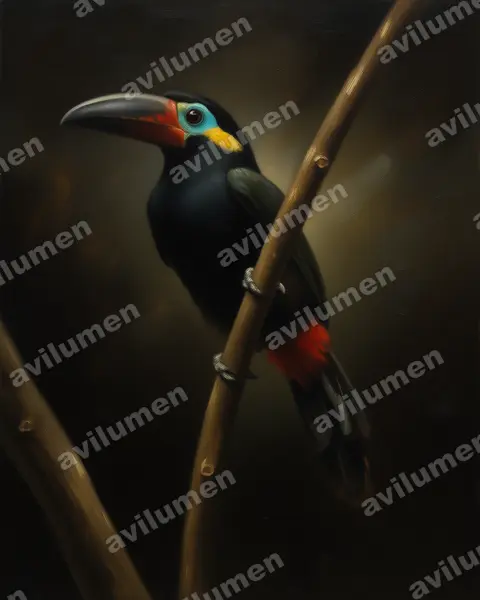
Oil 
Realistic 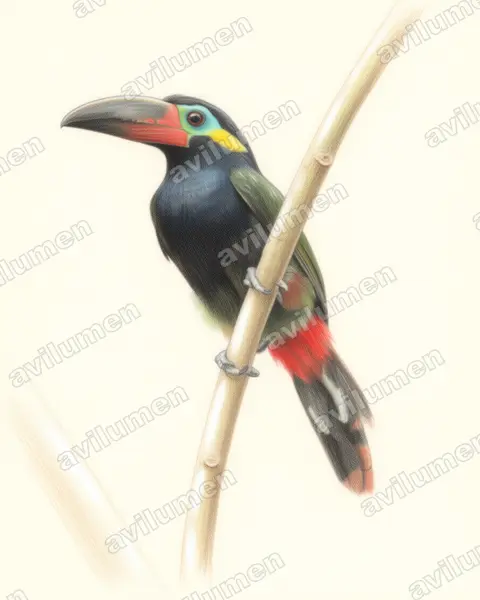
Colored pencil
Illustrations based on the photograph by Manjith Kainickara (CC BY 2.0), from Wikimedia Commons.
Digital editions
HD Digital Art Pack — Guianan toucanet
Digital download: 6 high-resolution illustrations of the Guianan toucanet (Selenidera piperivora), print-ready. This is a digital file; no animal or physical item is included.
AI Avatar — Guianan toucanet
Generate an avatar fusing your face with the Guianan toucanet (Selenidera piperivora). Delivered digitally in 8K, watermark-free. Digital product; no animals are sold or brokered.
Instant download. No live birds are sold.
Frequently asked questions
- Is Selenidera piperivora (Guianan toucanet) endangered?
- The IUCN Red List places Selenidera piperivora, commonly known as the Guianan toucanet, in the «Least concern» category. «Least concern» means it is not currently threatened.
- Where does Selenidera piperivora (Guianan toucanet) live?
- Selenidera piperivora (Guianan toucanet) is found in Brazil and South America.
- What family does Selenidera piperivora (Guianan toucanet) belong to?
- Selenidera piperivora (Guianan toucanet) belongs to the family Ramphastidae, in the order Piciformes.
- What colour is Selenidera piperivora (Guianan toucanet)?
- The plumage of Selenidera piperivora (Guianan toucanet) combines these colours: Green and Yellow.
More from the same family
 Least concern
Hooded Mountain Toucan
Andigena cucullata
The hooded mountain toucan is a species of bird in the toucan family Ramphastidae. It is found in Bolivia and Peru.
from $1.99
 Near threatened
Grey-breasted Mountain Toucan
Andigena hypoglauca
The grey-breasted mountain toucan is a least-concern species of bird in the toucan family, Ramphastidae. It is found in South American countries such as Colombia, Ecuador and Peru.
from $1.99
 Near threatened
Plate-billed Mountain Toucan
Andigena laminirostris
The plate-billed mountain toucan is a species of bird in the family Ramphastidae. It is native to the west slope of Ecuador and extreme southern Colombia, where it lives in the high-altitude humid mountain forests of the Andes.
from $1.99
 Least concern
Black-billed Mountain Toucan
Andigena nigrirostris
The black-billed mountain toucan is a species of bird in the toucan family Ramphastidae. It is found in Colombia, Ecuador, Peru, and Venezuela.
from $1.99