Olivaceous Piha
Snowornis cryptolophus
Avilumen editorial team ·

The olivaceous piha is a species of bird in the family Cotingidae, the cotingas. It is found in Colombia, Ecuador, and Peru.
The olivaceous piha (Snowornis cryptolophus) is a species of bird in the family Cotingidae, the cotingas. It is found in Colombia, Ecuador, and Peru.
Taxonomy and systematics
The olivaceous piha was originally described as Lathria cryptolophia. It was later moved to genus Lipaugus and then back to Lathria. Because that genus already applied to species unrelated to subalaris, its current genus Snowornis was erected in 2001 for it and the similar grey-tailed piha (S. subalaris). The genus honors Dr. David W. Snow for his many contributions to the knowledge of the cotingas.
The olivaceous piha has two subspecies, the nominate S. c. crytolophus (Sclater, PL & Salvin, 1877) and S. c. mindoensis (Hellmayr & Seilern, 1914).
Description
The olivaceous piha is 23 to 24 cm (9.1 to 9.4 in) long; three males weighed about 72 to 76 g (2.5 to 2.7 oz). The sexes have similar plumage. Adult males of the nominate subspecies have a mostly olive head with brighter olive ear coverts and a partially hidden black crest in the middle of the crown. Their upperparts are olive green that is brightest on the rump. Their tail is a browner to grayer olive than their upperparts with thin olive edges on the feathers. Their wings are mostly brown with thin olive edges on the flight feathers. Their underparts are mostly olive with thin white streaks from the lower throat to the belly and some lemon yellow undertail coverts. Adult females are much more brownish than males and have little or no crest on the crown. Subspecies S. c. mindoensis is smaller than the nominate with hidden creamy white bases to the crest feathers. Both sexes of both subspecies have a dark brown iris, a dark horn to black bill with a paler base to the mandible, and bluish gray to gray legs and feet.
Distribution and habitat
The olivaceous piha has a disjunct distribution. Subspecies S. c. mindoensis has the smaller and more northerly range of the two. It is found on the western slope of Colombia's Western Andes from Antioquia Department south into northwestern Ecuador's Pichincha Province. The nominate subspecies is found from the upper valley of the Magdalena River in far southern Colombia south on the eastern slope of the Andes through Ecuador slightly into Peru and separately in Peru from central Amazonas Department south to Huánuco Department. It inhabits humid montane forest in the subtropical zone, where it mostly occurs from the forest's understory to its mid-story. In elevation it ranges between 1,000 and 2,300 m (3,300 and 7,500 ft) in Colombia, between 1,000 and 1,800 m (3,300 and 5,900 ft) in Ecuador, and between 1,350 and 2,300 m (4,400 and 7,500 ft) in Peru.
Movement
The olivaceous piha is a year-round resident.
Feeding
The olivaceous piha feeds on fruit and large arthropods but details are lacking. It usually forages singly and occasionally joins mixed-species feeding flocks. It perches and moves quietly and inconspicuously, taking prey and plucking fruit while perched or while briefly hovering after a short flight. It also takes prey in mid-air.
Breeding
The olivaceous piha's breeding season is not known but in northwestern Ecuador spans at least September to November. Its nest is a shallow cup made from twigs and plant tendrils placed in the fork of a tree branch. Two were respectively 4.5 and 9 m (15 and 30 ft) above the ground. Nothing else is known about the species' breeding biology.
Vocalization
As of August 2025 xeno-canto had five recordings of olivaceous piha vocalizations; the Cornell Lab's Macaulay Library had one of them and four others. Olivaceous piha vocalizations "remain one of the great mysteries of the avifauna of humid montane forest of the Andes". A "short rattle" has been attributed to the species by some recordists.
Status
The IUCN has assessed the olivaceous piha as being of Least Concern. It has a large range; its population size is not known and is believed to be decreasing. No immediate threats have been identified. It is considered fairly common in Colombia, "scarce and local" in Ecuador, and uncommon in Peru. "As is the case generally with birds of humid montane forests, Olivaceous Piha is vulnerable to habitat loss, degradation, and fragmentation."
Text adapted from Wikipedia · CC BY-SA 4.0
Where it lives
Plumage colours
Distribution

Taxonomy
- Order
- Passeriformes
- Family
- Cotingidae
- Genus
- Snowornis
- Conservation status
- Least concern
Listen to its call
No recording yet
Illustration gallery
6 illustrations of Snowornis cryptolophus (Olivaceous Piha) in different styles, true to its real plumage. Shown watermarked; the art pack includes the high-resolution originals, ready to print.
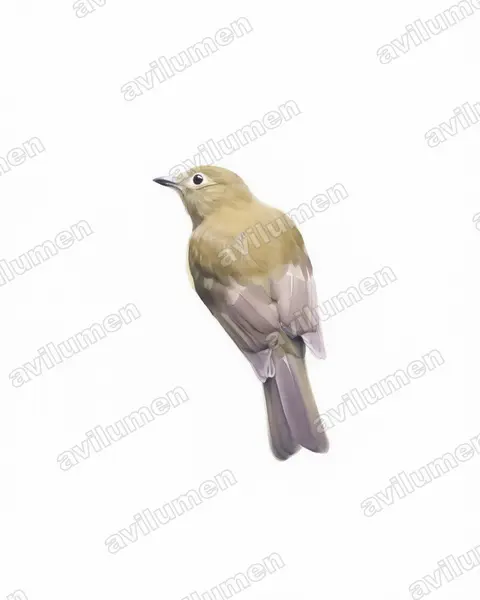
Watercolor 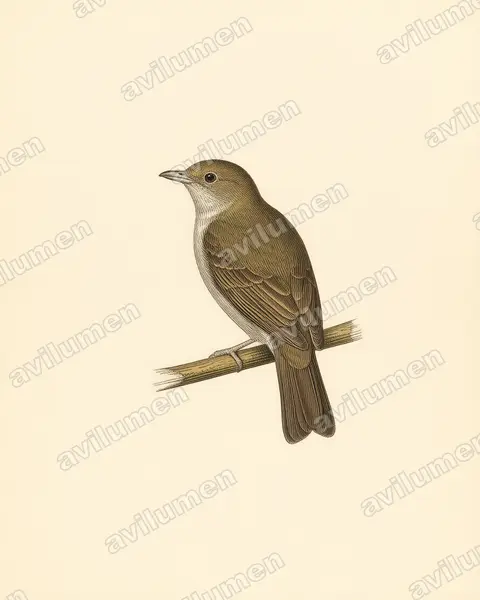
Vintage plate 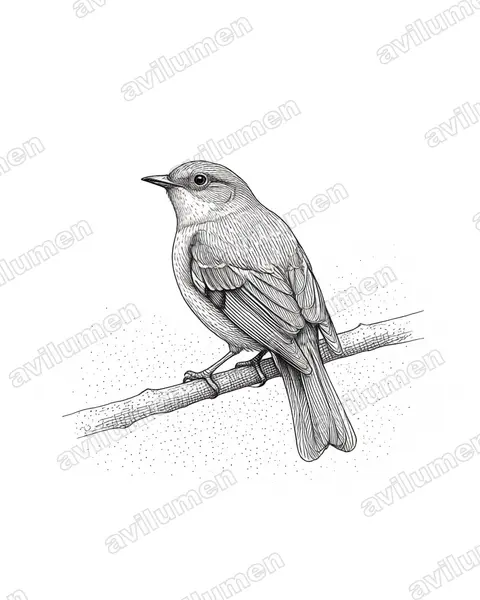
Ink 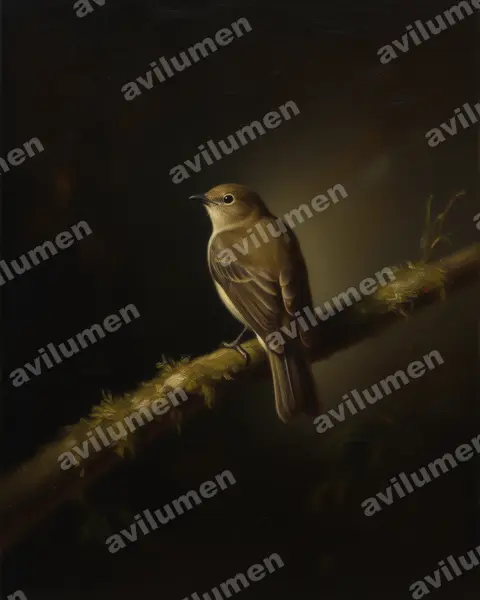
Oil 
Realistic 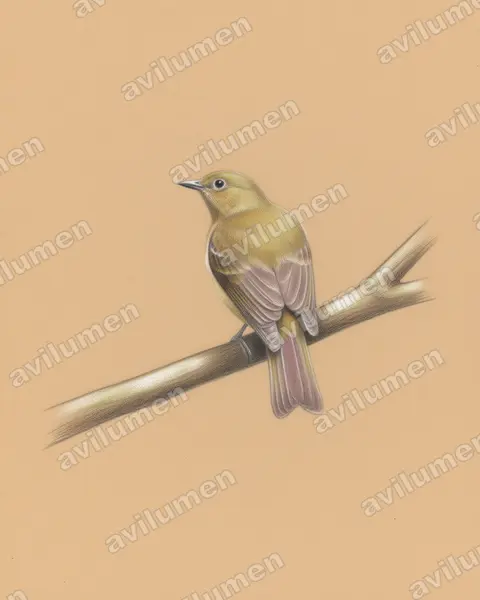
Colored pencil
Illustrations based on the photograph by Mike's Birds from Riverside, CA, US (CC BY-SA 2.0), from Wikimedia Commons.
Digital editions
HD Digital Art Pack — Olivaceous Piha
Digital download: 6 high-resolution illustrations of the Olivaceous Piha (Snowornis cryptolophus), print-ready. This is a digital file; no animal or physical item is included.
AI Avatar — Olivaceous Piha
Generate an avatar fusing your face with the Olivaceous Piha (Snowornis cryptolophus). Delivered digitally in 8K, watermark-free. Digital product; no animals are sold or brokered.
Instant download. No live birds are sold.
Frequently asked questions
- Is Snowornis cryptolophus (Olivaceous Piha) endangered?
- The IUCN Red List places Snowornis cryptolophus, commonly known as the Olivaceous Piha, in the «Least concern» category. «Least concern» means it is not currently threatened.
- Where does Snowornis cryptolophus (Olivaceous Piha) live?
- Snowornis cryptolophus (Olivaceous Piha) is found in South America.
- What family does Snowornis cryptolophus (Olivaceous Piha) belong to?
- Snowornis cryptolophus (Olivaceous Piha) belongs to the family Cotingidae, in the order Passeriformes.
- What colour is Snowornis cryptolophus (Olivaceous Piha)?
- The plumage of Snowornis cryptolophus (Olivaceous Piha) combines these colours: Green.
More from the same family
 Least concern
Scaled Fruiteater
Ampelioides tschudii
The scaled fruiteater is a species of bird in the family Cotingidae. It is the only member of the genus Ampelioides. This bird is found in Bolivia, Colombia, Ecuador, Peru, and Venezuela, where its natural habitat is the high elevation tropical forests of the Andes mountains. The scaled fruiteater is a chunky, short-tailed, flat-headed bird measuring 19–20 cm (7.5–7.9 in) in length.
from $1.99
 Least concern
Red-crested Cotinga
Ampelion rubrocristatus
The red-crested cotinga is a species of bird in the family Cotingidae. It is found in Bolivia, Colombia, Ecuador, Peru, and Venezuela.
from $1.99
 Least concern
Chestnut-crested Cotinga
Ampelion rufaxilla
The chestnut-crested cotinga is a species of bird in the family Cotingidae. It is found in Bolivia, Colombia, Ecuador, and Peru.
from $1.99
 Critically endangered
Kinglet Calyptura
Calyptura cristata
The kinglet calyptura is a small Critically Endangered passerine bird in the family Tyrannidae, the tyrant flycatchers. It is endemic to southeastern Brazil.
from $1.99