Carduelis cucullata
Spinus cucullatus
Avilumen editorial team ·

The red siskin is a small endangered finch.
The red siskin (Spinus cucullatus) is a small endangered finch.
Distribution
It is native to tropical South America - in northern Colombia, northern Venezuela (where it is called the "cardenalito") and Guyana. It was common in the early 20th century, occurring throughout the foothills of northern Venezuela, but has now become extremely rare in a fragmented range. The population on Trinidad is believed to be extirpated, with no sightings since 1960. An introduced population derived from escaped cagebirds in Puerto Rico has since thought to become extinct.
Description
The red siskin is about 10 cm long. The male is mainly deep red, with black on the head, throat, flight feathers and tail tip, and a whitish lower belly and under tail. The female is grey on the head, breast, and upper parts, apart from a red rump and upper tail. The breast is grey with reddish flanks, and the rest of the underparts, the wings and tail resemble the corresponding areas of the male. Immature females are paler than the adults, and immature males are brown rather than red.
Call
The call is a high-pitched chitter and sharp chi-tit like the Indian silverbill, and the male's song is a musical goldfinch-like melody with twitters and trills.
Behaviour and ecology
The red siskin is found in open country, forest edges and grassland with trees or shrubs. The female is believed to lay three greenish-white eggs in a grassy cup nest in a tree. Red siskins eat seeds and are highly gregarious. When they were more numerous, they formed semi-nomadic flocks.
Conservation
This siskin has been illegally trapped for the cage bird trade and endangered by environmental factors. Domestication has probably been responsible for the continuation of the species, which might otherwise be extinct. This is an attractive finch with a pleasant song, and its unique coloration for a small finch has led to it being used for interbreeding with domestic canaries to produce varieties with red in the plumage.
Conservation status
The red siskin is listed as endangered by the IUCN Red List and nationally critically endangered in Venezuela. It is listed on CITES Appendix I. The greatest threat to the species has been intense illegal trapping for the bird trade since the 1940s; however, the species also faces extensive habitat loss. Some hope has been given to this highly endangered species by the discovery in 2003 of a population of several thousand birds in southern Guyana, 1000 km from any previously known colony. Otherwise, the world population is believed to be between 600–6,000 pairs.
Researchers at the Smithsonian Conservation Biology Institute lead a program, the Red Siskin Initiative, with the goals of uncovering more about this species and preventing its extinction. The National Aviary in Pittsburgh, PA has a captive breeding program for the species.
Text adapted from Wikipedia · CC BY-SA 4.0
Where it lives
Distribution

Taxonomy
- Order
- Passeriformes
- Family
- Fringillidae
- Genus
- Spinus
- Conservation status
- Endangered
Listen to its call
No recording yet
Care guide
Canary and Finch Care Guide: Diet, Housing and Breeding
How to care for canaries, zebra finches, Gouldian finches and other finches: diet, flight cage setup, health, song and breeding. A guide for bird keepers.
Read the guide →Illustration gallery
6 illustrations of Spinus cucullatus (Carduelis cucullata) in different styles, true to its real plumage. Shown watermarked; the art pack includes the high-resolution originals, ready to print.
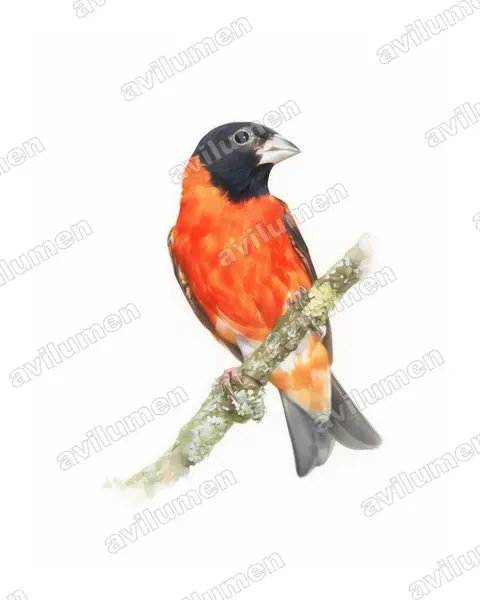
Watercolor 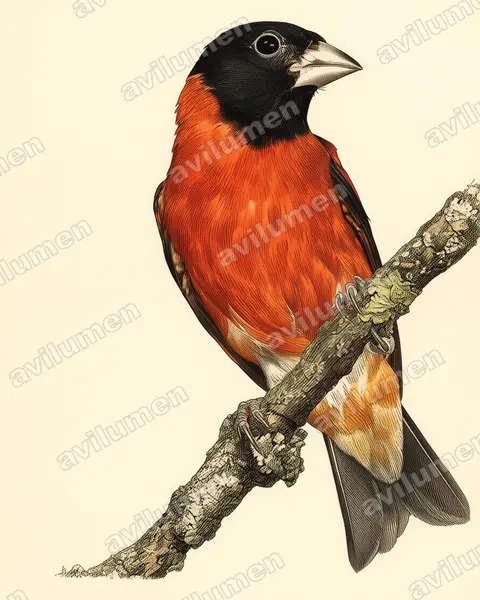
Vintage plate 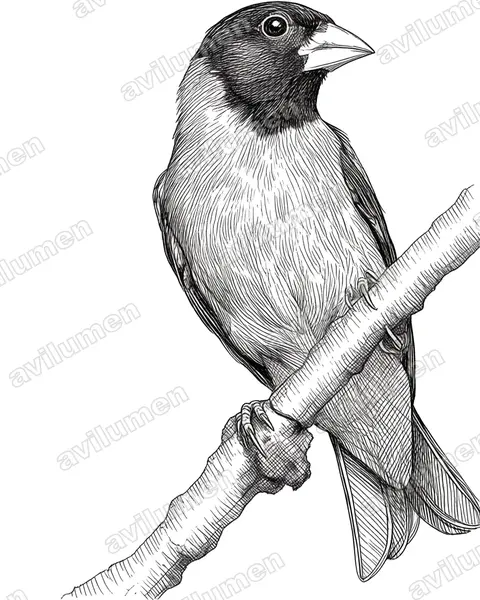
Ink 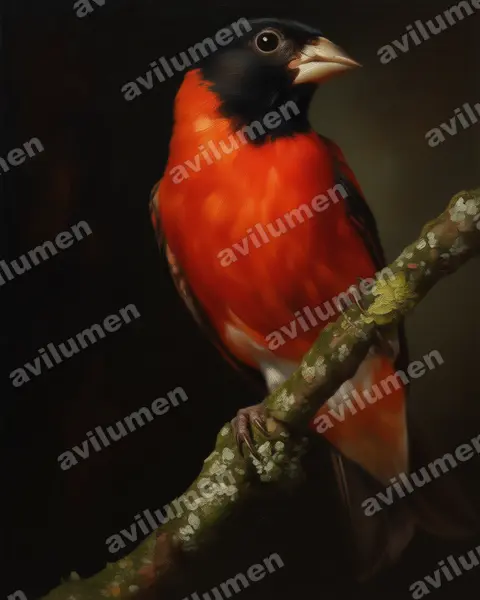
Oil 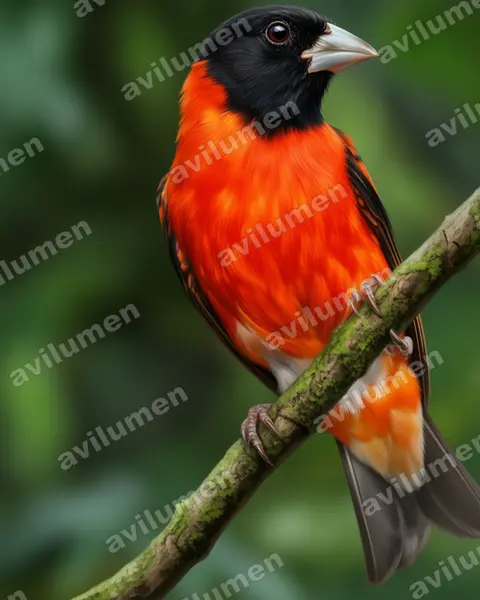
Realistic 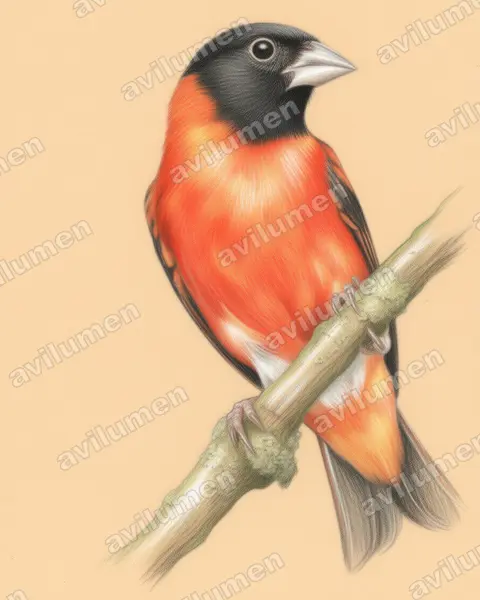
Colored pencil
Illustrations based on the photograph by Siskini (Public domain), from Wikimedia Commons.
Digital editions
HD Digital Art Pack — Carduelis cucullata
Digital download: 6 high-resolution illustrations of the Carduelis cucullata (Spinus cucullatus), print-ready. This is a digital file; no animal or physical item is included.
AI Avatar — Carduelis cucullata
Generate an avatar fusing your face with the Carduelis cucullata (Spinus cucullatus). Delivered digitally in 8K, watermark-free. Digital product; no animals are sold or brokered.
Instant download. No live birds are sold.
Frequently asked questions
- Is Spinus cucullatus (Carduelis cucullata) endangered?
- The IUCN Red List places Spinus cucullatus, commonly known as the Carduelis cucullata, in the «Endangered» category. «Endangered» means it faces a very high risk of disappearing in the wild.
- Where does Spinus cucullatus (Carduelis cucullata) live?
- Spinus cucullatus (Carduelis cucullata) is found in South America.
- What family does Spinus cucullatus (Carduelis cucullata) belong to?
- Spinus cucullatus (Carduelis cucullata) belongs to the family Fringillidae, in the order Passeriformes.
- What colour is Spinus cucullatus (Carduelis cucullata)?
- The plumage of Spinus cucullatus (Carduelis cucullata) combines these colours: Red and Black.
More from the same family
 Least concern
European Goldfinch
Carduelis carduelis
The European goldfinch, or simply goldfinch, is a small passerine bird in the finch family that is native to the Palearctic zone in Europe, northern Africa, and western Asia. It has been introduced to other areas, including Australia, New Zealand, Uruguay and the United States.
from $1.99
 Least concern
Atlantic Canary
Serinus canaria
The Atlantic canary, known worldwide simply as the wild canary and also called the island canary, common canary, or canary, is a small passerine bird belonging to the genus Serinus in the true finch family, Fringillidae. It is native to the Canary Islands, the Azores, and Madeira. Wild birds are mostly yellow-green, with brownish streaking on the back.
from $1.99