Band-tailed Barbthroat
Threnetes ruckeri
Avilumen editorial team ·

The band-tailed barbthroat is a medium-sized hummingbird that is found from southeastern Guatemala and Belize to western Ecuador and western Venezuela.
The band-tailed barbthroat (Threnetes ruckeri) is a medium-sized hummingbird that is found from southeastern Guatemala and Belize to western Ecuador and western Venezuela.
Taxonomy and systematics
The band-tailed barbthroat has the three subspecies listed. A fourth proposed subspecies, T. r. darienensis of the Panama-Colombia border area, shares the characteristics of all three recognized subspecies. The band-tailed barbthroat and the other two members of its genus pale-tailed barbthroat (T. lecurus) and sooty barbthroat (T. niger) form a superspecies.
Description
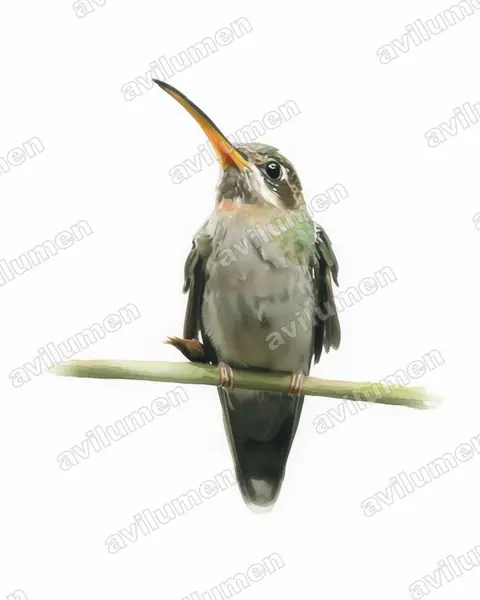
The band-tailed barbthroat is 10 to 11 cm (3.9 to 4.3 in) long. Males weigh 5.5 to 7 g (0.19 to 0.25 oz) and females 5 to 7 g (0.18 to 0.25 oz).The adult male of the nominate subspecies has bronze-green upperparts, a dark ear patch and chin, and a dusky malar stripe. The tail is dark with white bases and tips to the feathers that create a black band near the end. The throat is ochraceous and the underparts are otherwise gray with some green feathers. It has a nearly straight bill. As with other hermit hummingbirds, the sexes are similar; the female's bill is somewhat more decurved than the male's and the plumage has less contrast among the throat, breast, and belly. Young birds resemble the adult but have ochraceous feather edges. T. r. venezuelensis has a somewhat larger ochraceous throat patch than the nominate. T. r. ventosus has a much larger and bright orange throat patch and an ochraceous tinge to the belly.
Distribution and habitat
T. r. ventosus is the northernmost subspecies of band-tailed barbthroat. It is found from eastern Guatemala and Belize through Honduras, Nicaragua, and Costa Rica into Panama. The nominate T. r. ruckeri is found from northern and western Colombia south through western Ecuador almost to Peru. T. r. venezuelensis is found in northwestern Venezuela. The species inhabits the understory and edges of primary forest and old second growth, and also semi-open shrublands, thickets, and plantations. In elevation it ranges from sea level to 1,200 m (3,900 ft).
Movement
The band-tailed barbthroat is presumed to be sedentary. However, some movement has been noted after the breeding season, especially among young birds.
Feeding
Like other hermit hummingbirds, the band-tailed barbthroat is a "trap-line" feeder, visiting a circuit of flowering plants. It feeds on nectar at Heliconia and other tubular flowers and also on small arthropods, especially spiders. In addition to probing flowers for nectar, it also "robs" by piercing the base of the tube.
Breeding
The band-tailed barbthroat's nesting season varies widely across its range. Its nest is a cup of plant and other fibers and cobweb attached to the underside tip of a long drooping leaf. The female alone incubates the two white eggs, though males have been observed remaining in the nest's vicinity.
Vocalization
The band-tailed barbthroat's song is "a fast high-pitched phrase of some 5–10 notes repeated with intervals of several seconds...e.g. 'tzi-tzi-tsee-ee-tsi-tzi-tzi'." In Costa Rica the Pacific slope population has a more complex song than that of the Caribbean slope birds; it includes trills.
Status
The IUCN has assessed the band-tailed barbthroat as being of Least Concern, although its population has not been enumerated and its trend is not known. It appears to be generally common and occurs is several protected areas.
Text adapted from Wikipedia · CC BY-SA 4.0
Where it lives
Distribution

Taxonomy
- Order
- Apodiformes
- Family
- Trochilidae
- Genus
- Threnetes
- Conservation status
- Least concern
Listen to its call
No recording yet
Illustration gallery
6 illustrations of Threnetes ruckeri (Band-tailed Barbthroat) in different styles, true to its real plumage. Shown watermarked; the art pack includes the high-resolution originals, ready to print.
Watercolor 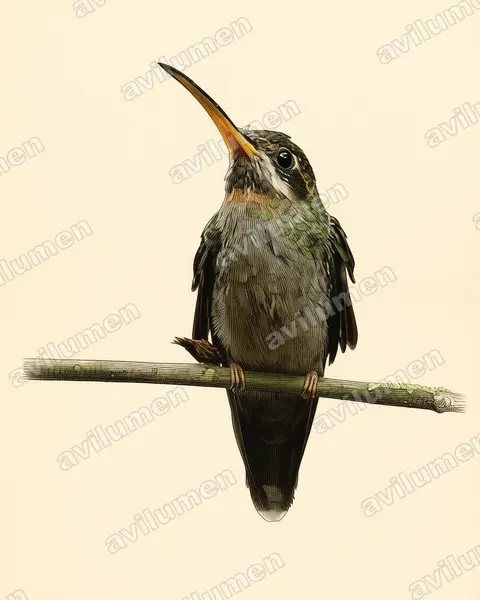
Vintage plate 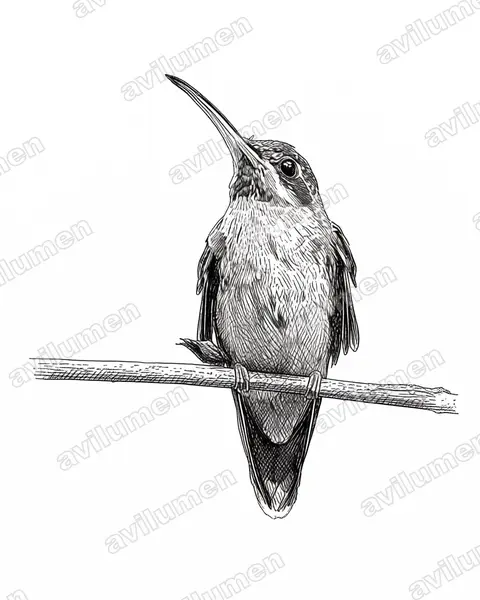
Ink 
Oil 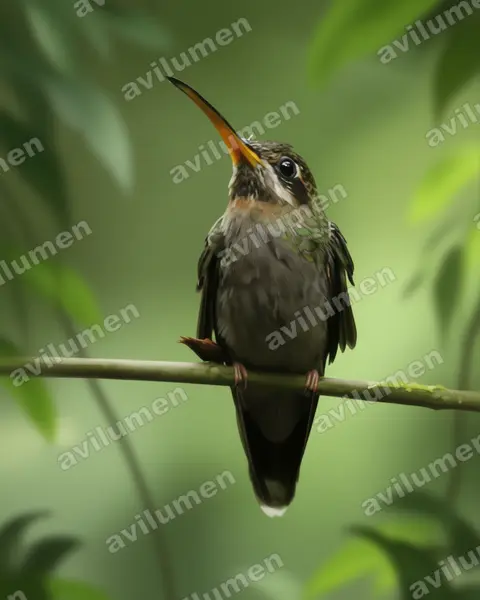
Realistic 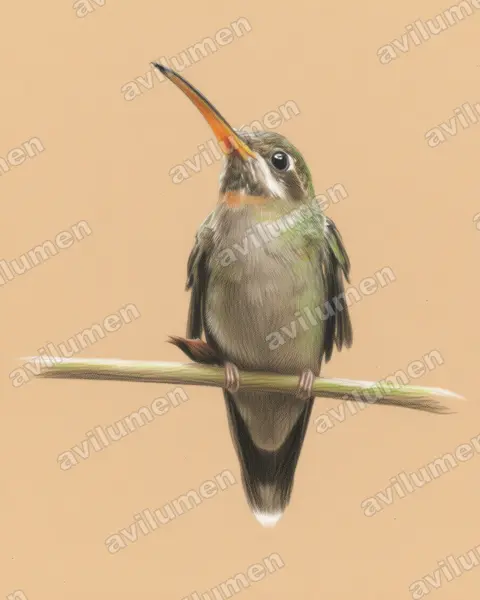
Colored pencil
Illustrations based on the photograph by Michael Woodruff from Spokane, Washington, USA (CC BY-SA 2.0), from Wikimedia Commons.
Digital editions
HD Digital Art Pack — Band-tailed Barbthroat
Digital download: 6 high-resolution illustrations of the Band-tailed Barbthroat (Threnetes ruckeri), print-ready. This is a digital file; no animal or physical item is included.
AI Avatar — Band-tailed Barbthroat
Generate an avatar fusing your face with the Band-tailed Barbthroat (Threnetes ruckeri). Delivered digitally in 8K, watermark-free. Digital product; no animals are sold or brokered.
Instant download. No live birds are sold.
Frequently asked questions
- Is Threnetes ruckeri (Band-tailed Barbthroat) endangered?
- The IUCN Red List places Threnetes ruckeri, commonly known as the Band-tailed Barbthroat, in the «Least concern» category. «Least concern» means it is not currently threatened.
- Where does Threnetes ruckeri (Band-tailed Barbthroat) live?
- Threnetes ruckeri (Band-tailed Barbthroat) is found in South America.
- What family does Threnetes ruckeri (Band-tailed Barbthroat) belong to?
- Threnetes ruckeri (Band-tailed Barbthroat) belongs to the family Trochilidae, in the order Apodiformes.
- What colour is Threnetes ruckeri (Band-tailed Barbthroat)?
- The plumage of Threnetes ruckeri (Band-tailed Barbthroat) combines these colours: Green and Blue.
More from the same family
 Least concern
Emerald-chinned Hummingbird
Abeillia abeillei
The emerald-chinned hummingbird is a species of hummingbird in the "emeralds", tribe Trochilini of subfamily Trochilinae.
from $1.99
 Least concern
Speckled hummingbird
Adelomyia melanogenys
The speckled hummingbird is a species of hummingbird. It is the only member of the genus Adelomyia. It inhabits Neotropical montane cloud forests at elevations of 1,000–2,500 meters and is confined to the Andes of Argentina, Bolivia, Peru, Ecuador, Colombia and Venezuela; as well as to some isolated montane forests in western Ecuador and Venezuela.
from $1.99
 Vulnerable
Purple-backed sunbeam
Aglaeactis aliciae
The purple-backed sunbeam is a bird species in the family Trochilidae. It is found only in Peru.
from $1.99
 Near threatened
White-tufted sunbeam
Aglaeactis castelnaudii
The white-tufted sunbeam is a species of hummingbird in the family Trochilidae. It is found only in Peru. Its natural habitats are subtropical or tropical moist montane forest and subtropical or tropical high-altitude shrubland.
from $1.99