Sparkling-tailed woodstar
Tilmatura dupontii
Avilumen editorial team ·

The sparkling-tailed woodstar, also known as the sparkling-tailed hummingbird, is a species of hummingbird in tribe Mellisugini of subfamily Trochilinae, the "bee hummingbirds". It is the only species placed in the genus Tilmatura. It is found in El Salvador, Guatemala, Honduras, Mexico, and Nicaragua.
The sparkling-tailed woodstar (Tilmatura dupontii), also known as the sparkling-tailed hummingbird, is a species of hummingbird in tribe Mellisugini of subfamily Trochilinae, the "bee hummingbirds". It is the only species placed in the genus Tilmatura. It is found in El Salvador, Guatemala, Honduras, Mexico, and Nicaragua.
Taxonomy and systematics
The sparkling-tailed woodstar is the only member of its genus and has no subspecies. However, some authors have proposed that it belongs to the larger genus Philodice and others have assigned a second subspecies to it. Neither of these treatments have received significant support.
Description
Male sparkling-tailed woodstars are 8.2 to 10.1 cm (3.2 to 4.0 in) long. Females are 5.8 to 7.5 cm (2.3 to 3.0 in) long. Twelve specimens weighed an average of 2.23 g (0.079 oz). Both sexes have a long, straight, black bill and a large white patch on each side of the rump. Males have metallic green upperparts, a grayish white breast, and dark metallic bronze green belly and flanks. Their gorget is metallic violet blue. The central two pairs of tail feathers are metallic bronze green. The outer three pairs are about four times as long as the inner pairs, giving a deeply forked tail. They are purplish black with white tips and the outer two pairs also have a chestnut band and a white band. The female has metallic bronze or bronze green upperparts and cinnamon underparts that are darker on the flanks and lower belly. The tail is only slightly forked. The central two pairs of feathers are metallic bronze green with black tips. The outer three pairs have bronze green bases, a wide black band near the tip, and pale cinnamon or white tips.
Distribution and habitat
The sparkling-tailed woodstar is found discontinuously in Mexico from Sinaloa in the west and Veracruz in the east through Guatemala, El Salvador, and Honduras into northern Nicaragua. It inhabits semi-open landscapes such as the edges of pine-oak forest, bushy secondary forest, and scrubby woods. In elevation it generally ranges from 750 to 2,500 m (2,500 to 8,200 ft) though it occurs locally or seasonally almost down to sea level.
Movement
The sparkling-tailed woodstars movements are not well known; it possibly makes seasonal movements to lower elevations.
Feeding
The sparkling-tailed woodstar forages for nectar by trap-lining, visiting a circuit of flowering plants and trees. It seeks nectar at all levels of the vegetation with a slow, bee-like flight, and apparently feeds at a wide variety of plants but details are lacking. In addition to nectar, it feeds on insects captured by hawking from a perch.
Breeding
Almost nothing is known about the sparkling-tailed woodstar's breeding phenology. Individuals collected in August in western Mexico were in breeding condition, so the breeding season apparently includes that month.
Vocalization
The sparkling-tailed woodstar's song is "a very high, thin, but musical squeaking in a continuous stream, rising and falling slightly and lasting for many seconds at a time." It is sung from a high exposed perch. It also occasionally gives "high, sharp, twittering chirps".
Status
The IUCN has assessed the sparkling-tailed woodstar as being of Least Concern. It has a large range, and though its population size is not known it is believed to be stable. However, Mexican authorities consider it threatened because of its scattered distribution in the country and the pressures on its habitat.
Text adapted from Wikipedia · CC BY-SA 4.0
Distribution

Taxonomy
- Order
- Apodiformes
- Family
- Trochilidae
- Genus
- Tilmatura
- Conservation status
- Least concern
Listen to its call
No recording yet
Illustration gallery
6 illustrations of Tilmatura dupontii (Sparkling-tailed woodstar) in different styles, true to its real plumage. Shown watermarked; the art pack includes the high-resolution originals, ready to print.
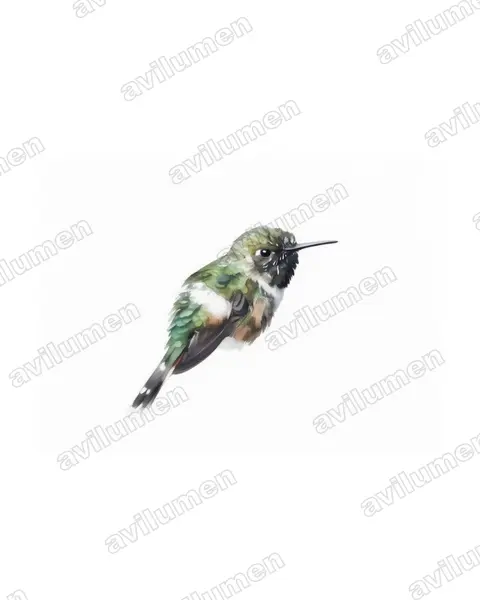
Watercolor 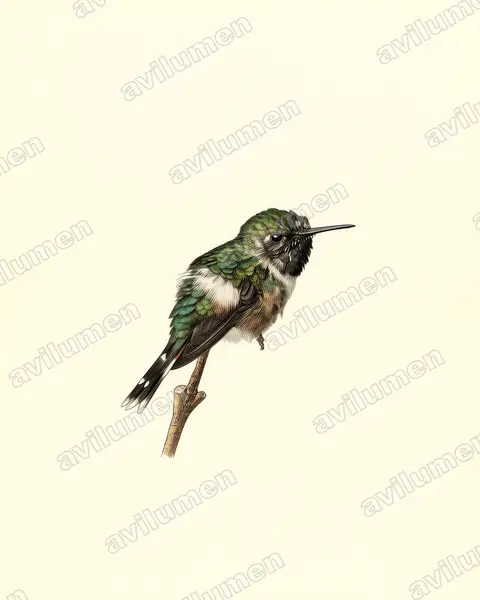
Vintage plate 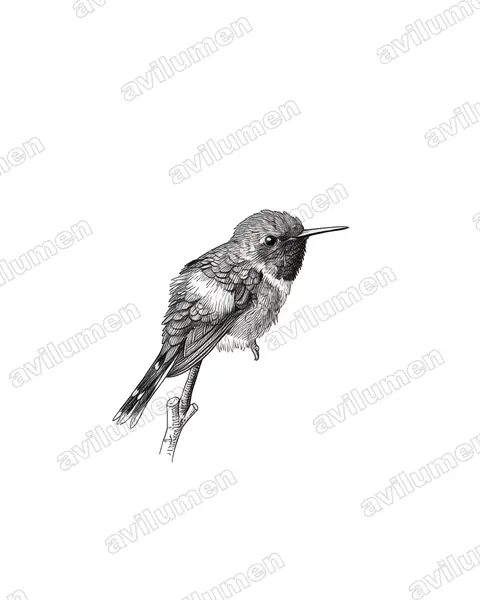
Ink 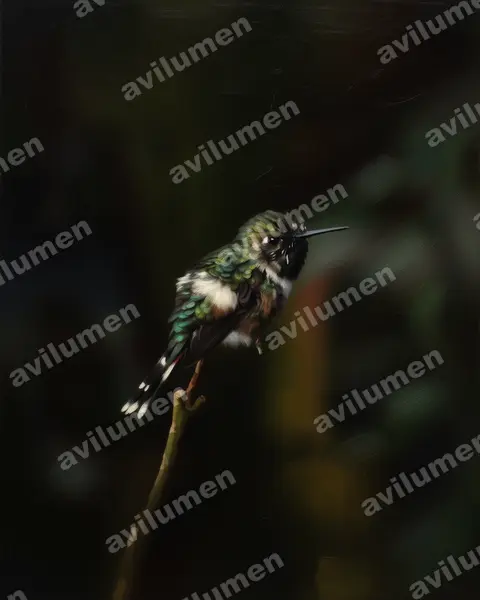
Oil 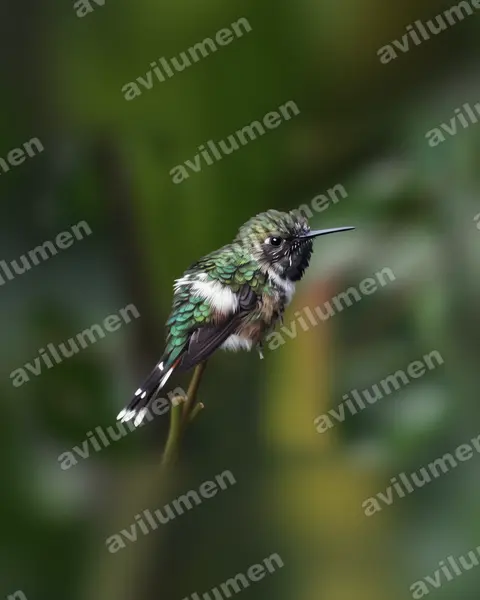
Realistic 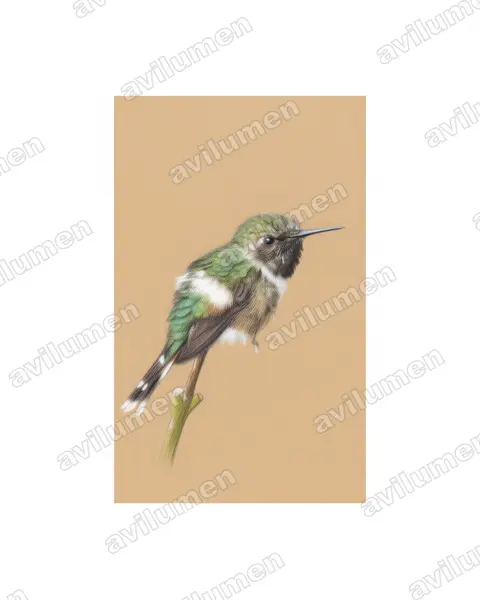
Colored pencil
Illustrations based on the photograph by Grete Pasch (CC BY 4.0), from Wikimedia Commons.
Digital editions
HD Digital Art Pack — Sparkling-tailed woodstar
Digital download: 6 high-resolution illustrations of the Sparkling-tailed woodstar (Tilmatura dupontii), print-ready. This is a digital file; no animal or physical item is included.
AI Avatar — Sparkling-tailed woodstar
Generate an avatar fusing your face with the Sparkling-tailed woodstar (Tilmatura dupontii). Delivered digitally in 8K, watermark-free. Digital product; no animals are sold or brokered.
Instant download. No live birds are sold.
Frequently asked questions
- Is Tilmatura dupontii (Sparkling-tailed woodstar) endangered?
- The IUCN Red List places Tilmatura dupontii, commonly known as the Sparkling-tailed woodstar, in the «Least concern» category. «Least concern» means it is not currently threatened.
- What family does Tilmatura dupontii (Sparkling-tailed woodstar) belong to?
- Tilmatura dupontii (Sparkling-tailed woodstar) belongs to the family Trochilidae, in the order Apodiformes.
- What colour is Tilmatura dupontii (Sparkling-tailed woodstar)?
- The plumage of Tilmatura dupontii (Sparkling-tailed woodstar) combines these colours: Green and Blue.
More from the same family
 Least concern
Emerald-chinned Hummingbird
Abeillia abeillei
The emerald-chinned hummingbird is a species of hummingbird in the "emeralds", tribe Trochilini of subfamily Trochilinae.
from $1.99
 Least concern
Speckled hummingbird
Adelomyia melanogenys
The speckled hummingbird is a species of hummingbird. It is the only member of the genus Adelomyia. It inhabits Neotropical montane cloud forests at elevations of 1,000–2,500 meters and is confined to the Andes of Argentina, Bolivia, Peru, Ecuador, Colombia and Venezuela; as well as to some isolated montane forests in western Ecuador and Venezuela.
from $1.99
 Vulnerable
Purple-backed sunbeam
Aglaeactis aliciae
The purple-backed sunbeam is a bird species in the family Trochilidae. It is found only in Peru.
from $1.99
 Near threatened
White-tufted sunbeam
Aglaeactis castelnaudii
The white-tufted sunbeam is a species of hummingbird in the family Trochilidae. It is found only in Peru. Its natural habitats are subtropical or tropical moist montane forest and subtropical or tropical high-altitude shrubland.
from $1.99