Monteiro's Hornbill
Tockus monteiri
Avilumen editorial team ·

Monteiro's hornbill is a species of hornbill that is native to the dry woodlands of southwestern Africa. It is a common, near-endemic species in Namibia, with a total population estimated at 340,000 individuals.
Monteiro's hornbill (Tockus monteiri) is a species of hornbill that is native to the dry woodlands of southwestern Africa. It is a common, near-endemic species in Namibia, with a total population estimated at 340,000 individuals.
Description
It is a medium-sized bird, 54–58 cm (21–23 in) in length. With a body mass of 210 to 400 g (7.4 to 14.1 oz), it appears to be the largest hornbill of the relatively diminutive Tockus genus. The species is characterized by a white belly, black back, with white spots on the wings and white secondary flight feathers. The outer feathers of the long tail are also white. Females are smaller than males and can be recognized by their turquoise facial skin. The eyes are black and the beak is red.
Range and habitat
Its habitat is the savannah and dry thornveldt of northwestern Namibia and southwestern Angola.
Habits
Unlike other hornbills, which are omnivorous, the Monteiro's hornbill feeds exclusively on insects and other small arthropods. In springtime, Monteiro's hornbills migrate to the southern Windhoek region to nest. They are adapted to the arid environment, and drinking is not a vital necessity for them. They breed at the end of a good rainy season, laying 3 to 5 greyish-white eggs, which hatch after about 45 days. The nest is built on rock faces or in trees.
Text adapted from Wikipedia · CC BY-SA 4.0
Distribution

Taxonomy
- Order
- Bucerotiformes
- Family
- Bucerotidae
- Genus
- Tockus
- Conservation status
- Least concern
Listen to its call
No recording yet
Illustration gallery
6 illustrations of Tockus monteiri (Monteiro's Hornbill) in different styles, true to its real plumage. Shown watermarked; the art pack includes the high-resolution originals, ready to print.
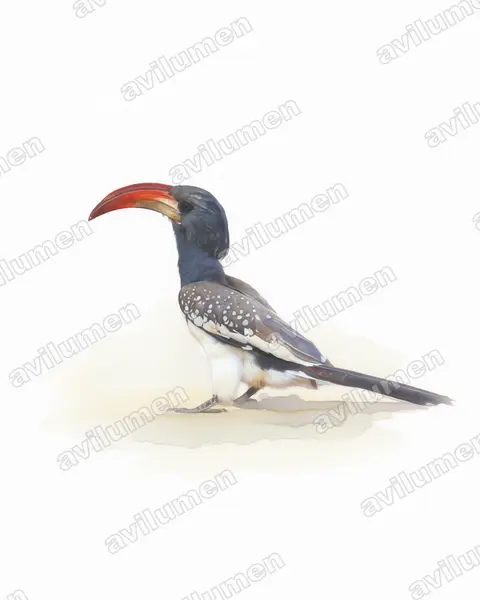
Watercolor 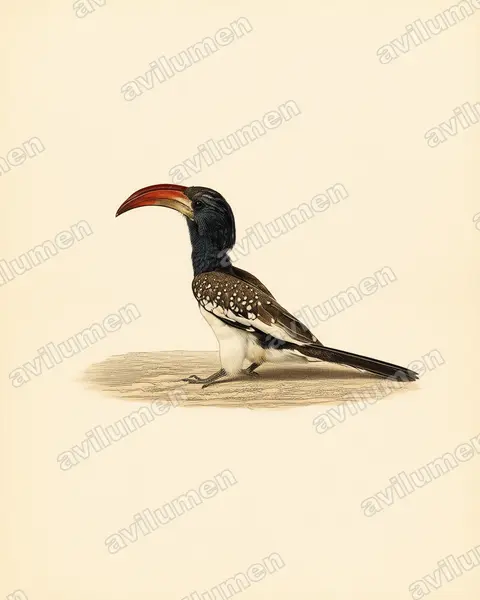
Vintage plate 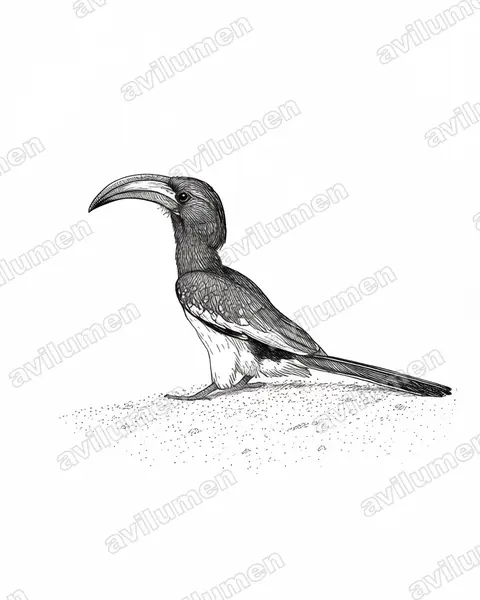
Ink 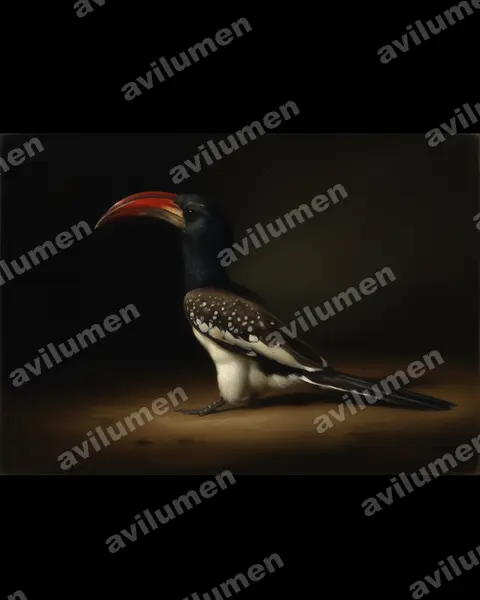
Oil 
Realistic 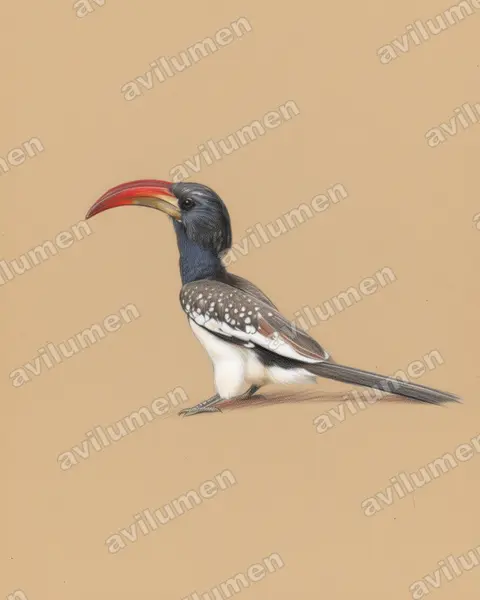
Colored pencil
Illustrations based on the photograph by Nanosanchez (CC BY-SA 3.0), from Wikimedia Commons.
Digital editions
HD Digital Art Pack — Monteiro's Hornbill
Digital download: 6 high-resolution illustrations of the Monteiro's Hornbill (Tockus monteiri), print-ready. This is a digital file; no animal or physical item is included.
AI Avatar — Monteiro's Hornbill
Generate an avatar fusing your face with the Monteiro's Hornbill (Tockus monteiri). Delivered digitally in 8K, watermark-free. Digital product; no animals are sold or brokered.
Instant download. No live birds are sold.
Frequently asked questions
- Is Tockus monteiri (Monteiro's Hornbill) endangered?
- The IUCN Red List places Tockus monteiri, commonly known as the Monteiro's Hornbill, in the «Least concern» category. «Least concern» means it is not currently threatened.
- Where does Tockus monteiri (Monteiro's Hornbill) live?
- Tockus monteiri (Monteiro's Hornbill) is found in Africa.
- What family does Tockus monteiri (Monteiro's Hornbill) belong to?
- Tockus monteiri (Monteiro's Hornbill) belongs to the family Bucerotidae, in the order Bucerotiformes.
- What colour is Tockus monteiri (Monteiro's Hornbill)?
- The plumage of Tockus monteiri (Monteiro's Hornbill) combines these colours: Black.
More from the same family
 Vulnerable
Rufous-necked Hornbill
Aceros nipalensis
The rufous-necked hornbill is a species of hornbill in Bhutan, northeastern India, especially in Arunachal Pradesh, Indian subcontinent and Southeast Asia. It is locally extinct in Nepal due to hunting and significant loss of habitat. There are less than 10,000 adults left in the wild. With a length of about 117 cm (46 in), it is among the largest Bucerotine hornbills.
from $1.99
 Near threatened
Austen's Brown Hornbill
Anorrhinus austeni
Austen's brown hornbill, also known as the white-throated brown hornbill or brown hornbill, is a medium-sized species of hornbill found in forests from northeastern India to Vietnam and northern Thailand. It is rare throughout its range and is threatened by habitat loss and fragmentation.
from $1.99
 Near threatened
Bushy-crested Hornbill
Anorrhinus galeritus
The bushy-crested hornbill is a bird in the hornbill family. It is found in Brunei, Indonesia, Malaysia, Myanmar, and Thailand. Its natural habitat is subtropical or tropical moist lowland forests.
from $1.99
 Near threatened
Austen's Brwon Hornbill
Anorrhinus tickelli
Tickell's brown hornbill, also known as the rusty-cheeked hornbill, is a species of hornbill found in forests in Burma and adjacent western Thailand. Austen's brown hornbill is sometimes considered as a subspecies of Tickell's brown hornbill.
from $1.99