Red-faced lovebird
Agapornis pullarius
Avilumen editorial team ·

The red-headed lovebird, also known as the red-faced lovebird, is a member of the genus Agapornis, a group commonly known as lovebirds. Like other lovebirds, it is native to Africa.
The red-headed lovebird (Agapornis pullarius), also known as the red-faced lovebird, is a member of the genus Agapornis, a group commonly known as lovebirds. Like other lovebirds, it is native to Africa.
Taxonomy
The red-headed lovebird was formally described in 1758 by the Swedish naturalist Carl Linnaeus in the tenth edition of his Systema Naturae. He placed it with all the other parrots in the genus Psittacus and coined the binomial name Psittacus pullarius. The type locality is Ghana. The red-headed lovebird is now one of nine species placed in the genus Agapornis that was introduced in 1836 by the English naturalist Prideaux John Selby. The genus name combines the Ancient Greek ἀγάπη agápē meaning "love" and ὄρνις órnis meaning "bird". The specific epithet pullārius is from Latin and means "of young birds" (pullus means "chick").
Two subspecies are recognised:
A. p. pullarius (Linnaeus, 1758) – Guinea and Sierra Leone to Sudan, DR Congo and Angola
A. p. ugandae Neumann, 1908 – west Ethiopia to east DR Congo and northwest Tanzania
Description
The red-headed lovebird is a 15 cm (6 inches) long, mostly green parrot. It has a well demarcated red area on its head extending from the top of the beak, over the forehead to mid-crown, and extending to the left and right up to the eyelid margins. It has grey feet. The underside of the wings is a lighter green. The female has orange head colouring, which is less well demarcated than the male's red head. The adult male has a red beak while the female's is a paler red.
Distribution and habitat
It has a patchy distribution across the African tropical rainforest.
Breeding
It makes its nest in a termites nest usually in a tree or sometimes on the ground. To make a nest the female digs a tunnel up to a length of 30 cm (12 in) in the termites nest in a colony with other lovebirds.
Aviculture
It is difficult to breed in captivity because it has to burrow to make its nest and the nest chamber needs to be heated to about 27 °C (81 °F); however, they can be induced to burrow into cork to build a nest. It is a very nervous species.
Text adapted from Wikipedia · CC BY-SA 4.0
Taxonomy
- Order
- Psittaciformes
- Family
- Psittaculidae
- Genus
- Agapornis
- Conservation status
- Least concern
Listen to its call
No recording yet
Care guide
Lovebird Care Guide: Diet, Housing and Breeding
How to care for lovebirds: diet, cage size, whether they need a mate, health, breeding, color mutations and legal status. A practical guide for owners.
Read the guide →Illustration gallery
6 illustrations of Agapornis pullarius (Red-faced lovebird) in different styles, true to its real plumage. Shown watermarked; the art pack includes the high-resolution originals, ready to print.
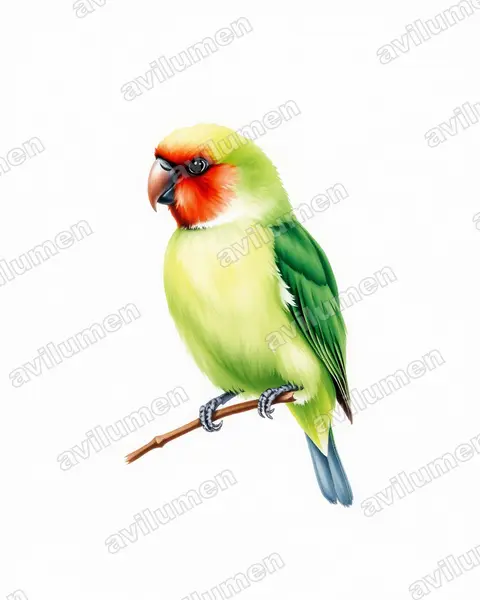
Watercolor 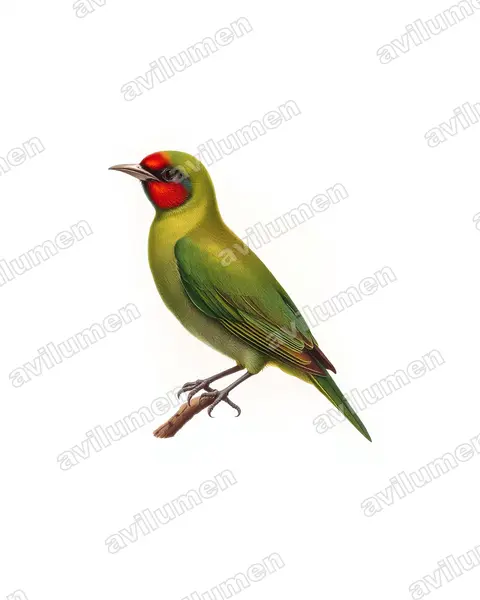
Vintage plate 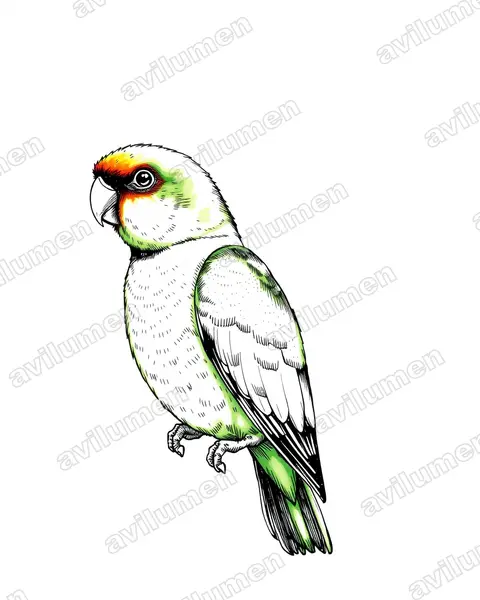
Ink 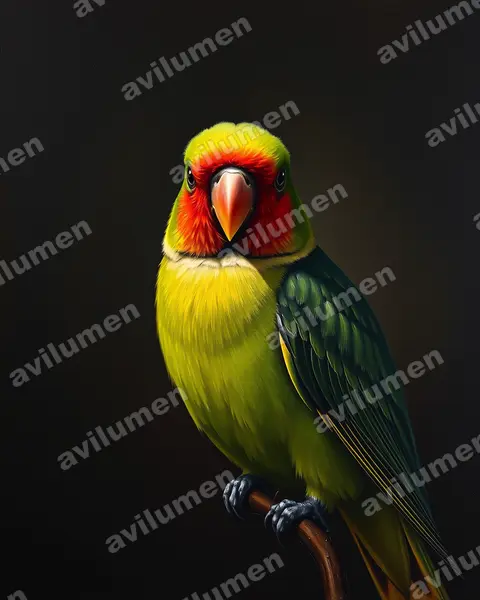
Oil 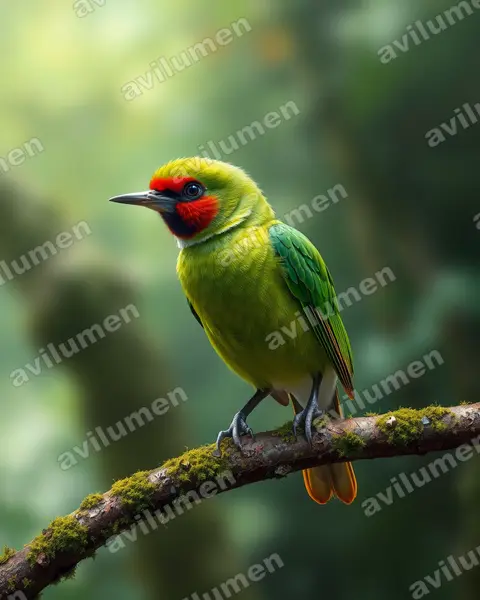
Realistic 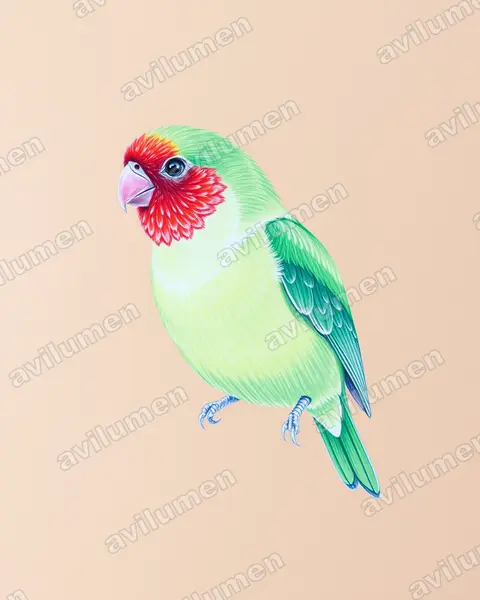
Colored pencil
Digital editions
HD Digital Art Pack — Red-faced lovebird
Digital download: 6 high-resolution illustrations of the Red-faced lovebird (Agapornis pullarius), print-ready. This is a digital file; no animal or physical item is included.
AI Avatar — Red-faced lovebird
Generate an avatar fusing your face with the Red-faced lovebird (Agapornis pullarius). Delivered digitally in 8K, watermark-free. Digital product; no animals are sold or brokered.
Instant download. No live birds are sold.
Frequently asked questions
- Is Agapornis pullarius (Red-faced lovebird) endangered?
- The IUCN Red List places Agapornis pullarius, commonly known as the Red-faced lovebird, in the «Least concern» category. «Least concern» means it is not currently threatened.
- Where does Agapornis pullarius (Red-faced lovebird) live?
- Agapornis pullarius (Red-faced lovebird) is found in Africa.
- What family does Agapornis pullarius (Red-faced lovebird) belong to?
- Agapornis pullarius (Red-faced lovebird) belongs to the family Psittaculidae, in the order Psittaciformes.
- What colour is Agapornis pullarius (Red-faced lovebird)?
- The plumage of Agapornis pullarius (Red-faced lovebird) combines these colours: Green and Red.
More from the same family
 Least concern
Grey-headed Lovebird
Agapornis canus
The gray-headed lovebird or Madagascar lovebird is a small species of parrot of the lovebird genus. It is a mainly green parrot. The species is sexually dimorphic and only the adult male has grey on its upper body. They are native on the island of Madagascar and are the only lovebird species which are not native on the African continent. They are the smallest of the lovebird species.
from $1.99
 Near threatened
Fischer's Lovebird
Agapornis fischeri
Fischer's lovebird is a small parrot species of the genus Agapornis. They were originally discovered in the late 19th century. They are named after the 19th century German explorer of East Africa Gustav Fischer.
from $1.99
 Near threatened
Lilian's Lovebird
Agapornis lilianae
Lilian's lovebird, also known as the Nyasa lovebird, is a small African parrot species of the lovebird genus. It is mainly green and has orange on its upper chest and head. It is 13 cm (5 inches) long and is the smallest parrot on mainland Africa. In captivity, it is uncommon and difficult to breed.
from $1.99
 Extinct
Agapornis longipes
Agapornis longipes
Agapornis longipes is an extinct species of lovebird that lived in what is now Gauteng, South Africa during the Early Pleistocene epoch, about 2.5–1.38 million years ago. The fossilized remains of this bird were first discovered in the Kromdraai fossil site and reported in 1969 by T.N. Pocock, though the species would not be named until decades later in 2024.
from $4.99