Rosy-faced Lovebird
Agapornis roseicollis
Avilumen editorial team ·

The rosy-faced lovebird, also known as the rosy-collared or peach-faced lovebird, is a species of lovebird native to the Namibian savanna woodlands. Loud and constant chirpers, these birds are very social animals and often congregate in small groups in the wild. They eat throughout the day and take frequent baths. Coloration can vary widely among populations. Plumage is identical in males and females.
The rosy-faced lovebird (Agapornis roseicollis), also known as the rosy-collared or peach-faced lovebird, is a species of lovebird native to the Namibian savanna woodlands. Loud and constant chirpers, these birds are very social animals and often congregate in small groups in the wild. They eat throughout the day and take frequent baths. Coloration can vary widely among populations. Plumage is identical in males and females. Lovebirds are renowned for their sleep position in which they sit side-by-side and turn their faces in towards each other. Also, females are well noted to tear raw materials into long strips, "twisty-tie" them onto their backs, and fly substantial distances back to make a nest. These birds are common in the pet industry.
Taxonomy
It was described by the French ornithologist Louis Pierre Vieillot in 1818. It was originally named Psittacus roseicollis but later moved to the genus Agapornis with the other lovebirds.
Two subspecies are recognised:
Agapornis roseicollis, (Vieillot, 1818)
Agapornis roseicollis catumbella, B.P. Hall, 1952 - Angola
Agapornis roseicollis roseicollis, (Vieillot 1818) - Namibia, Botswana, and South Africa
Description
The rosy-faced lovebird is a fairly small bird, 17–18 cm (6.7–7.1 in) long, with an average wing length of 106 mm (4.2 in) and tail length of 44–52 mm (1.7–2.0 in). Wild birds are mostly green with a blue rump. The face and throat are pink, darkest on the forehead and above the eye. The bill is horn-coloured, the iris is brown, and the legs and feet are grey. The pink of the A. r. roseicollis is lighter than that of the A. r. catumbella. Juvenile birds have a pale pink face and throat, a greenish fore crown and crown, and the beak has a brownish base.
Distribution and habitat
The rosy-faced lovebird inhabits dry, open country in southwest Africa. Its range extends from southwest Angola across most of Namibia to the lower Orange River valley in northwest South Africa. It lives up to 1,600 metres (5,200 ft) above sea level in broad-leaved woodland, semi-desert, and mountainous areas. It is dependent on the presence of water sources and gathers around pools to drink.
Escapes from captivity are frequent in many parts of the world and feral birds dwell in metropolitan Phoenix, Arizona, where they live in a variety of habitats, both urban and rural. Some dwell in cacti and others have been known to frequent feeders in decent-sized flocks. Temperatures in Arizona regularly exceed 40 °C (104 °F) and feral lovebirds have been observed perching in large numbers on air-conditioner vents in order to remain cool. Feral rosy-faced lovebird colonies can also be found on Maui and the Big Island in Hawaii. Although they have been observed in the wild in Puerto Rico, they are probably the result of escaped pets, and no reproduction has been recorded.
Status and conservation
Populations have been reduced in some areas by trapping for the pet trade. However, numbers may have increased in other areas due to human creation of new water sources and the building of artificial structures which provide new nesting sites. Because of this, the species is classed as Least Concern by the International Union for Conservation of Nature (IUCN).
Feeding
The diet consists mainly of seeds and berries. When food is plentiful, the birds may gather in flocks containing hundreds of individuals. They can sometimes be pests in agricultural areas, feeding on crops such as millet.
Breeding
Lovebirds are monomorphic, meaning the male and
female of the species look alike. The nest is built in a rock crevice or within a compartment of the large communal nests built by sociable weavers. Man-made structures such as the roofs of houses may also be used. A total of 4-6 eggs are laid between February and April. They are dull white and measure 23.5 by 17.3 mm (0.93 by 0.68 in). They are incubated for about 23 days. The young birds fledge after 43 days.
Self-recognition
Rosy-faced lovebirds are the first Psittacidae species to pass the mark test, which means they are able to self-recognize their image reflected in a mirror [9].
Aviculture
Rosy-faced lovebirds are one of the more common parrots kept in captivity, because of their small size and ease of care and breeding. The birds are kept alone or in pairs, although due to their social requirements, they are best kept in pairs. They can be aggressive, and tend to bond towards an individual, either human or avian, and may not get on well with other people or pets. Two lovebirds may not always get along, and may have to be separated, and lovebirds should not be kept with smaller species of birds. Lovebirds require daily exercise.
Mutations
Rosy-faced lovebirds have the widest range of colour mutations of all the Agapornis genus. Generally speaking, these mutations fall into the genetic categories of dominant, codominant, recessive, and sex-linked recessive. While this seems fairly straightforward, it can quickly become confusing when a single specimen has multiple examples of these mutational traits.
General references
"Species factsheet: Agapornis roseicollis". BirdLife International (2008). Retrieved 9 July 2008.
Burt, D.W.; White, S.J. (July 2007). "Avian Genomics in the 21st Century". Cytogenetic and Genome Research. 117 (1–4: Avian Genomics in Evolution, Agriculture and Health): 6–13. doi:10.1159/000103159. ISBN 978-3-8055-8338-1. PMID 17675839. S2CID 23593471.{{cite journal}}: CS1 maint: periodical has ISBN (link)
Rosy-faced Lovebird Bird Observations, Jan–Dec, 2003–2011, eBird.org
Luft, Stefan (2007). Parrots of Africa (1st ed.). Norderstedt, Germany: Books On Demand. ISBN 978-3-8334-8445-2. OCLC 176931136.
Text adapted from Wikipedia · CC BY-SA 4.0
Distribution

Taxonomy
- Order
- Psittaciformes
- Family
- Psittaculidae
- Genus
- Agapornis
- Conservation status
- Least concern
Listen to its call
No recording yet
Rosy-faced Lovebird on video
Metraje: Envato Elements (licencia comercial)
Care guide
Lovebird Care Guide: Diet, Housing and Breeding
How to care for lovebirds: diet, cage size, whether they need a mate, health, breeding, color mutations and legal status. A practical guide for owners.
Read the guide →Illustration gallery
6 illustrations of Agapornis roseicollis (Rosy-faced Lovebird) in different styles, true to its real plumage. Shown watermarked; the art pack includes the high-resolution originals, ready to print.
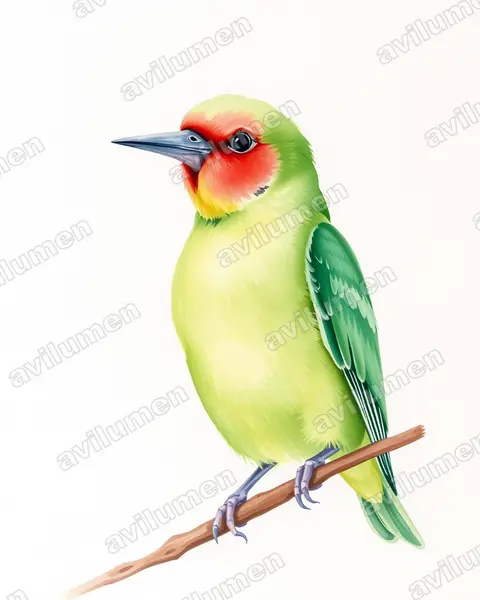
Watercolor 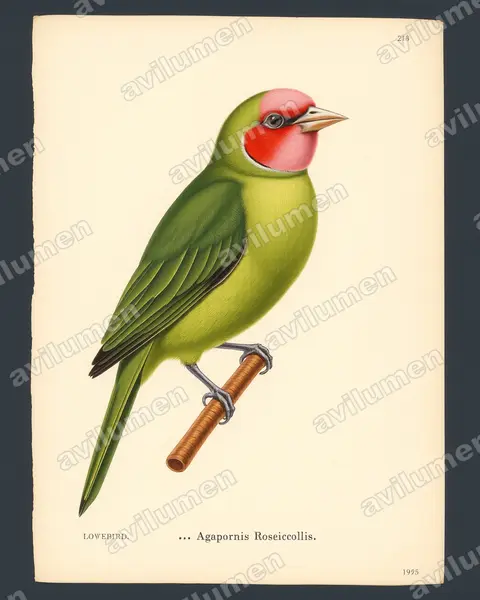
Vintage plate 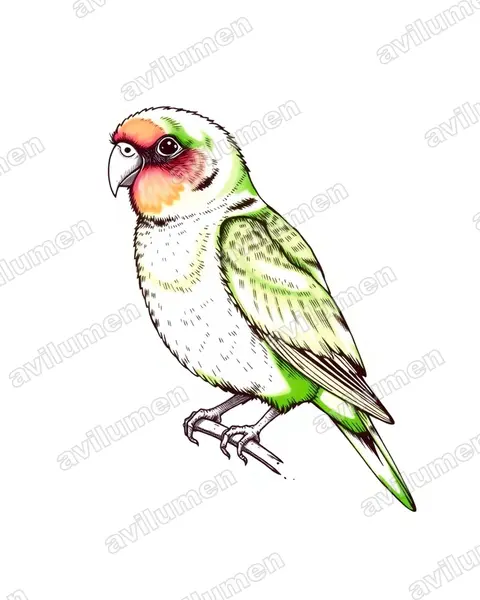
Ink 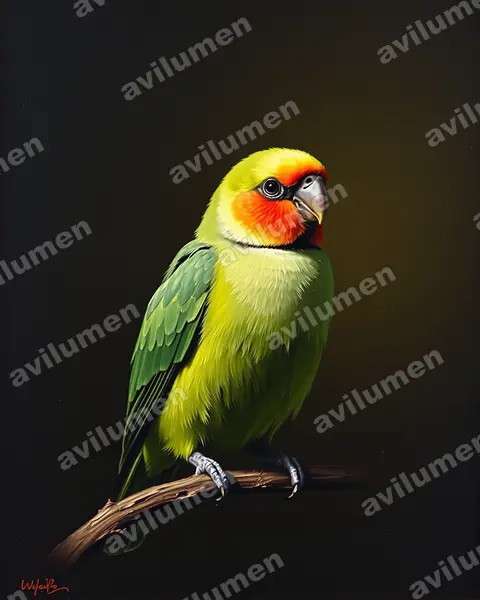
Oil 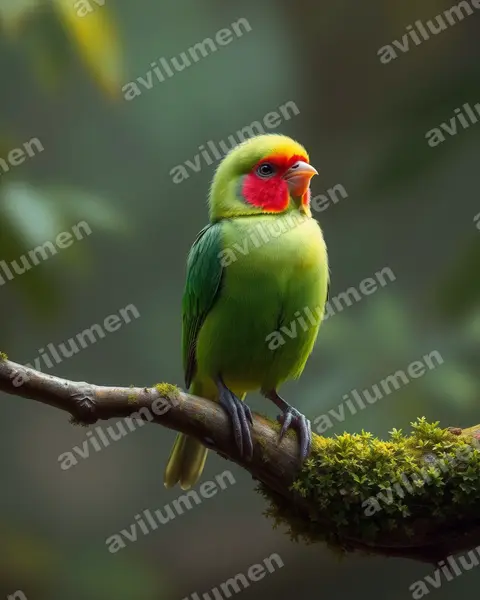
Realistic 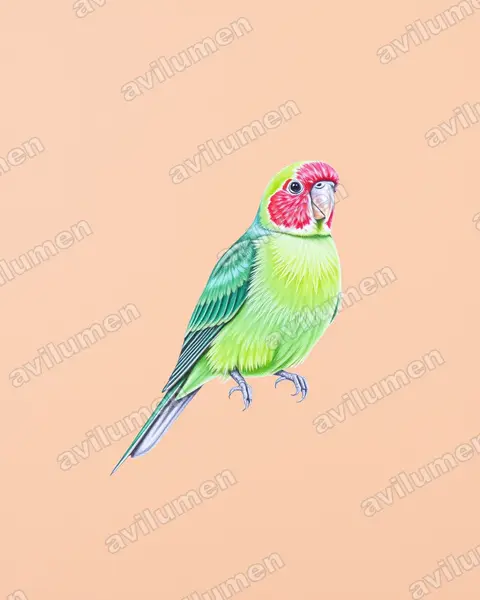
Colored pencil
Digital editions
HD Digital Art Pack — Rosy-faced Lovebird
Digital download: 6 high-resolution illustrations of the Rosy-faced Lovebird (Agapornis roseicollis), print-ready. This is a digital file; no animal or physical item is included.
AI Avatar — Rosy-faced Lovebird
Generate an avatar fusing your face with the Rosy-faced Lovebird (Agapornis roseicollis). Delivered digitally in 8K, watermark-free. Digital product; no animals are sold or brokered.
Instant download. No live birds are sold.
Frequently asked questions
- Is Agapornis roseicollis (Rosy-faced Lovebird) endangered?
- The IUCN Red List places Agapornis roseicollis, commonly known as the Rosy-faced Lovebird, in the «Least concern» category. «Least concern» means it is not currently threatened.
- Where does Agapornis roseicollis (Rosy-faced Lovebird) live?
- Agapornis roseicollis (Rosy-faced Lovebird) is found in Africa.
- What family does Agapornis roseicollis (Rosy-faced Lovebird) belong to?
- Agapornis roseicollis (Rosy-faced Lovebird) belongs to the family Psittaculidae, in the order Psittaciformes.
- What colour is Agapornis roseicollis (Rosy-faced Lovebird)?
- The plumage of Agapornis roseicollis (Rosy-faced Lovebird) combines these colours: Green and Pink.
More from the same family
 Least concern
Grey-headed Lovebird
Agapornis canus
The gray-headed lovebird or Madagascar lovebird is a small species of parrot of the lovebird genus. It is a mainly green parrot. The species is sexually dimorphic and only the adult male has grey on its upper body. They are native on the island of Madagascar and are the only lovebird species which are not native on the African continent. They are the smallest of the lovebird species.
from $1.99
 Near threatened
Fischer's Lovebird
Agapornis fischeri
Fischer's lovebird is a small parrot species of the genus Agapornis. They were originally discovered in the late 19th century. They are named after the 19th century German explorer of East Africa Gustav Fischer.
from $1.99
 Near threatened
Lilian's Lovebird
Agapornis lilianae
Lilian's lovebird, also known as the Nyasa lovebird, is a small African parrot species of the lovebird genus. It is mainly green and has orange on its upper chest and head. It is 13 cm (5 inches) long and is the smallest parrot on mainland Africa. In captivity, it is uncommon and difficult to breed.
from $1.99
 Extinct
Agapornis longipes
Agapornis longipes
Agapornis longipes is an extinct species of lovebird that lived in what is now Gauteng, South Africa during the Early Pleistocene epoch, about 2.5–1.38 million years ago. The fossilized remains of this bird were first discovered in the Kromdraai fossil site and reported in 1969 by T.N. Pocock, though the species would not be named until decades later in 2024.
from $4.99