Black-winged Lovebird
Agapornis taranta
Avilumen editorial team ·

The black-winged lovebird also known as Abyssinian lovebird is a mainly green bird of the parrot family. At about 16.5 cm (6.5 inches) long, it is the largest of the lovebird genus, a group of small parrots. The adult male is easily identified by its red forehead, and the adult female by its all-green head. They are native to Eritrea and Ethiopia, and they are uncommon as pets.
The black-winged lovebird (Agapornis taranta) also known as Abyssinian lovebird is a mainly green bird of the parrot family. At about 16.5 cm (6.5 inches) long, it is the largest of the lovebird genus, a group of small parrots. The adult male is easily identified by its red forehead, and the adult female by its all-green head. They are native to Eritrea and Ethiopia, and they are uncommon as pets.
Description
The black-winged lovebird, with a length of about 16–16.5 cm (6.3–6.5 inches), is the largest species of lovebird. It is sexually dimorphic, as are the red-headed lovebird and grey-headed lovebird. The dimorphism becomes apparent in juvenile birds after their first molt at about eight or nine months of age. Both the male and female black-winged lovebird are mostly green, and only the adult male black-winged lovebird has a red forehead and a ring of red feathers around its eyes.
The tail is black tipped and feathers below the tail show a yellowish colour. The rump and feathers above the tail are light green. In the male, feathers under the wing are typically black, and in the female the feathers under the wing are typically greenish or brownish black. Both sexes have a red beak and gray feet.
Habitat
The natural distribution for the black-winged lovebird is typically from southern Eritrea to southwestern Ethiopia, and they normally live in either high plains or mountainous regions.
Food and feeding
Sunflower seeds, corn, apples and mission figs are typical of an Abyssinian lovebird diet.
Breeding
The black-winged lovebird nests in a tree cavity. The eggs are white and there are usually three or four eggs in a clutch. The female incubates the eggs for 23 days, and the chicks fledge from the nest about 45 days after hatching.
Black-winged lovebirds reproduce from March to November; nesting takes place in tree hollows, crevices in walls, and potentially in weavers' nests. The nests are furnished with a combination of plant debris and feathers.
Status
Widespread and common throughout its range, the black-winged lovebird is evaluated as Least Concern on the IUCN Red List of Threatened Species.
Aviculture
In aviculture the black-winged lovebird has not become well established as a breeding bird, although it can tolerate cold weather. Breeding in aviculture is on a small scale, so it is an uncommon pet.
Taxonomy
A holotype of Psittacus taranta Stanley (Salt's Voy. to Abyssinia, 1814, App IV, p.lii(=52)), an adult male, is held in the vertebrate zoology collection of National Museums Liverpool at World Museum, with accession number NML-VZ D704. The specimen was collected in Taranta Pass, Acchele Guzai District, Eritrea in 1809-10 by Henry Salt. The specimen came to the Liverpool national collection via the 13th Earl of Derby's collection, which was bequeathed to the people of Liverpool in 1851.
Text adapted from Wikipedia · CC BY-SA 4.0
Taxonomy
- Order
- Psittaciformes
- Family
- Psittaculidae
- Genus
- Agapornis
- Conservation status
- Least concern
Listen to its call
No recording yet
Care guide
Lovebird Care Guide: Diet, Housing and Breeding
How to care for lovebirds: diet, cage size, whether they need a mate, health, breeding, color mutations and legal status. A practical guide for owners.
Read the guide →Illustration gallery
6 illustrations of Agapornis taranta (Black-winged Lovebird) in different styles, true to its real plumage. Shown watermarked; the art pack includes the high-resolution originals, ready to print.
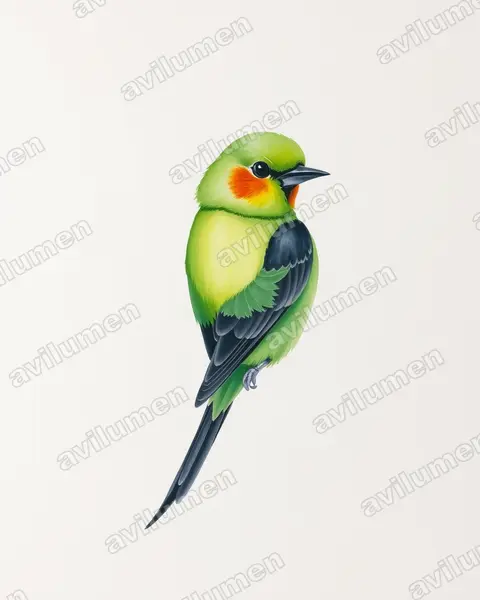
Watercolor 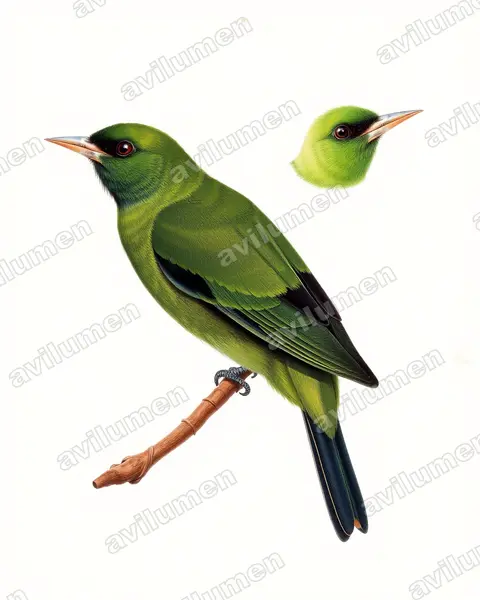
Vintage plate 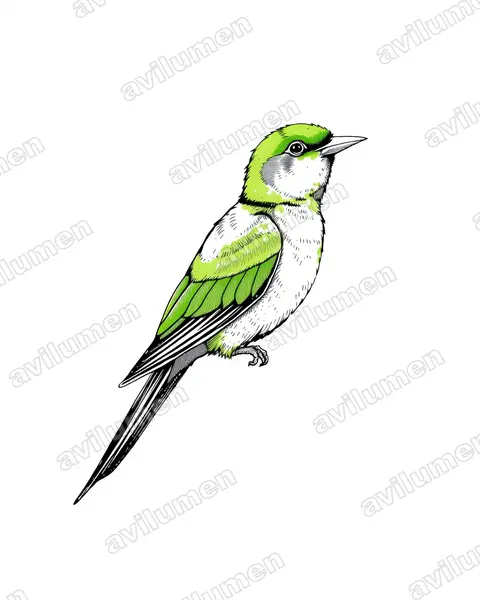
Ink 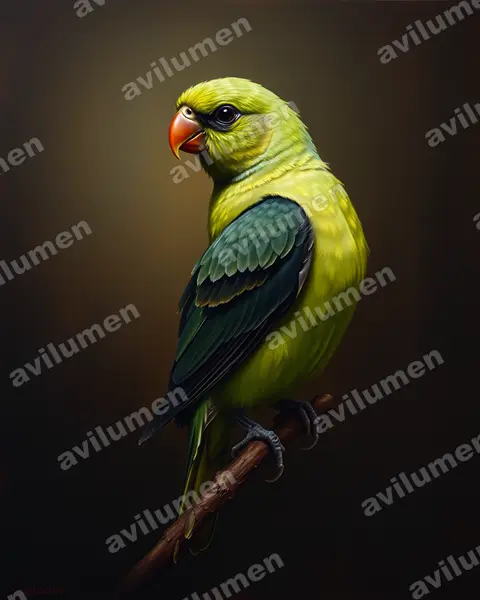
Oil 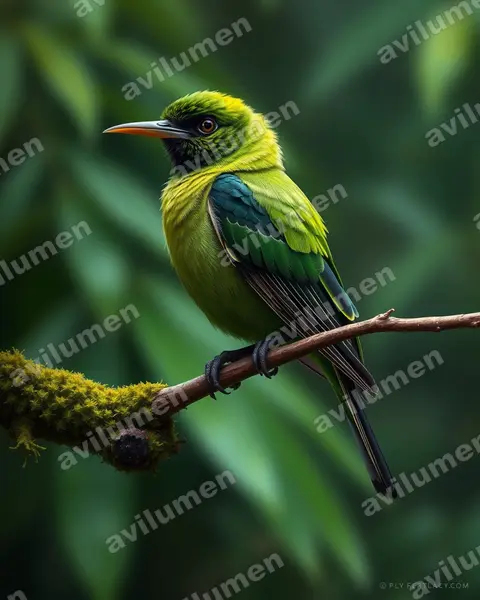
Realistic 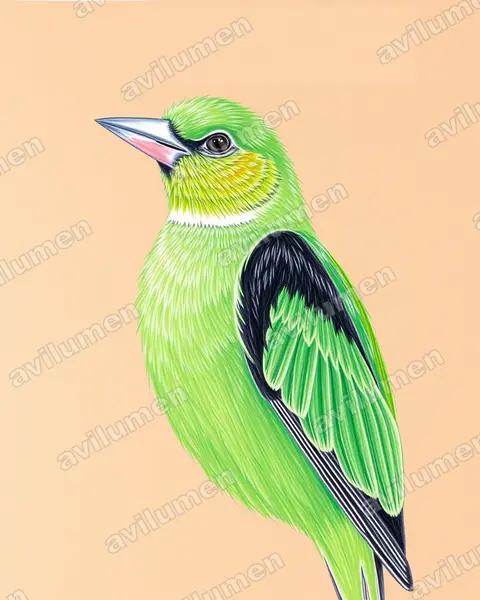
Colored pencil
Digital editions
HD Digital Art Pack — Black-winged Lovebird
Digital download: 6 high-resolution illustrations of the Black-winged Lovebird (Agapornis taranta), print-ready. This is a digital file; no animal or physical item is included.
AI Avatar — Black-winged Lovebird
Generate an avatar fusing your face with the Black-winged Lovebird (Agapornis taranta). Delivered digitally in 8K, watermark-free. Digital product; no animals are sold or brokered.
Instant download. No live birds are sold.
Frequently asked questions
- Is Agapornis taranta (Black-winged Lovebird) endangered?
- The IUCN Red List places Agapornis taranta, commonly known as the Black-winged Lovebird, in the «Least concern» category. «Least concern» means it is not currently threatened.
- Where does Agapornis taranta (Black-winged Lovebird) live?
- Agapornis taranta (Black-winged Lovebird) is found in Africa.
- What family does Agapornis taranta (Black-winged Lovebird) belong to?
- Agapornis taranta (Black-winged Lovebird) belongs to the family Psittaculidae, in the order Psittaciformes.
- What colour is Agapornis taranta (Black-winged Lovebird)?
- The plumage of Agapornis taranta (Black-winged Lovebird) combines these colours: Green and Red.
More from the same family
 Least concern
Grey-headed Lovebird
Agapornis canus
The gray-headed lovebird or Madagascar lovebird is a small species of parrot of the lovebird genus. It is a mainly green parrot. The species is sexually dimorphic and only the adult male has grey on its upper body. They are native on the island of Madagascar and are the only lovebird species which are not native on the African continent. They are the smallest of the lovebird species.
from $1.99
 Near threatened
Fischer's Lovebird
Agapornis fischeri
Fischer's lovebird is a small parrot species of the genus Agapornis. They were originally discovered in the late 19th century. They are named after the 19th century German explorer of East Africa Gustav Fischer.
from $1.99
 Near threatened
Lilian's Lovebird
Agapornis lilianae
Lilian's lovebird, also known as the Nyasa lovebird, is a small African parrot species of the lovebird genus. It is mainly green and has orange on its upper chest and head. It is 13 cm (5 inches) long and is the smallest parrot on mainland Africa. In captivity, it is uncommon and difficult to breed.
from $1.99
 Extinct
Agapornis longipes
Agapornis longipes
Agapornis longipes is an extinct species of lovebird that lived in what is now Gauteng, South Africa during the Early Pleistocene epoch, about 2.5–1.38 million years ago. The fossilized remains of this bird were first discovered in the Kromdraai fossil site and reported in 1969 by T.N. Pocock, though the species would not be named until decades later in 2024.
from $4.99