Blue-eared kingfisher
Alcedo meninting
Avilumen editorial team ·

The blue-eared kingfisher is found in Asia, ranging across the Indian subcontinent and Southeast Asia. It is found mainly in dense shaded forests where it hunts in small streams. It is darker crowned, with darker rufous underparts and lacking the rufous ear stripe of the common kingfisher which is found in more open habitats. A number of subspecies have been described that differ in measurement and colour shade.
The blue-eared kingfisher (Alcedo meninting) is found in Asia, ranging across the Indian subcontinent and Southeast Asia. It is found mainly in dense shaded forests where it hunts in small streams. It is darker crowned, with darker rufous underparts and lacking the rufous ear stripe of the common kingfisher (Alcedo atthis) which is found in more open habitats. A number of subspecies have been described that differ in measurement and colour shade. Adult males have an all dark bill while females have a reddish lower mandible.
Taxonomy
The blue-eared kingfisher was described by the American naturalist Thomas Horsfield in 1821 and given its current binomial name Alcedo meninting. The name Alcedo is the Latin word for a "kingfisher". The specific epithet meninting is the Javanese word for the species. The blue-eared kingfisher is one of seven species in the genus Alcedo and is most closely related to Blyth's kingfisher (Alcedo hercules).
Several plumage variations in the population that occur across its wide distribution range have been recognized as subspecies:
A. m. coltarti Baker ECS, 1919 – Nepal, northeast India, northern Thailand and Indochina
A. m. phillipsi Baker ECS, 1927 – southwest India and Sri Lanka
A. m. scintillans Baker ECS, 1919 – southern Myanmar and Thailand
A. m. rufigastra Walden, 1873 – Andaman Islands
A. m. meninting Horsfield, 1821 – southern Malay Peninsula, Borneo, southern Philippines, Islands off the west coast of Sumatra, Java, Lombok, Sulawesi, Banggai and Sula Islands.
Some other subspecies such as verreauxii, callima, subviridis and proxima are not considered to be sufficiently distinct.
Description
This 16 centimetres (6.3 in) long kingfisher is almost identical to the common kingfisher (Alcedo atthis) but is distinguished by the blue ear coverts, darker and more intense cobalt-blue upperparts with richer rufous under parts. The juvenile blue-eared kingfisher has rufous ear-coverts as in the common kingfisher but it usually shows some mottling on the throat and upper breast which disappears when the bird reaches adulthood. Young birds have a reddish bill with whitish tips.
Distribution and habitat
The range of this species stretches from India in the west, eastwards across Nepal, Bhutan and Bangladesh, and further into Myanmar, Thailand, Cambodia, Vietnam and Malaysia. The usual habitat is pools or streams in dense evergreen forest and sometimes mangroves, situated under 1,000 metres (3,300 ft) of altitude.
Behaviour and ecology
The blue-eared kingfisher is largely resident within its range. They usually perch on branches overhanging densely shaded streams before diving below to capture prey that includes crustaceans, dragonfly larvae and fish. Other insects including grasshoppers and mantids have been recorded.
The breeding season in India is mainly May to June in northern India and January in southwestern India. The nest is a metre long tunnel in the bank of a forest stream where about five to seven white near spherical eggs are laid.
Text adapted from Wikipedia · CC BY-SA 4.0
Taxonomy
- Order
- Coraciiformes
- Family
- Alcedinidae
- Genus
- Alcedo
- Conservation status
- Least concern
Listen to its call
No recording yet
Illustration gallery
6 illustrations of Alcedo meninting (Blue-eared kingfisher) in different styles, true to its real plumage. Shown watermarked; the art pack includes the high-resolution originals, ready to print.

Watercolor 
Vintage plate 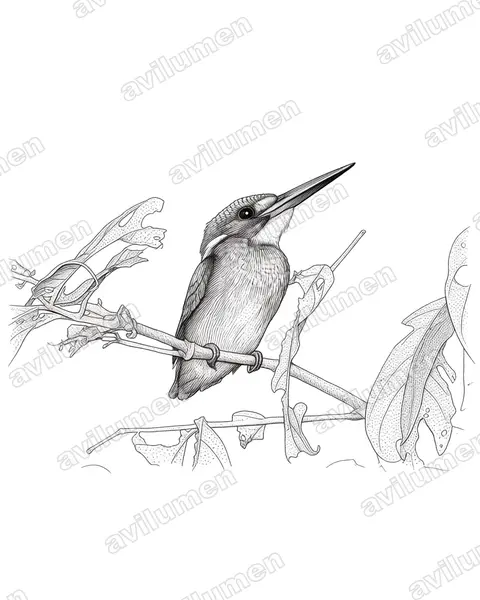
Ink 
Oil 
Realistic 
Colored pencil
Illustrations based on the photograph by Bernard DUPONT from FRANCE (CC BY-SA 2.0), from Wikimedia Commons.
Digital editions
HD Digital Art Pack — Blue-eared kingfisher
Digital download: 6 high-resolution illustrations of the Blue-eared kingfisher (Alcedo meninting), print-ready. This is a digital file; no animal or physical item is included.
AI Avatar — Blue-eared kingfisher
Generate an avatar fusing your face with the Blue-eared kingfisher (Alcedo meninting). Delivered digitally in 8K, watermark-free. Digital product; no animals are sold or brokered.
Instant download. No live birds are sold.
Frequently asked questions
- Is Alcedo meninting (Blue-eared kingfisher) endangered?
- The IUCN Red List places Alcedo meninting, commonly known as the Blue-eared kingfisher, in the «Least concern» category. «Least concern» means it is not currently threatened.
- Where does Alcedo meninting (Blue-eared kingfisher) live?
- Alcedo meninting (Blue-eared kingfisher) is found in Indonesia.
- What family does Alcedo meninting (Blue-eared kingfisher) belong to?
- Alcedo meninting (Blue-eared kingfisher) belongs to the family Alcedinidae, in the order Coraciiformes.
- What colour is Alcedo meninting (Blue-eared kingfisher)?
- The plumage of Alcedo meninting (Blue-eared kingfisher) combines these colours: Blue and Brown.
More from the same family
 Least concern
Moustached Kingfisher
Actenoides bougainvillei
The moustached kingfisher, also called Bougainville moustached kingfisher, is a species of bird in the family Alcedinidae. It is endemic to Bougainville Island in Papua New Guinea. An estimated 1,300–7,000 mature individuals are left.
from $1.99
 Near threatened
Rufous-collared Kingfisher
Actenoides concretus
The rufous-collared kingfisher is a species of bird in the family Alcedinidae. It is found in Brunei, Indonesia, Malaysia, Myanmar, and Thailand. Its natural habitats are subtropical or tropical moist lowland forest and subtropical or tropical moist montane forest. It is threatened by habitat loss.
from $1.99
 Least concern
Hombron's Kingfisher
Actenoides hombroni
The blue-capped kingfisher, also known as Hombron's kingfisher, is a species of bird in the family Alcedinidae endemic to the Philippines and found only on Mindanao. It is one of the most colorful kingfishers in the country having a dark blue cap and wings with rufous spots, a striped rufous belly, white chin and red bill.
from $1.99
 Least concern
Spotted Wood Kingfisher
Actenoides lindsayi
The spotted wood kingfisher or spotted kingfisher is a species of bird in the family Alcedinidae. It is endemic to the Philippines found on the islands of Luzon, Catanduanes, Marinduque, Negros and Panay where its natural habitat is tropical moist lowland forests.
from $1.99