Green avadavat
Amandava formosa
Avilumen editorial team ·

The green avadavat or green munia is a species of Estrildid finch with green and yellow on the body, a bright red bill and black "zebra stripes" on the flanks. They are endemic to the Indian subcontinent and were formerly popular as cagebirds. The name "avadavat" is a corruption of the name the city of Ahmedabad in Gujarat, India, which was a centre of bird trade.
The green avadavat or green munia (Amandava formosa) is a species of Estrildid finch with green and yellow on the body, a bright red bill and black "zebra stripes" on the flanks. They are endemic to the Indian subcontinent and were formerly popular as cagebirds. The name "avadavat" is a corruption of the name the city of Ahmedabad in Gujarat, India, which was a centre of bird trade. They have a restricted distribution and populations are threatened by the bird trade.
Description
The green avadavat is approximately 10 cm long with green above, yellow below, black and white bars on the flank and reddish bill. Both sexes have pale tips to wing-coverts and tertials. The upper plumage is olive green. The upper tail coverts are more yellow and the tail is black and rounded with broad feathers. The chin is pale yellow and the lower breast, belly and vent are brighter yellow. The flanks are barred with brown and white. The bill is waxy red and the legs are pale fleshy or brown. The female is slightly paler than the male. Young birds are duller with a black bill and lack the barring on the flanks.
Distribution
This species is found mainly in the dry scrub regions and agricultural lands and is often found close to water. The largest populations are in central and north-western India. A population of escaped birds once existed near Lahore. The key areas where they are well known are in central India, around southern Rajasthan specifically around Oriya village, central Uttar Pradesh, southern Bihar and West Bengal extending south to southern Maharashtra and northern Andhra Pradesh. Some records are from further south from Wynaad in northern Kerala but it is unclear if these are wild populations.
Behaviour and ecology
They breed in central India from October to January but are also known to breed in July. The nest is made out of broad leaves of grass or sugarcane and is spherical with an entrance on the side. The adaptability for altered habitats is a positive side of its natural survival. Several nests may be built in the vicinity by pairs that form a loose colony. They forage in small groups especially in the non-breeding season. The clutch is four to six eggs.
Its voice song is high-pitched warble, ending with prolonged trill with weak seee and swee notes not unlike that of Turdoides subrufus.
Conservation and community protection
The green avadavat has been a popular cage bird and has been in the bird trade since the late 19th century. It continues to be common in some areas such as Oriya village, Achalgarh and Guru Shikhar in Mount Abu, Rajasthan, but has declined mainly due to trapping. In trade the bird is called the green waxbill. Entire flocks are easily trapped using bait and decoy birds. Awareness and protection of habitats at Mt Abu have helped the continued existence of some populations. The bird has been considered a mascot for the district by the Rajasthan forest department. A 2020 study identified habitat loss as a major threat to the birds.
Text adapted from Wikipedia · CC BY-SA 4.0
Taxonomy
- Order
- Passeriformes
- Family
- Estrildidae
- Genus
- Amandava
- Conservation status
- Vulnerable
Listen to its call
No recording yet
Care guide
Canary and Finch Care Guide: Diet, Housing and Breeding
How to care for canaries, zebra finches, Gouldian finches and other finches: diet, flight cage setup, health, song and breeding. A guide for bird keepers.
Read the guide →Illustration gallery
6 illustrations of Amandava formosa (Green avadavat) in different styles, true to its real plumage. Shown watermarked; the art pack includes the high-resolution originals, ready to print.
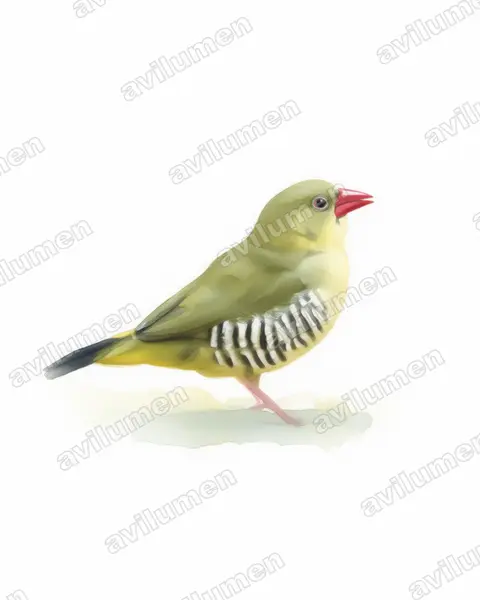
Watercolor 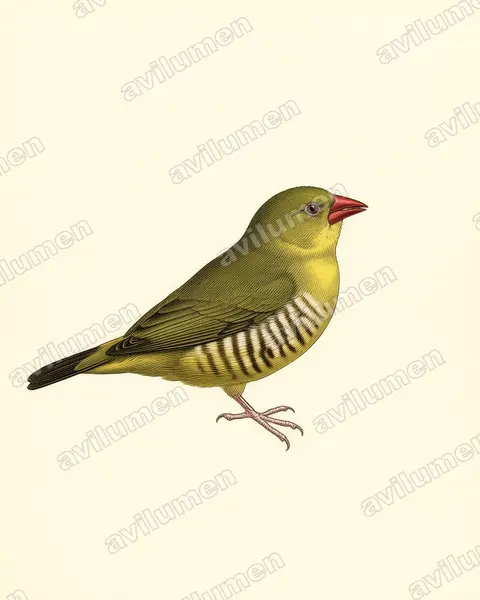
Vintage plate 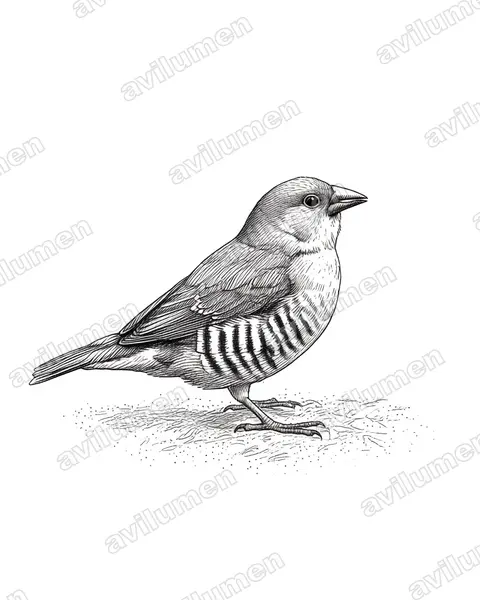
Ink 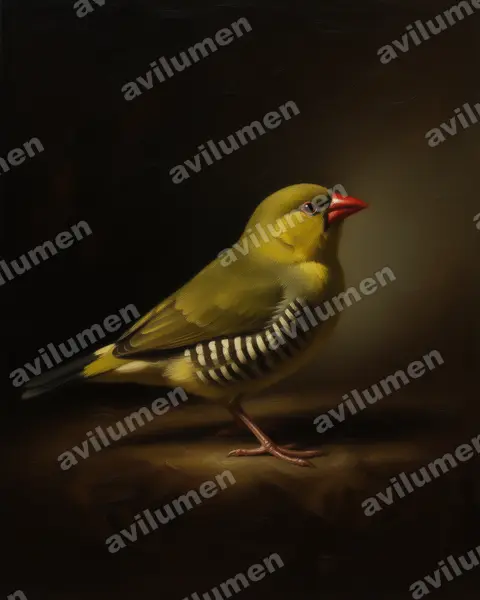
Oil 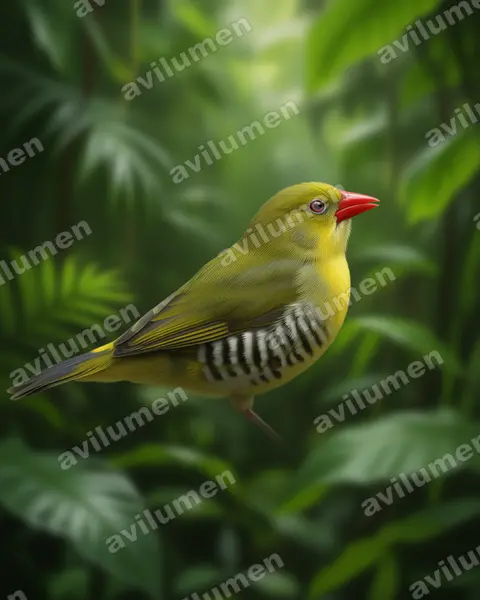
Realistic 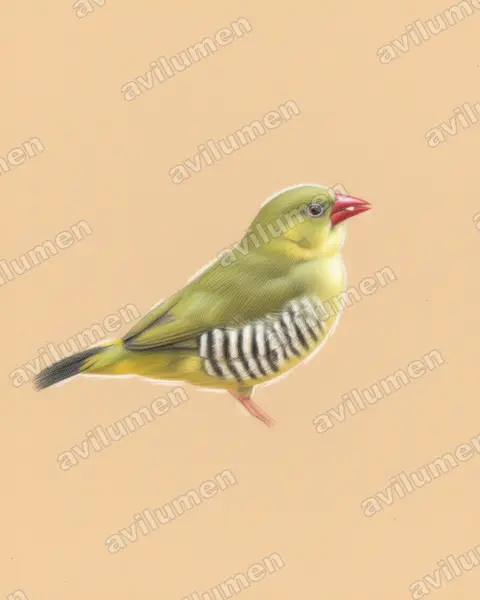
Colored pencil
Illustrations based on the photograph by Pkspks (CC BY-SA 3.0), from Wikimedia Commons.
Digital editions
HD Digital Art Pack — Green avadavat
Digital download: 6 high-resolution illustrations of the Green avadavat (Amandava formosa), print-ready. This is a digital file; no animal or physical item is included.
AI Avatar — Green avadavat
Generate an avatar fusing your face with the Green avadavat (Amandava formosa). Delivered digitally in 8K, watermark-free. Digital product; no animals are sold or brokered.
Instant download. No live birds are sold.
Frequently asked questions
- Is Amandava formosa (Green avadavat) endangered?
- The IUCN Red List places Amandava formosa, commonly known as the Green avadavat, in the «Vulnerable» category. «Vulnerable» means it faces a high risk of extinction in the medium term.
- Where does Amandava formosa (Green avadavat) live?
- Amandava formosa (Green avadavat) is found in India.
- What family does Amandava formosa (Green avadavat) belong to?
- Amandava formosa (Green avadavat) belongs to the family Estrildidae, in the order Passeriformes.
- What colour is Amandava formosa (Green avadavat)?
- The plumage of Amandava formosa (Green avadavat) combines these colours: Green and Yellow.
More from the same family
 Least concern
Red-headed finch
Amadina erythrocephala
The red-headed finch is a common species of estrildid finch found in Africa. It has an estimated global extent of occurrence of 1,600,000 km2 (620,000 sq mi). It is found in Angola, Botswana, Lesotho, Namibia, South Africa and Zimbabwe.
from $1.99
 Least concern
Cut-throat finch
Amadina fasciata
The cut-throat finch is a common species of estrildid finch found throughout Africa; it is also known as the bearded finch, the ribbon finch, the cut throat, and the weaver finch.
from $1.99
 Least concern
Red avadavat
Amandava amandava
The red avadavat, red munia or strawberry finch, is a sparrow-sized bird of the family Estrildidae. It is found in the open fields and grasslands of tropical Asia and is popular as a cage bird due to the colourful plumage of the males in their breeding season. It breeds in the Indian subcontinent in the monsoon season.
from $1.99
 Least concern
Orange-breasted waxbill
Amandava subflava
The orange-breasted waxbill, also known as the zebra waxbill, is a small sparrow-like bird with a reddish iris, orange breast, red bill and dark olive-green plumage. The male has a red rump, dark bars on the whitish flank and a scarlet eyebrow stripe. The female is duller and smaller than male; it also lacks the male's red eyebrow.
from $1.99