Cinnamon hummingbird
Amazilia rutila
Avilumen editorial team ·

The cinnamon hummingbird is a species of hummingbird in the tribe of the 'emeralds', Trochilini. Currently, four regional subspecies are recognized.
The cinnamon hummingbird (Amazilia rutila) is a species of hummingbird (named for its brilliant brown gold color) in the tribe of the 'emeralds', Trochilini (subfamily Trochilinae). Currently, four regional subspecies are recognized.
Cinnamon hummingbirds are typically found at or just slightly above sea level, often inhabiting coastal and lowland areas, as well as further inland in warmer locations in the southern parts of their range. They are predominantly found along the Pacific western coast of México and south through Guatemala, El Salvador, Honduras, Nicaragua and Costa Rica. They are also found in Belize and the southern Mexican states of Campeche, Quintana Roo and Yucatán.
Taxonomy
The cinnamon hummingbird was formally described in 1842 by French naturalist René Lesson after a specimen he had collected near Acapulco, Guerrero, in southwestern Mexico. Lesson placed the new species in the genus Ornismya and coined the binomial name Ornismya cinnamomea. Unfortunately, the specific epithet was already in-use, as Paul Gervais had previously used O. cinnamomeus for a separate species of hummingbird described in 1835. In 1843, French ornithologist Adolphe Delattre introduced O. rutila as a new name for Lesson's hummingbird.
Today, the cinnamon hummingbird is placed in the genus Amazilia, first introduced by Lesson in 1843. The generic name comes from an Inca heroine in Jean-François Marmontel's novel Les Incas, ou la destruction de l'Empire du Pérou ("The Incas, or the destruction of the Peruvian Empire"). The specific epithet rutila is from the Latin rutilus, meaning "golden", "red" or "auburn".
Four subspecies are recognised:
Amazilia rutila diluta (Van Rossem, 1938)
Amazilia rutila graysoni (Lawrence, 1867)—Islas Marías, Mexico
Amazilia rutila rutila (DeLattre, 1843)—Western coastal Mexico
Amazilia rutila corallirostris (Bourcier & Mulsant, 1846)—Honduras and Nicaragua
It has been suggested that graysoni be treated as a separate species, due to its restricted and isolated range on the Islas Marías. Additionally, it has been debated as to whether or not diluta should be included with rutila, as the two subspecies intergrade.
Description
The cinnamon hummingbird is 9.5 to 11.5 cm (3.7 to 4.5 in) long and on average weighs about 5 to 5.5 g (0.18 to 0.19 oz). Adults of the nominate subspecies A. r. rutila have metallic bronze green upperparts and cinnamon to cinnamon rufous underparts that are paler on the chin and upper throat. The tail is deep cinnamon rufous to rufous chestnut; the feathers have dark metallic bronze tips and the outermost have dark metallic bronze outer edges. The wings are a dark brownish slate. Males' bills are red with a black tip and females' mostly black with red at the base. Juveniles are similar to adults but have rufous edges to the face, crown, and rump feathers and an all black bill.
The song is "varied, high, thin, slightly squeaky chips, si ch chi-chit or tsi si si-si-sit, or chi chi-chi chi chi, etc." Its call has been described as "a buzzy, scratchy tzip" and "a hard to sharp chik".
Amazilia rutila diluta is similar to the nominate, with slightly less intense green upperparts and paler and pinker underparts. A. r. corallirostris is also similar to the nominate but overall its colors are richer and deeper. A. r. graysoni is significantly larger and darker than the nominate but otherwise similar.
Distribution and habitat
The cinnamon hummingbird is resident throughout its range. The subspecies of cinnamon hummingbird are found in the following regions:
Amazilia rutila diluta — NW Mexican states of Sinaloa and Nayarit.
A. rutila graysoni — María Madre and Cleopha Islands, part of the Islas Tres Marías archipelago off the coast of Western Mexico.
A. r. rutila — Jalisco, Colima, Guerrero, Michoacán and Oaxaca in Mexico; El Salvador, W. Honduras, Nicaragua and Costa Rica.
A. rutila corallirostris — Chiapas in S. Mexico through to El Salvador.
The populations in Mexico's Yucatán Peninsula, as well as N.E. Honduras, Nicaragua, and Costa Rica, are often attributed to A. r. rutila but have sometimes been considered part of A. r. corallirostris.
The cinnamon hummingbird inhabits primary and secondary deciduous and semi-deciduous forests and thorn forest. It ranges from sea level to about 1,600 m (5,200 ft) of elevation.
Feeding
The cinnamon hummingbird usually forages from the understory to the mid-story, but also will visit taller flowering trees. It feeds on nectar from a very wide variety of flowering plants and also eats insects. It is territorial and defends feeding sites from intrusion by other hummingbirds, bees, and butterflies.
Breeding
The cinnamon hummingbird's breeding season varies throughout its range; every month is represented somewhere. Its nest is a cup made of plant material and spider web placed on a horizontal branch. Three nests in western Mexico had a small platform of wood pieces under the cup. The cup was made of kapok seed fibers with grass, bits of wood, and lichens on the outside. All three were in semi-deciduous forest. The clutch size is two eggs, but little more is known about the species' breeding phenology.
Status
The IUCN has assessed the cinnamon hummingbird as being of Least Concern. It has a large range and its population is estimated to be at least 500,000 mature individuals and stable. Localized habitat destruction appears to be its only threat.
Text adapted from Wikipedia · CC BY-SA 4.0
Distribution

Taxonomy
- Order
- Apodiformes
- Family
- Trochilidae
- Genus
- Amazilia
- Conservation status
- Least concern
Listen to its call
No recording yet
Illustration gallery
6 illustrations of Amazilia rutila (Cinnamon hummingbird) in different styles, true to its real plumage. Shown watermarked; the art pack includes the high-resolution originals, ready to print.
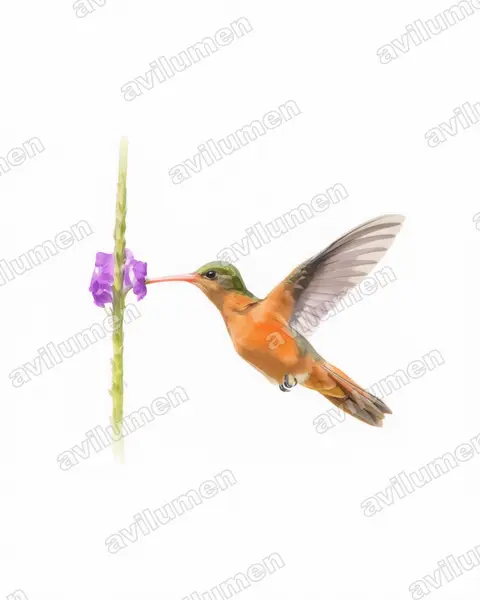
Watercolor 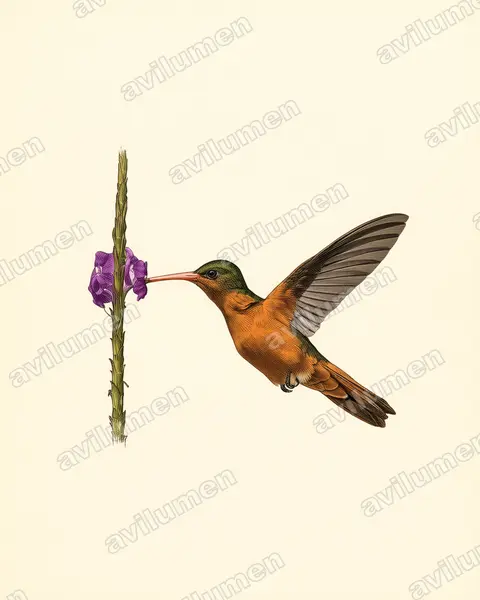
Vintage plate 
Ink 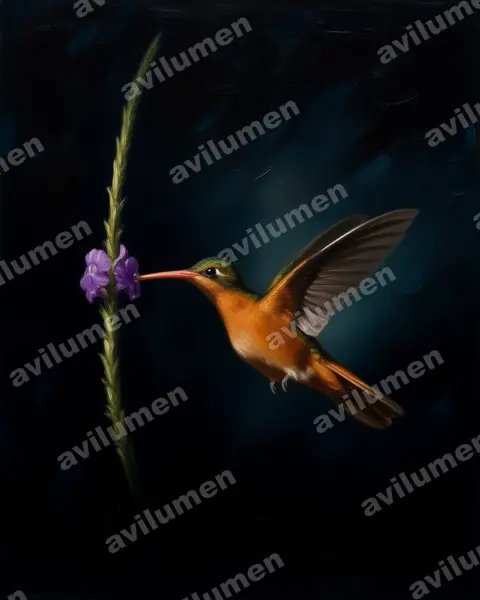
Oil 
Realistic 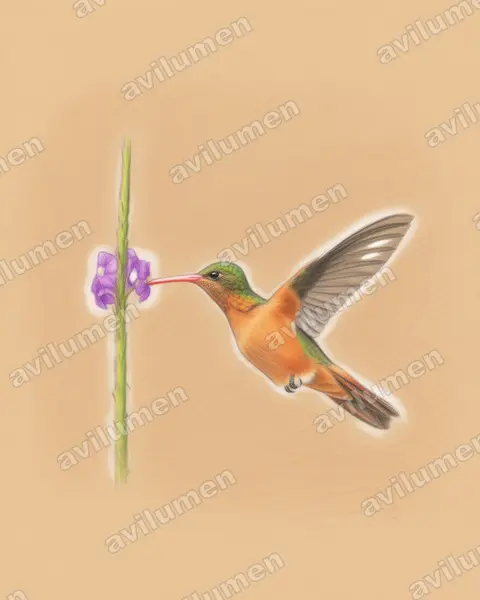
Colored pencil
Illustrations based on the photograph by Charles J. Sharp (CC BY-SA 4.0), from Wikimedia Commons.
Digital editions
HD Digital Art Pack — Cinnamon hummingbird
Digital download: 6 high-resolution illustrations of the Cinnamon hummingbird (Amazilia rutila), print-ready. This is a digital file; no animal or physical item is included.
AI Avatar — Cinnamon hummingbird
Generate an avatar fusing your face with the Cinnamon hummingbird (Amazilia rutila). Delivered digitally in 8K, watermark-free. Digital product; no animals are sold or brokered.
Instant download. No live birds are sold.
Frequently asked questions
- Is Amazilia rutila (Cinnamon hummingbird) endangered?
- The IUCN Red List places Amazilia rutila, commonly known as the Cinnamon hummingbird, in the «Least concern» category. «Least concern» means it is not currently threatened.
- What family does Amazilia rutila (Cinnamon hummingbird) belong to?
- Amazilia rutila (Cinnamon hummingbird) belongs to the family Trochilidae, in the order Apodiformes.
- What colour is Amazilia rutila (Cinnamon hummingbird)?
- The plumage of Amazilia rutila (Cinnamon hummingbird) combines these colours: Brown and Green.
More from the same family
 Least concern
Emerald-chinned Hummingbird
Abeillia abeillei
The emerald-chinned hummingbird is a species of hummingbird in the "emeralds", tribe Trochilini of subfamily Trochilinae.
from $1.99
 Least concern
Speckled hummingbird
Adelomyia melanogenys
The speckled hummingbird is a species of hummingbird. It is the only member of the genus Adelomyia. It inhabits Neotropical montane cloud forests at elevations of 1,000–2,500 meters and is confined to the Andes of Argentina, Bolivia, Peru, Ecuador, Colombia and Venezuela; as well as to some isolated montane forests in western Ecuador and Venezuela.
from $1.99
 Vulnerable
Purple-backed sunbeam
Aglaeactis aliciae
The purple-backed sunbeam is a bird species in the family Trochilidae. It is found only in Peru.
from $1.99
 Near threatened
White-tufted sunbeam
Aglaeactis castelnaudii
The white-tufted sunbeam is a species of hummingbird in the family Trochilidae. It is found only in Peru. Its natural habitats are subtropical or tropical moist montane forest and subtropical or tropical high-altitude shrubland.
from $1.99