Violet-crowned hummingbird
Amazilia violiceps
Avilumen editorial team ·

The violet-crowned hummingbird is a hummingbird in the "emeralds", tribe Trochilini of subfamily Trochilinae. It is found in Mexico and the southwestern United States.
The violet-crowned hummingbird (Ramosomyia violiceps) is a hummingbird in the "emeralds", tribe Trochilini of subfamily Trochilinae. It is found in Mexico and the southwestern United States.
Taxonomy and systematics
The violet-crowned hummingbird was formerly placed in the genus Amazilia. A molecular phylogenetic study published in 2014 found that Amazilia was polyphyletic. In the revised classification to create monophyletic genera, the violet-crowned hummingbird was one of three species moved to the resurrected genus Leucolia by some taxonomic systems. However, a study published in 2021 showed that Leucolia was not available because of the principle of priority. The authors proposed the new genus Ramosomyia and in mid-2022 it was adopted by the North American Classification Committee of the American Ornithological Society and the International Ornithological Committee. As of that date the Clements taxonomy retains the species in Leucolia and BirdLife International's Handbook of the Birds of the World in the earlier Amazilia.
The violet-crowned hummingbird has two subspecies, the nominate R. v. violiceps and R. v. ellioti.
Description
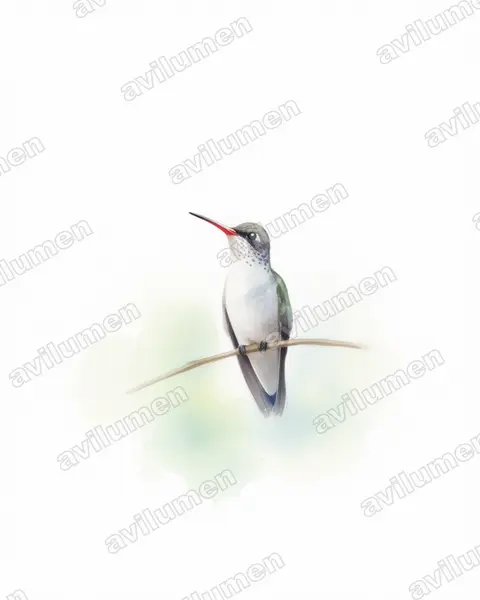
The violet-crowned hummingbird is 10 to 11.5 cm (3.9 to 4.5 in) long and weighs 5.1 to 5.8 g (0.18 to 0.20 oz). Both sexes of both subspecies have a bright red bill, sometimes with a black tip. Adult males of the nominate subspecies have an intense violet-blue crown, a bluish violet hindneck, and dull grayish brown to greenish brown back and rump. Their tail is coppery bronze. Their underside from throat to undertail coverts is pure white with light olive green flanks. Adult females are virtually identical, though in general somewhat duller overall. Males of subspecies R. v. ellioti are similar to the nominate. However, their crown is more turquoise blue and their tail greenish bronze. Females again are almost identical but duller.
Distribution and habitat
The violet-crowned hummingbird's subspecies R. v. ellioti is the more northern. It is found from southeastern Arizona and southwestern New Mexico south into Mexico to Michoacán and Hidalgo and possibly as far as the states of Puebla and México. In Arizona and New Mexico it occurs almost entirely between 1,200 and 1,700 m (3,900 and 5,600 ft). In Sonora it occurs between 200 and 1,300 m (660 and 4,300 ft) and extends its elevational range further south. The nominate A. v. violiceps is found from extreme eastern and southern Michoacán south into northwestern Oaxaca. In this southern part of its range it is typically found between 200 and 1,400 m (660 and 4,600 ft) but ranges overall from sea level to 2,400 m (7,900 ft). The nominate and the southerly population of ellioti inhabit a variety of landscapes including riparian corridors in thorn scrub, deciduous and pine-oak forest, fields, orchards, and urban and suburban parks and gardens.
Movement
The violet-crowned hummingbird's populations in the U.S. and well into Sonora and Chihuahua are mostly migratory, but some individuals have overwintered as far north as Arizona. The increasing numbers of breeding and non-breeding observations in the U.S. suggest that the species "is best viewed as a wanderer that is expanding its range northward." From southern Sonora and Chihuahua it is essentially sedentary, though it appears to makes some movements to follow food resources.
Feeding
The violet-crowned hummingbird forages for nectar while hovering; it feeds from a wide variety of flowering plants and shrubs. Where flowers are plentiful it and other hummingbirds appear to feed with little agonistic behavior but where they are scarce this species attempts to defend flower patches from smaller hummingbirds. In addition to nectar, it feeds on small insects by hawking from a perch and also by hover-gleaning from vegetation.
Breeding
In Arizona and New Mexico the violet-crowned hummingbird breeds from April to September. There it nests mostly in Arizona sycamore (Platanus wrightii). In Mexico it breeds mostly between March and August but individuals have been seen nesting at almost any time of year. Little is known about its nesting habits there. The species' nests themselves vary somewhat depending on available plant material. In general they are cups of soft plant down bound with spiderweb with lichen on the outside. The only known clutches were of two eggs. The incubation length and time to fledging are not known.
Vocalization
One description of the violet-crowned hummingbird's song is "a series of very high, thin, descending notes seew seew seew seew seew". It is sung from an exposed perch. One of its calls is described as "a rather dry tak or chap or as a hard chip, stik or tik", and it makes a wide variety of other calls when interacting with other hummingbirds.
Status
The IUCN has assessed the violet-crowned hummingbird as being of Least Concern. It has a large range and its estimated population of two million mature individuals is believed to be stable. No immediate threats have been identified.
Text adapted from Wikipedia · CC BY-SA 4.0
Plumage colours
Distribution

Taxonomy
- Order
- Apodiformes
- Family
- Trochilidae
- Genus
- Amazilia
- Conservation status
- Not evaluated
Listen to its call
No recording yet
Illustration gallery
6 illustrations of Amazilia violiceps (Violet-crowned hummingbird) in different styles, true to its real plumage. Shown watermarked; the art pack includes the high-resolution originals, ready to print.
Watercolor 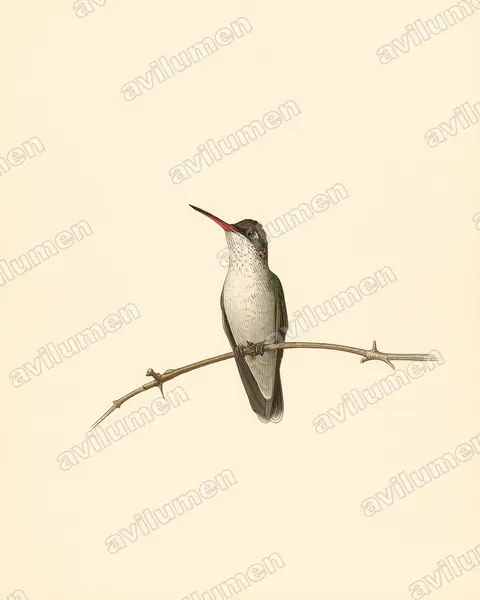
Vintage plate 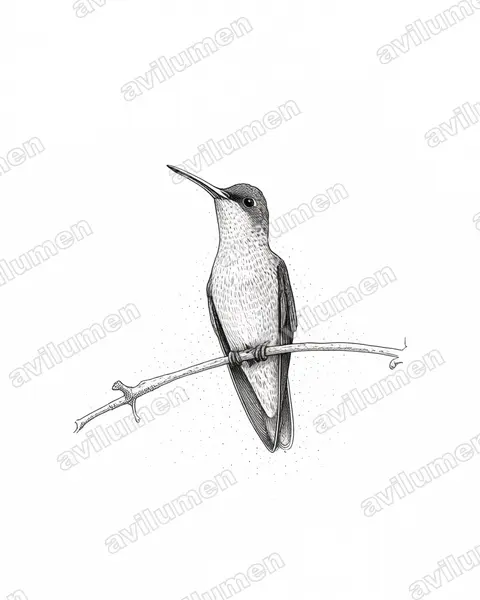
Ink 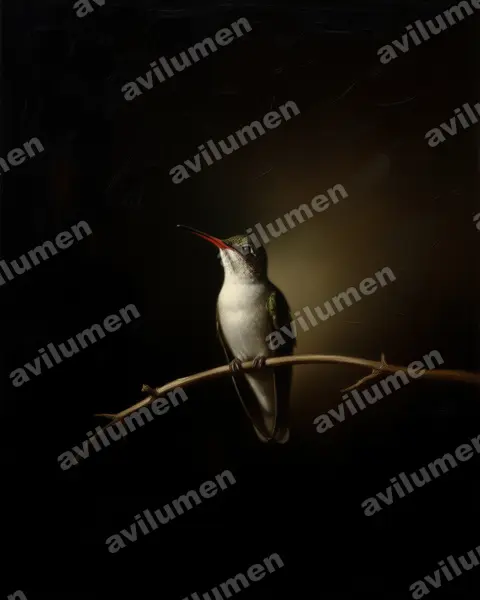
Oil 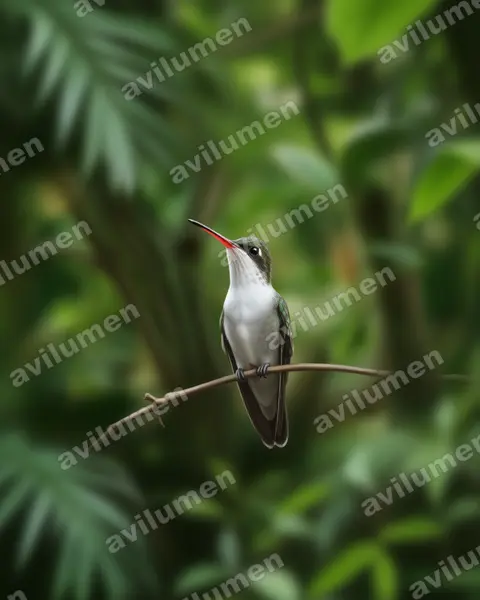
Realistic 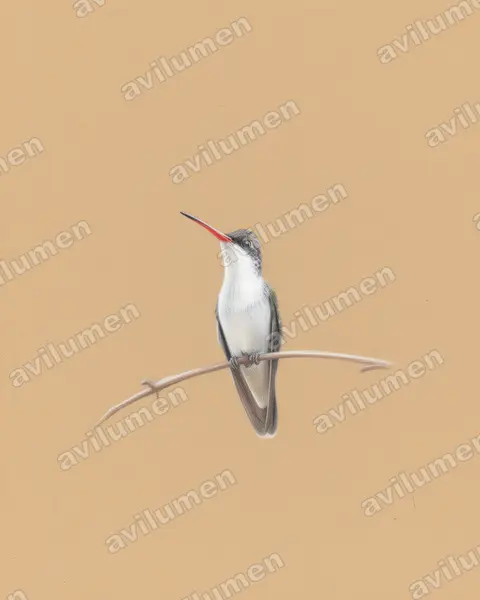
Colored pencil
Illustrations based on the photograph by Dario (CC0), from Wikimedia Commons.
Digital editions
HD Digital Art Pack — Violet-crowned hummingbird
Digital download: 6 high-resolution illustrations of the Violet-crowned hummingbird (Amazilia violiceps), print-ready. This is a digital file; no animal or physical item is included.
AI Avatar — Violet-crowned hummingbird
Generate an avatar fusing your face with the Violet-crowned hummingbird (Amazilia violiceps). Delivered digitally in 8K, watermark-free. Digital product; no animals are sold or brokered.
Instant download. No live birds are sold.
Frequently asked questions
- Is Amazilia violiceps (Violet-crowned hummingbird) endangered?
- The IUCN Red List places Amazilia violiceps, commonly known as the Violet-crowned hummingbird, in the «Not evaluated» category. «Not evaluated» means the IUCN has not yet assessed this species.
- What family does Amazilia violiceps (Violet-crowned hummingbird) belong to?
- Amazilia violiceps (Violet-crowned hummingbird) belongs to the family Trochilidae, in the order Apodiformes.
- What colour is Amazilia violiceps (Violet-crowned hummingbird)?
- The plumage of Amazilia violiceps (Violet-crowned hummingbird) combines these colours: Green.
More from the same family
 Least concern
Emerald-chinned Hummingbird
Abeillia abeillei
The emerald-chinned hummingbird is a species of hummingbird in the "emeralds", tribe Trochilini of subfamily Trochilinae.
from $1.99
 Least concern
Speckled hummingbird
Adelomyia melanogenys
The speckled hummingbird is a species of hummingbird. It is the only member of the genus Adelomyia. It inhabits Neotropical montane cloud forests at elevations of 1,000–2,500 meters and is confined to the Andes of Argentina, Bolivia, Peru, Ecuador, Colombia and Venezuela; as well as to some isolated montane forests in western Ecuador and Venezuela.
from $1.99
 Vulnerable
Purple-backed sunbeam
Aglaeactis aliciae
The purple-backed sunbeam is a bird species in the family Trochilidae. It is found only in Peru.
from $1.99
 Near threatened
White-tufted sunbeam
Aglaeactis castelnaudii
The white-tufted sunbeam is a species of hummingbird in the family Trochilidae. It is found only in Peru. Its natural habitats are subtropical or tropical moist montane forest and subtropical or tropical high-altitude shrubland.
from $1.99