Tooth-billed hummingbird
Androdon aequatorialis
Avilumen editorial team ·

The tooth-billed hummingbird is a species of bird from the family Trochilidae. It is monotypic within the genus Androdon. It is found in humid forests in western Colombia, north-western Ecuador, and far eastern Panama.
The tooth-billed hummingbird (Androdon aequatorialis) is a species of bird from the family Trochilidae. It is monotypic within the genus Androdon. It is found in humid forests in western Colombia, north-western Ecuador (south to Pichincha Province), and far eastern Panama (Darién Province). While generally scarce, localized and associated with the highly threatened humid sections of the Chocó, its range remains relatively large, and it is therefore considered to be of least concern by BirdLife International.
Description
The tooth-billed hummingbird has a total length of c. 14 cm (5+1⁄2 in), which includes the long, essentially straight bill of c. 4 cm (1+1⁄2 in). Its common name refers to the small tooth-like serrations on the inner part of the distal half of the bill. It is shiny green above with a coppery crown. The underparts are whitish streaked dusky. The rounded tail is greyish with a broad black subterminal band and white tips. There is a conspicuous white band on the rump. In males, the bill has a small hook at the tip and more prominent tooth-like spikes; their plumage color averages brighter overall than females. While the green upper parts of this species are iridescent, its plumage is duller than that of most hummingbirds. Within its range, it is essentially unmistakable by the combination of the long, almost straight bill and the dark-streaked whitish underparts.
Habitat
The tooth-billed hummingbird is restricted to humid primary forests and nearby second growth. It occurs up to an altitude of c. 1,560 m (5,120 ft). In Ecuador, it is most frequent between 400–800 m (1,300–2,600 ft), while it mainly occurs between 600–1,560 m (1,970–5,120 ft) in Panama, and up to 1,050 m (3,440 ft) in Colombia.
Behavior
Rather inconspicuous and generally poorly known. It is a swift flier. It forages from low levels to sub-canopy, where it feeds on nectar from flowers of plant families such Ericaceae and Gesneriaceae. Its main feeding strategy involves trap-lining. The serrated bill is also well adapted for catching small spiders and insects, while the hooked tip of the males' bill is further suited for extracting prey from within rolled leaves and cavities. It has sometimes been seen rapidly gleaning below large leaves, while flicking its tail.
Little is known about its breeding behavior, but individuals captured in Colombia in January–March have had enlarged gonads, indicating that they were in breeding condition. In Ecuador, it has been reported that males gather in leks in February–May, which is unusual among members of the subfamily Trochilinae, but frequent among the members of Phaethornithinae. Its calls include a high-pitches tsit-tseé-tsu and penetrating cheet notes.
Taxonomy
The tooth-billed hummingbird's taxonomic position has been controversial, with some arguing that it should be placed in the subfamily Phaethornithinae, and others that it, together with the two lancebills, should be placed in their own small subfamily, Doryferinae. Today most authorities place it at the beginning of Trochilinae.
Text adapted from Wikipedia · CC BY-SA 4.0
Where it lives
Distribution

Taxonomy
- Order
- Apodiformes
- Family
- Trochilidae
- Genus
- Androdon
- Conservation status
- Least concern
Listen to its call
No recording yet
Illustration gallery
6 illustrations of Androdon aequatorialis (Tooth-billed hummingbird) in different styles, true to its real plumage. Shown watermarked; the art pack includes the high-resolution originals, ready to print.
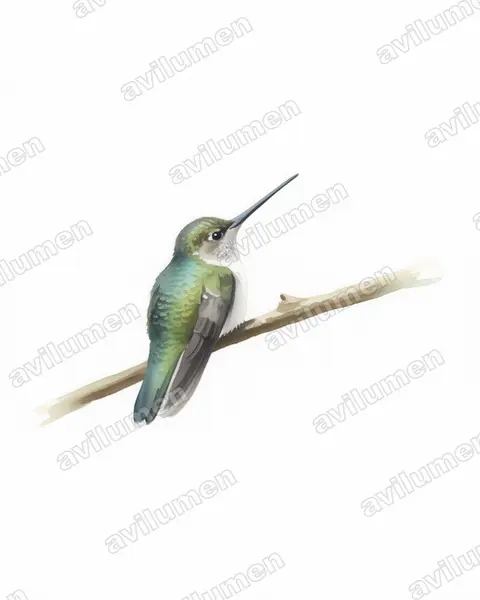
Watercolor 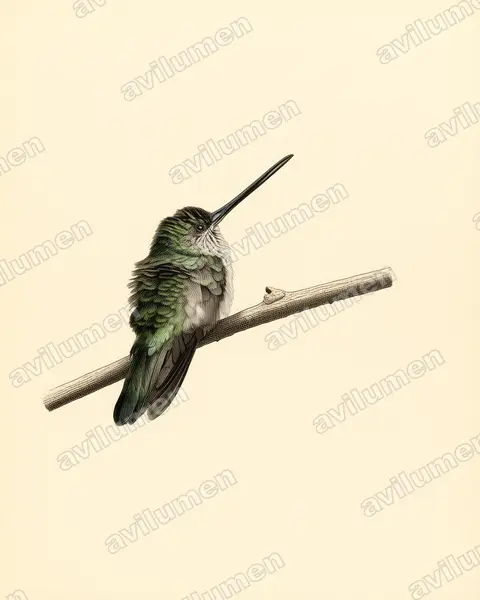
Vintage plate 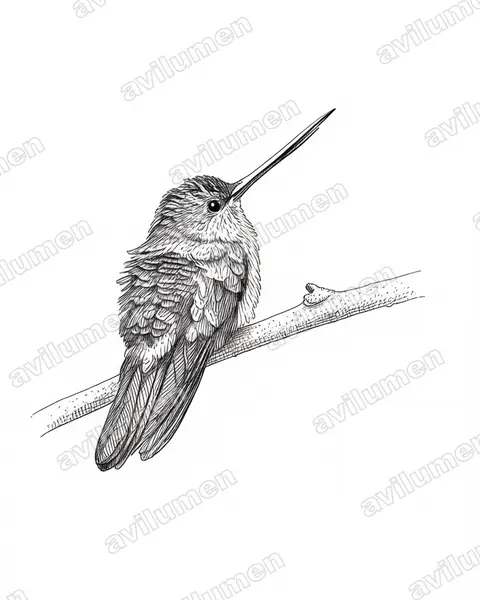
Ink 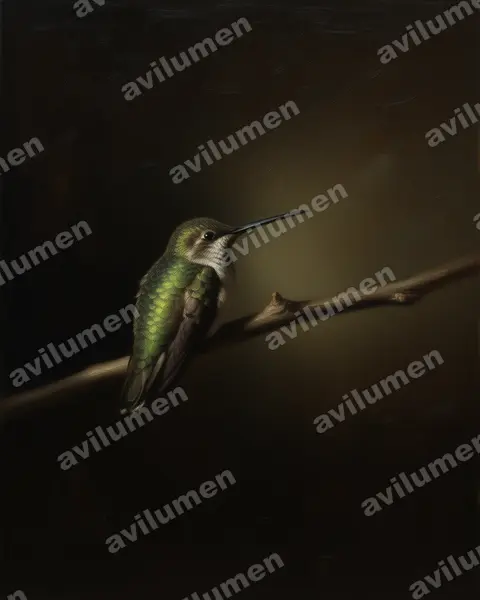
Oil 
Realistic 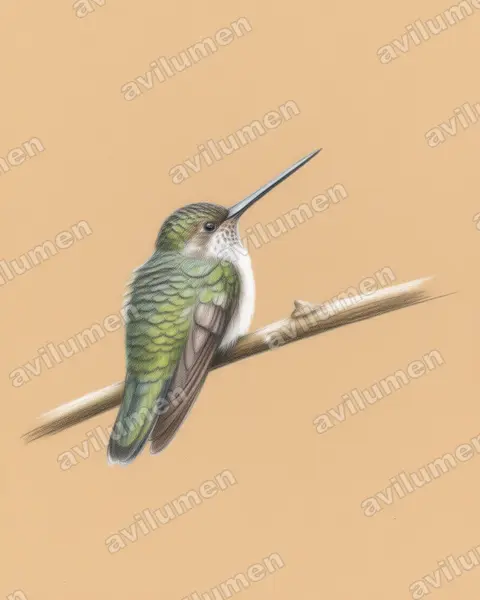
Colored pencil
Illustrations based on the photograph by Zieger M (CC BY-SA 4.0), from Wikimedia Commons.
Digital editions
HD Digital Art Pack — Tooth-billed hummingbird
Digital download: 6 high-resolution illustrations of the Tooth-billed hummingbird (Androdon aequatorialis), print-ready. This is a digital file; no animal or physical item is included.
AI Avatar — Tooth-billed hummingbird
Generate an avatar fusing your face with the Tooth-billed hummingbird (Androdon aequatorialis). Delivered digitally in 8K, watermark-free. Digital product; no animals are sold or brokered.
Instant download. No live birds are sold.
Frequently asked questions
- Is Androdon aequatorialis (Tooth-billed hummingbird) endangered?
- The IUCN Red List places Androdon aequatorialis, commonly known as the Tooth-billed hummingbird, in the «Least concern» category. «Least concern» means it is not currently threatened.
- Where does Androdon aequatorialis (Tooth-billed hummingbird) live?
- Androdon aequatorialis (Tooth-billed hummingbird) is found in South America.
- What family does Androdon aequatorialis (Tooth-billed hummingbird) belong to?
- Androdon aequatorialis (Tooth-billed hummingbird) belongs to the family Trochilidae, in the order Apodiformes.
- What colour is Androdon aequatorialis (Tooth-billed hummingbird)?
- The plumage of Androdon aequatorialis (Tooth-billed hummingbird) combines these colours: Green and White.
More from the same family
 Least concern
Emerald-chinned Hummingbird
Abeillia abeillei
The emerald-chinned hummingbird is a species of hummingbird in the "emeralds", tribe Trochilini of subfamily Trochilinae.
from $1.99
 Least concern
Speckled hummingbird
Adelomyia melanogenys
The speckled hummingbird is a species of hummingbird. It is the only member of the genus Adelomyia. It inhabits Neotropical montane cloud forests at elevations of 1,000–2,500 meters and is confined to the Andes of Argentina, Bolivia, Peru, Ecuador, Colombia and Venezuela; as well as to some isolated montane forests in western Ecuador and Venezuela.
from $1.99
 Vulnerable
Purple-backed sunbeam
Aglaeactis aliciae
The purple-backed sunbeam is a bird species in the family Trochilidae. It is found only in Peru.
from $1.99
 Near threatened
White-tufted sunbeam
Aglaeactis castelnaudii
The white-tufted sunbeam is a species of hummingbird in the family Trochilidae. It is found only in Peru. Its natural habitats are subtropical or tropical moist montane forest and subtropical or tropical high-altitude shrubland.
from $1.99