Indian Pied Hornbill
Anthracoceros coronatus
Avilumen editorial team ·

The Malabar pied hornbill, also known as the lesser pied hornbill, is a bird in the hornbill family, a family of tropical near-passerine birds found in the Old World.
The Malabar pied hornbill (Anthracoceros coronatus), also known as the lesser pied hornbill, is a bird in the hornbill family, a family of tropical near-passerine birds found in the Old World.
Taxonomy
The Malabar pied hornbill was described by the French polymath Georges-Louis Leclerc, Comte de Buffon in 1780 in his Histoire Naturelle des Oiseaux. The bird was also illustrated in a hand-coloured plate engraved by François-Nicolas Martinet in the Planches Enluminées D'Histoire Naturelle, which was produced under the supervision of Edme-Louis Daubenton to accompany Buffon's text. Neither the plate caption nor Buffon's description included a scientific name but in 1783 the Dutch naturalist Pieter Boddaert coined the binomial name Buceros coronatus in his catalogue of the Planches Enluminées. The Malabar pied hornbill is now placed in the genus Anthracoceros that was introduced by the German naturalist Ludwig Reichenbach in 1849. The species is monotypic. The generic name combines the Ancient Greek anthrax, meaning "coal black" and kerōs, meaning "horn". The specific epithet coronatus is Latin for "crowned".
Description
The Malabar pied hornbill is a large hornbill, at 65 cm (26 in) in length. It has mainly black plumage, apart from its white belly, throat patch, tail sides and trailing edge to the wings. The bill is yellow with a large, mainly black casque. Females have white orbital skin, which the males lack. Juveniles have no casque. It might be confused with the oriental pied hornbill. They weigh around 1 kg (2.2 pounds).
Distribution and habitat
The Malabar pied hornbill is a common resident breeder in India and Sri Lanka. Its habitat is evergreen and moist deciduous forests, often near human settlements. It is distributed across three main regions within the Indian sub-continent: Central and Eastern India, along the Western Ghats, and in Sri Lanka. In Central and Eastern India, it ranges from western West Bengal through parts of Jharkhand, Chhattisgarh, Odisha, Madhya Pradesh, northern and eastern Maharashtra, northern Andhra Pradesh, and north-east tip of Telangana. Along the Western Ghats, the species is distributed in pockets along the eastern slopes and in the Konkan belt and west coast from western Maharashtra through Goa, western Karnataka and Tamil Nadu, and in Kerala. In Sri Lanka, the species occurs mainly in the low country and dry zone forests as well as home gardens.
Breeding
During incubation, the female lays two or three white eggs in a tree hole, which is blocked off with a cement made of mud, droppings and fruit pulp. There is only one narrow aperture, just big enough for the male to transfer food to the mother and chicks. When the chicks have grown too large for the mother to fit in the nest with them, she breaks out and rebuilds the wall, after which both parents feed the chicks.
Food and feeding
This species is omnivorous, taking fruits, small mammals, birds, small reptiles, insects etc. Prey is killed and swallowed whole. Figs are an important food, contributing 60% of their diet from May to February, the non-breeding season; during breeding, in March and April, up to 75% of the fruits delivered at the nest were figs. They also feed on other fruits, including those of the Strychnos nux-vomica, which are toxic to many vertebrates.
Great pied hornbills and Malabar pied hornbills are frequently spotted at the township of the Kaiga Atomic Power Station near Karwar in India. The rich biodiversity in the forest around the plant has become a niche for a wide variety of rare bird species. A study comparing populations over a 23-year period at Dandeli found no significant change.
In central India, tribal peoples believed that hanging a skull of the hornbill (known as dhanchidiya) brought wealth.
Text adapted from Wikipedia · CC BY-SA 4.0
Taxonomy
- Order
- Bucerotiformes
- Family
- Bucerotidae
- Genus
- Anthracoceros
- Conservation status
- Near threatened
Listen to its call
No recording yet
Illustration gallery
6 illustrations of Anthracoceros coronatus (Indian Pied Hornbill) in different styles, true to its real plumage. Shown watermarked; the art pack includes the high-resolution originals, ready to print.
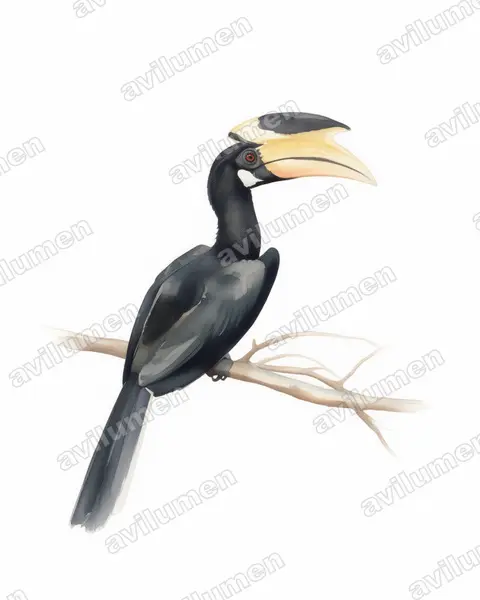
Watercolor 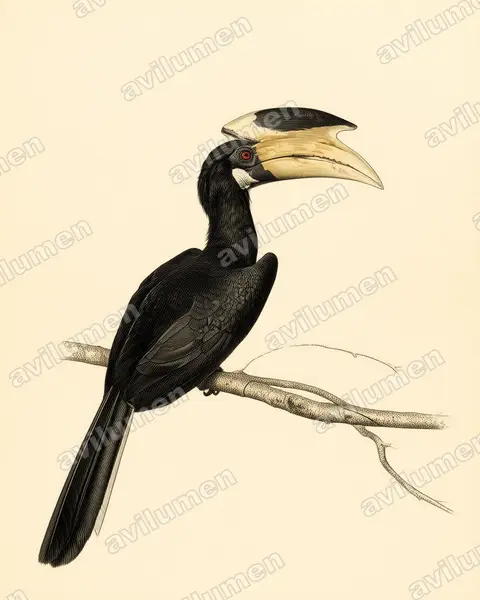
Vintage plate 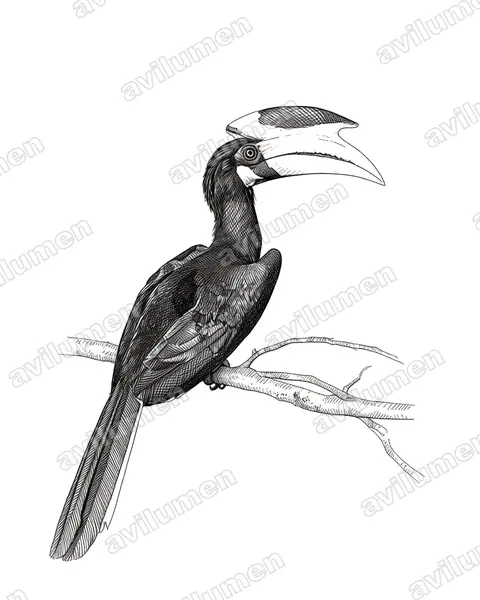
Ink 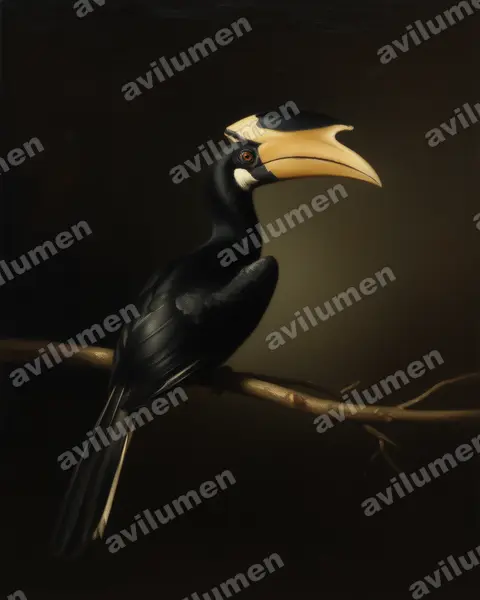
Oil 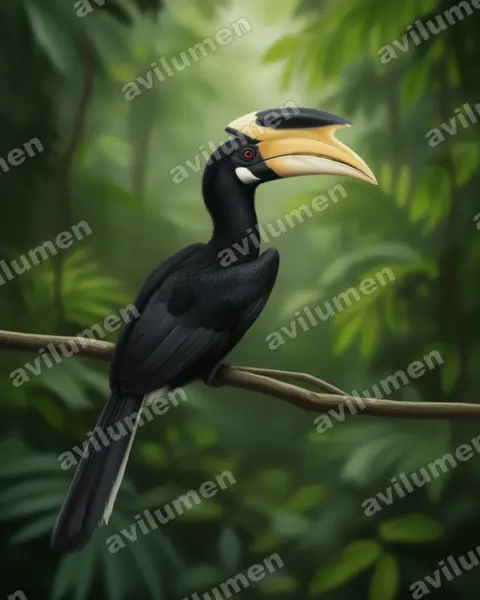
Realistic 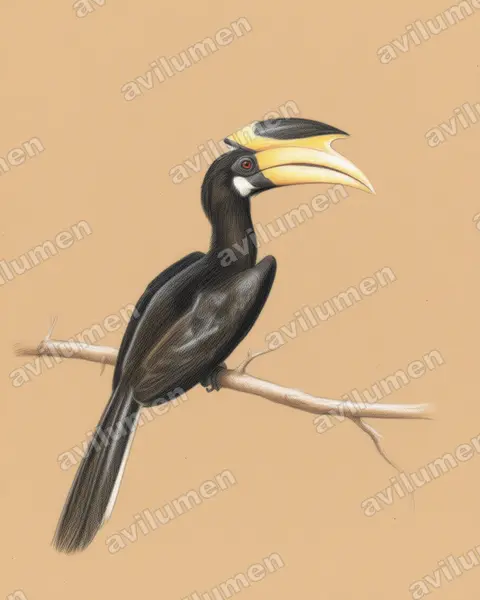
Colored pencil
Illustrations based on the photograph by Charles J. Sharp (CC BY-SA 4.0), from Wikimedia Commons.
Digital editions
HD Digital Art Pack — Indian Pied Hornbill
Digital download: 6 high-resolution illustrations of the Indian Pied Hornbill (Anthracoceros coronatus), print-ready. This is a digital file; no animal or physical item is included.
AI Avatar — Indian Pied Hornbill
Generate an avatar fusing your face with the Indian Pied Hornbill (Anthracoceros coronatus). Delivered digitally in 8K, watermark-free. Digital product; no animals are sold or brokered.
Instant download. No live birds are sold.
Frequently asked questions
- Is Anthracoceros coronatus (Indian Pied Hornbill) endangered?
- The IUCN Red List places Anthracoceros coronatus, commonly known as the Indian Pied Hornbill, in the «Near threatened» category. «Near threatened» means it is not threatened yet, but is close to becoming so.
- What family does Anthracoceros coronatus (Indian Pied Hornbill) belong to?
- Anthracoceros coronatus (Indian Pied Hornbill) belongs to the family Bucerotidae, in the order Bucerotiformes.
- What colour is Anthracoceros coronatus (Indian Pied Hornbill)?
- The plumage of Anthracoceros coronatus (Indian Pied Hornbill) combines these colours: Black and White.
More from the same family
 Vulnerable
Rufous-necked Hornbill
Aceros nipalensis
The rufous-necked hornbill is a species of hornbill in Bhutan, northeastern India, especially in Arunachal Pradesh, Indian subcontinent and Southeast Asia. It is locally extinct in Nepal due to hunting and significant loss of habitat. There are less than 10,000 adults left in the wild. With a length of about 117 cm (46 in), it is among the largest Bucerotine hornbills.
from $1.99
 Near threatened
Austen's Brown Hornbill
Anorrhinus austeni
Austen's brown hornbill, also known as the white-throated brown hornbill or brown hornbill, is a medium-sized species of hornbill found in forests from northeastern India to Vietnam and northern Thailand. It is rare throughout its range and is threatened by habitat loss and fragmentation.
from $1.99
 Near threatened
Bushy-crested Hornbill
Anorrhinus galeritus
The bushy-crested hornbill is a bird in the hornbill family. It is found in Brunei, Indonesia, Malaysia, Myanmar, and Thailand. Its natural habitat is subtropical or tropical moist lowland forests.
from $1.99
 Near threatened
Austen's Brwon Hornbill
Anorrhinus tickelli
Tickell's brown hornbill, also known as the rusty-cheeked hornbill, is a species of hornbill found in forests in Burma and adjacent western Thailand. Austen's brown hornbill is sometimes considered as a subspecies of Tickell's brown hornbill.
from $1.99