Sulu Hornbill
Anthracoceros montani
Avilumen editorial team ·

The Sulu hornbill, or Montano's hornbill, is a species of hornbill in the family Bucerotidae. It is endemic to the Sulu archipelago in the Philippines, with the remaining populations in Tawi-Tawi with it believed to be hunted to extinction on Jolo. Its natural habitat is tropical moist forests. It is threatened by habitat loss as well as potential harvesting for food.
The Sulu hornbill (Anthracoceros montani), or Montano's hornbill, is a species of hornbill in the family Bucerotidae. It is endemic to the Sulu archipelago in the Philippines, with the remaining populations in Tawi-Tawi with it believed to be hunted to extinction on Jolo. Its natural habitat is tropical moist forests. It is threatened by habitat loss as well as potential harvesting for food. Its diet includes fruit, insects, and small lizards.
In 2019 it was reported that only 27 mature individual hornbills are still believed to be alive in the wild, making it one of the most endangered animals in the world.
Description and taxonomy
The Sulu hornbill forms a monphyletic group, and is most closely related to the last common ancestor of its sister clade containing the Palawan hornbill, Malabar pied hornbill and the Oriental pied hornbill.
Ecology and behavior
It is locally known as "tawsi".
Feeding
Diet is mainly fruit but also feeds on insects, small mammals and reptiles. Recorded in pairs
Breeding
All hornbills are monogamous and mate for life.They are cavity nesters and rely on large dipterocarp trees for breeding. The female seals itself within the tree cavity and the male is in charge of gathering food for its mate and chicks. The male stores food in a gular pouch and regurgitates it to feed its mate and chicks.
Species specific information on its breeding habits are limited. Nests have been recorded from June to September. Reported to lay 2 eggs
Habitat and conservation status
It inhabits primary dipterocarp forest, typically on mountain slopes (although this may simply reflect a constraint enforced by forest loss), occasionally visiting isolated fruiting trees over 1 km from the nearest forest. It requires large trees for nesting.
The International Union for Conservation of Nature has assessed this bird as critically endangered. In 2019, it was reported that only 27 mature individual hornbills are still believed to be alive in the wild. However, these figures are rough estimates and this figure is disputed. Biggest numbers in the past decade seen together was 10 mature birds in 2014.
While the exact numbers are unknown, this is still undoubtedly the most endangered hornbill and one of the most endangered animals in the entire world. It has gone extinct on the island of Jolo with the last record in 1930s, due to hunting and the remaining populations in Tawi-Tawi are threatened by habitat destruction through logging and slash-and-burn farming.
The only species specific conservation actions as of 2019 were 16 "tawsi Rangers" employed by the local government patrolling against illegal logging and protecting nests.
In 2019, 44 participants which included military, conservationists, local government participated in a meeting hosted by the IUCN Species Survival Commission to formulate a species conservation plan. This meeting created a 10 year plan for the species continued survival. Conservation actions proposed were to improve the estimates on population and understanding of its ecology. This plan also included the creation of a species conservation program that involved the locals.
While an ex-situ captive breeding program was discussed, participants agreed that due to issues with ownership of the birds and general lack of expertise, these plans were to be re-explored 6-10 years in the future.
Text adapted from Wikipedia · CC BY-SA 4.0
Distribution

Taxonomy
- Order
- Bucerotiformes
- Family
- Bucerotidae
- Genus
- Anthracoceros
- Conservation status
- Critically endangered
Listen to its call
No recording yet
Illustration gallery
6 illustrations of Anthracoceros montani (Sulu Hornbill) in different styles, true to its real plumage. Shown watermarked; the art pack includes the high-resolution originals, ready to print.
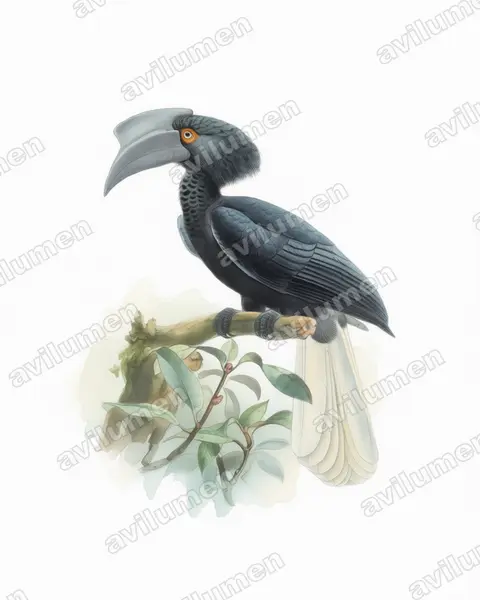
Watercolor 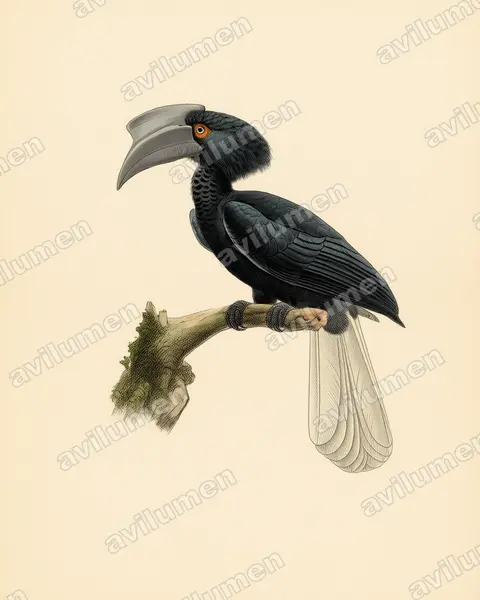
Vintage plate 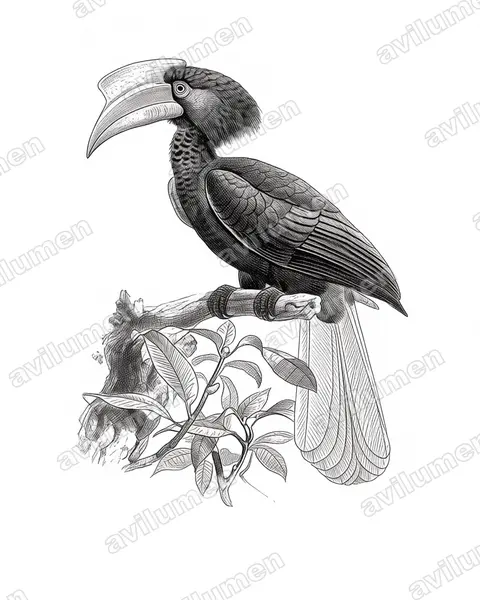
Ink 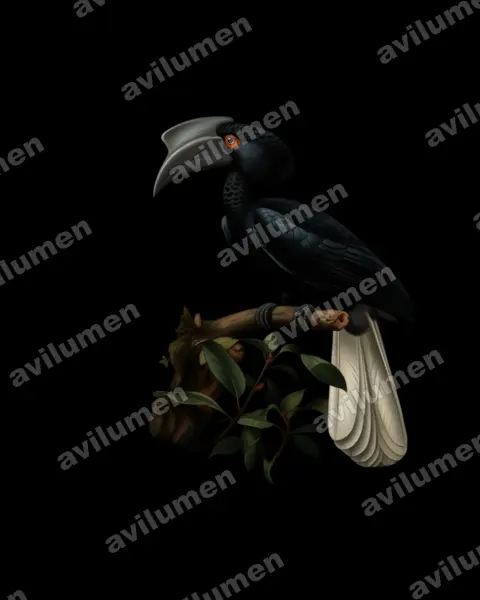
Oil 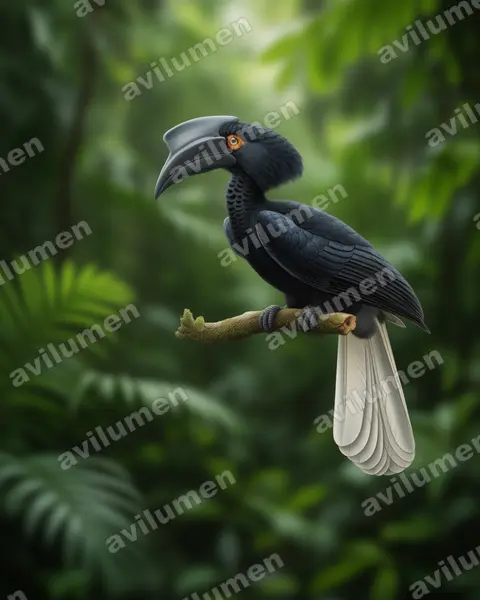
Realistic 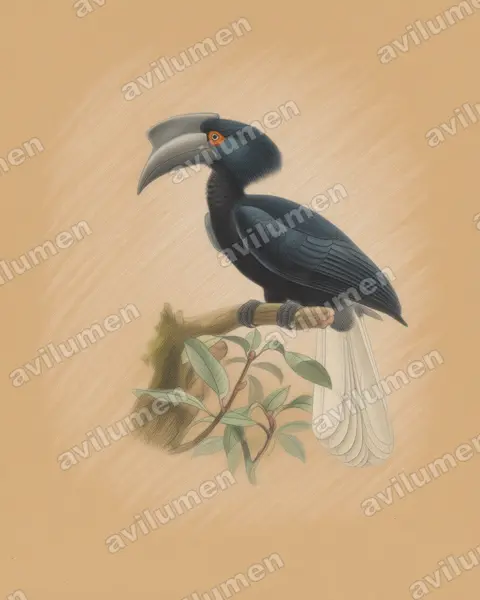
Colored pencil
Illustrations based on the photograph by Taylor and Francis, 1882 - Biodiversity Heritage Library (CC BY 2.0), from Wikimedia Commons.
Digital editions
HD Digital Art Pack — Sulu Hornbill
Digital download: 6 high-resolution illustrations of the Sulu Hornbill (Anthracoceros montani), print-ready. This is a digital file; no animal or physical item is included.
AI Avatar — Sulu Hornbill
Generate an avatar fusing your face with the Sulu Hornbill (Anthracoceros montani). Delivered digitally in 8K, watermark-free. Digital product; no animals are sold or brokered.
Instant download. No live birds are sold.
Frequently asked questions
- Is Anthracoceros montani (Sulu Hornbill) endangered?
- The IUCN Red List places Anthracoceros montani, commonly known as the Sulu Hornbill, in the «Critically endangered» category. «Critically endangered» is the highest threat level before extinction.
- What family does Anthracoceros montani (Sulu Hornbill) belong to?
- Anthracoceros montani (Sulu Hornbill) belongs to the family Bucerotidae, in the order Bucerotiformes.
- What colour is Anthracoceros montani (Sulu Hornbill)?
- The plumage of Anthracoceros montani (Sulu Hornbill) combines these colours: Black and Brown.
More from the same family
 Vulnerable
Rufous-necked Hornbill
Aceros nipalensis
The rufous-necked hornbill is a species of hornbill in Bhutan, northeastern India, especially in Arunachal Pradesh, Indian subcontinent and Southeast Asia. It is locally extinct in Nepal due to hunting and significant loss of habitat. There are less than 10,000 adults left in the wild. With a length of about 117 cm (46 in), it is among the largest Bucerotine hornbills.
from $1.99
 Near threatened
Austen's Brown Hornbill
Anorrhinus austeni
Austen's brown hornbill, also known as the white-throated brown hornbill or brown hornbill, is a medium-sized species of hornbill found in forests from northeastern India to Vietnam and northern Thailand. It is rare throughout its range and is threatened by habitat loss and fragmentation.
from $1.99
 Near threatened
Bushy-crested Hornbill
Anorrhinus galeritus
The bushy-crested hornbill is a bird in the hornbill family. It is found in Brunei, Indonesia, Malaysia, Myanmar, and Thailand. Its natural habitat is subtropical or tropical moist lowland forests.
from $1.99
 Near threatened
Austen's Brwon Hornbill
Anorrhinus tickelli
Tickell's brown hornbill, also known as the rusty-cheeked hornbill, is a species of hornbill found in forests in Burma and adjacent western Thailand. Austen's brown hornbill is sometimes considered as a subspecies of Tickell's brown hornbill.
from $1.99