Puerto Rican mango
Anthracothorax aurulentus
Avilumen editorial team ·

The Puerto Rican mango is a species of hummingbird in the subfamily Polytminae. It is found on the Caribbean islands of Puerto Rico, the British Virgin Islands, and the American Virgin Islands.
The Puerto Rican mango (Anthracothorax aurulentus) is a species of hummingbird in the subfamily Polytminae. It is found on the Caribbean islands of Puerto Rico, the British Virgin Islands, and the American Virgin Islands.
Taxonomy and systematics
From about 1945, some taxonomic systems treated what is now the Puerto Rican mango as a subspecies of the "Antillean mango" (Anthracothorax dominicus). BirdLife International's Handbook of the Birds of the World (HBW) treated the Puerto Rican mango as a separate species as early as 2003 and called A. dominicus the Hispaniolan mango. The American Ornithological Society (AOS), the International Ornithological Committee (IOC), and the Clements taxonomy followed suit in 2022.
Description
The Puerto Rican mango is 11 to 12 cm (4.3 to 4.7 in) long; males weigh 4.8 to 7.2 g (0.17 to 0.25 oz) and females 4.0 to 6.4 g (0.14 to 0.23 oz). The male's upperparts are shiny bronze-green. It has green flanks, a dark brownish gray belly, and a bronzy green tail. The female's upperparts are also shiny bronze-green and its underparts are grayish lightening to pale white on the abdomen. It has a brownish gray tail with broad black marks near the end; the outermost feathers have white tips.
Distribution and habitat
The Puerto Rican mango is found on Puerto Rico, its offshore island Culebra, and the British and American Virgin Islands. It is apparently extirpated from the Puerto Rican island of Vieques. It is found almost entirely in lowlands below 250 m (820 ft), where it occurs in gardens and forest edges.
Movements
The Puerto Rican mango is resident throughout its range.
Feeding
The Puerto Rican mango feeds on both nectar and arthropods, though details are not well known. It takes nectar from a wide variety of flowering plants and males defend nectar-rich territories. Insects are mostly taken on the wing and spiders from leaves and bark. It forages as high as 20 m (66 ft) above the ground.
Breeding
The Puerto Rican mango's breeding phenology has not been studied; most information is anecdotal. It is believed to breed at any time of the year and perhaps twice a year in Puerto Rico. The nest is a cup of soft plant fibers bound with spider silk and covered on the outside with lichens and bark flakes. It is usually placed in a tree or shrub and in Puerto Rico has been found on human-made substrates such as power lines, antennas, and fences. The clutch size is two eggs. The incubation time has been reported to be about 15 days with fledging 22 to 25 days after hatch.
Vocalization
The Puerto Rican mango is thought to be mostly silent, and its song has not been described. Its calls include "a repeated short tsip" and "a high-pitched liquid trill".
Status
The IUCN has assessed the Puerto Rican mango as being of Least Concern, though its population is not known and is believed to be decreasing. It is considered generally common in coastal areas. It has been extirpated from some small offshore islands.
Text adapted from Wikipedia · CC BY-SA 4.0
Distribution

Taxonomy
- Order
- Apodiformes
- Family
- Trochilidae
- Genus
- Anthracothorax
- Conservation status
- Least concern
Listen to its call
No recording yet
Illustration gallery
6 illustrations of Anthracothorax aurulentus (Puerto Rican mango) in different styles, true to its real plumage. Shown watermarked; the art pack includes the high-resolution originals, ready to print.
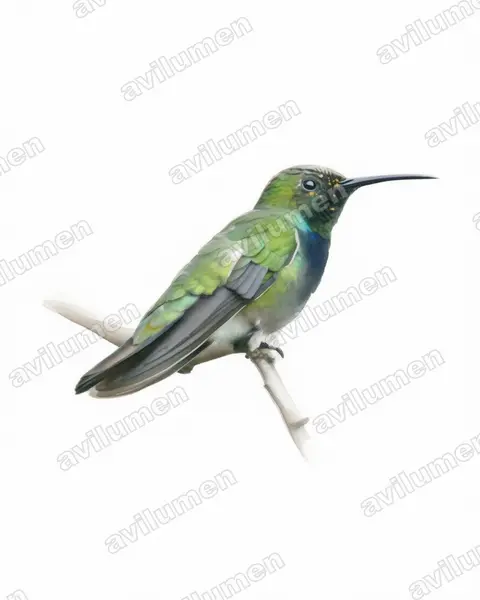
Watercolor 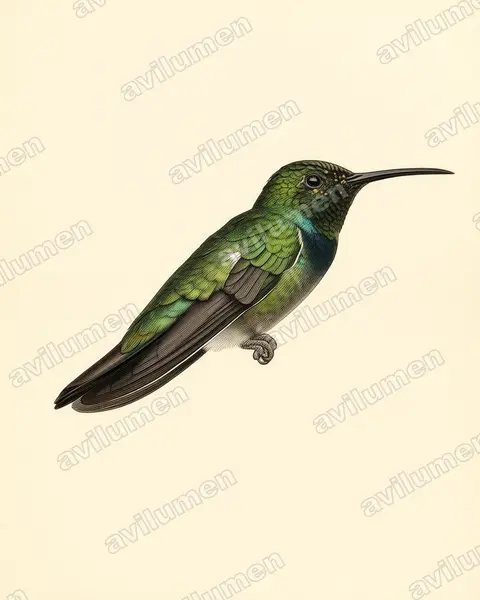
Vintage plate 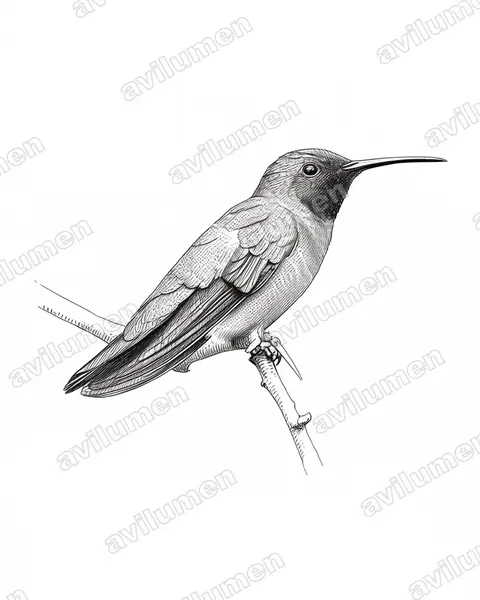
Ink 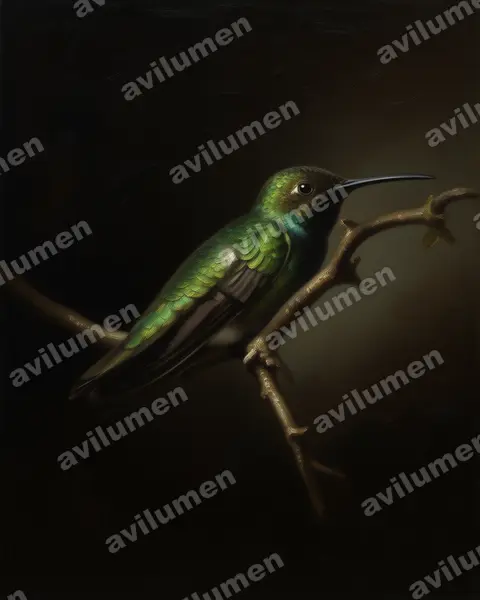
Oil 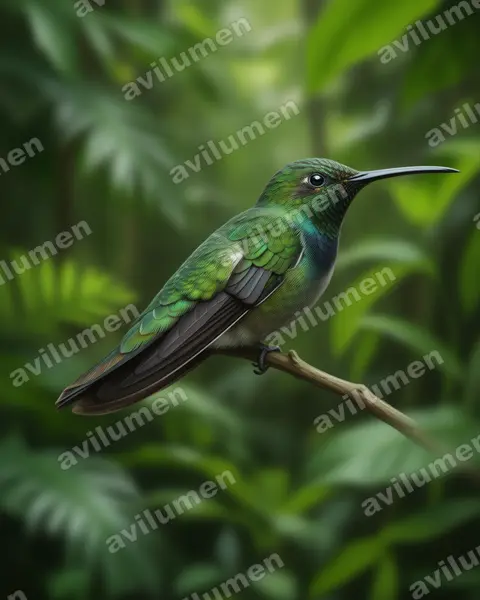
Realistic 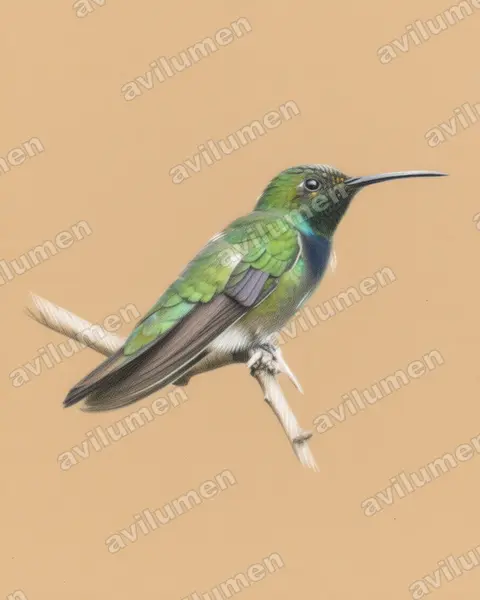
Colored pencil
Illustrations based on the photograph by Dick Daniels (http://theworldbirds.org/) (CC BY-SA 3.0), from Wikimedia Commons.
Digital editions
HD Digital Art Pack — Puerto Rican mango
Digital download: 6 high-resolution illustrations of the Puerto Rican mango (Anthracothorax aurulentus), print-ready. This is a digital file; no animal or physical item is included.
AI Avatar — Puerto Rican mango
Generate an avatar fusing your face with the Puerto Rican mango (Anthracothorax aurulentus). Delivered digitally in 8K, watermark-free. Digital product; no animals are sold or brokered.
Instant download. No live birds are sold.
Frequently asked questions
- Is Anthracothorax aurulentus (Puerto Rican mango) endangered?
- The IUCN Red List places Anthracothorax aurulentus, commonly known as the Puerto Rican mango, in the «Least concern» category. «Least concern» means it is not currently threatened.
- What family does Anthracothorax aurulentus (Puerto Rican mango) belong to?
- Anthracothorax aurulentus (Puerto Rican mango) belongs to the family Trochilidae, in the order Apodiformes.
- What colour is Anthracothorax aurulentus (Puerto Rican mango)?
- The plumage of Anthracothorax aurulentus (Puerto Rican mango) combines these colours: Green and Yellow.
More from the same family
 Least concern
Emerald-chinned Hummingbird
Abeillia abeillei
The emerald-chinned hummingbird is a species of hummingbird in the "emeralds", tribe Trochilini of subfamily Trochilinae.
from $1.99
 Least concern
Speckled hummingbird
Adelomyia melanogenys
The speckled hummingbird is a species of hummingbird. It is the only member of the genus Adelomyia. It inhabits Neotropical montane cloud forests at elevations of 1,000–2,500 meters and is confined to the Andes of Argentina, Bolivia, Peru, Ecuador, Colombia and Venezuela; as well as to some isolated montane forests in western Ecuador and Venezuela.
from $1.99
 Vulnerable
Purple-backed sunbeam
Aglaeactis aliciae
The purple-backed sunbeam is a bird species in the family Trochilidae. It is found only in Peru.
from $1.99
 Near threatened
White-tufted sunbeam
Aglaeactis castelnaudii
The white-tufted sunbeam is a species of hummingbird in the family Trochilidae. It is found only in Peru. Its natural habitats are subtropical or tropical moist montane forest and subtropical or tropical high-altitude shrubland.
from $1.99