Jamaican mango
Anthracothorax mango
Avilumen editorial team ·

The Jamaican mango is a species of hummingbird in the subfamily Polytminae. It is endemic to Jamaica.
The Jamaican mango (Anthracothorax mango) is a species of hummingbird in the subfamily Polytminae. It is endemic to Jamaica.
Taxonomy
The Jamaican mango was formally described by the Swedish naturalist Carl Linnaeus in 1758 in the tenth edition of his Systema Naturae under the binomial name Trochilus mango. Linnaeus based his description on the "Mango bird" that had been described and illustrated in 1738 by the English naturalist Eleazar Albin. The Jamaican mango is now placed in the genus Anthracothorax that was introduced in 1831 by Friedrich Boie. The species is monotypic: No subspecies are recognized.
There is some evidence that the species is the most basal within the genus Anthracothorax.
Description
The Jamaican mango is 11 to 12 cm (4.3 to 4.7 in) long and weighs 8.5 to 9.1 g (0.30 to 0.32 oz). It differs from all others of its genus by being dark overall rather than mostly bright green. The adult male's crown is dull green, the sides of the head and neck metallic magenta, and the back dull greenish bronze. The central tail feathers are dusky bronze to dull black and the rest metallic violet with a thin dark blue band. The underparts are velvety black. The adult female is similar but with faded velvety green flanks and white tips on the outer tail feathers. The immature male has a deep blue throat that becomes the adult's black after its second year.
Distribution and habitat
The Jamaican mango is found throughout the eponymous island, with the densest population being along the northern coast. It inhabits a wide variety of open and semi-open landscapes including forest edges, gardens, plantations, and arid areas. It shuns mangrove areas. In elevation it mostly ranges from sea level to 800 m (2,600 ft) and is regular but rare as high as 1,500 m (4,900 ft).
Movement
The Jamaican mango moves from the higher elevations to mid levels in June to August after the upper flowering season ends.
Feeding
The Jamaican mango feeds on both nectar and arthropods. It takes nectar from a large variety of flowering trees, shrubs, and vines, both native and introduced. Males defend flowering trees. Insects are mostly taken on the wing.
Breeding
The Jamaican mango nests at any time of the year, though most frequently between January and May. It weaves a small cup nest of soft plant fibers and seed down with spider silk on a thick tree branch, typically between 3 and 8 m (9.8 and 26 ft) above the ground. The clutch size is two eggs. The incubation period and time to fledging are not known.
Vocalization
The Jamaican mango is not highly vocal and its song has not been described. Its call is "a sharp, raspy 'tic...tic...tic'."
Status
The IUCN has assessed the Jamaican mango as being of Least Concern, though its population size and trend are not known. It is a common resident throughout the island. "Ready occupation of man-made habitats suggests that habitat loss is unlikely to be a problem."
Text adapted from Wikipedia · CC BY-SA 4.0
Distribution

Taxonomy
- Order
- Apodiformes
- Family
- Trochilidae
- Genus
- Anthracothorax
- Conservation status
- Least concern
Listen to its call
No recording yet
Illustration gallery
6 illustrations of Anthracothorax mango (Jamaican mango) in different styles, true to its real plumage. Shown watermarked; the art pack includes the high-resolution originals, ready to print.
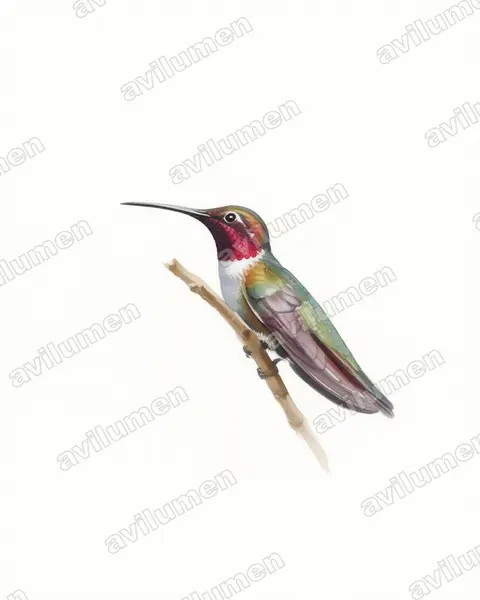
Watercolor 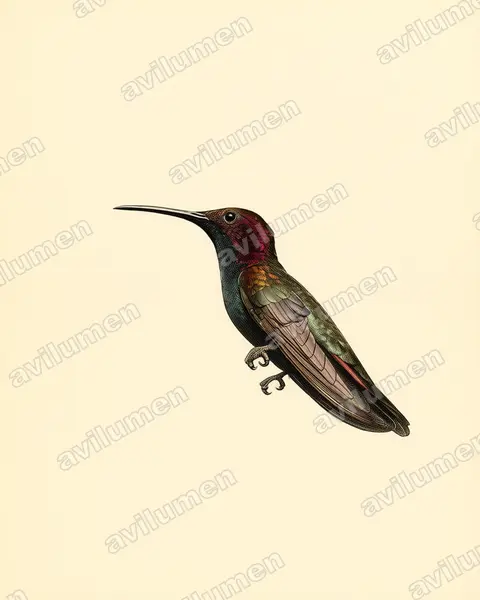
Vintage plate 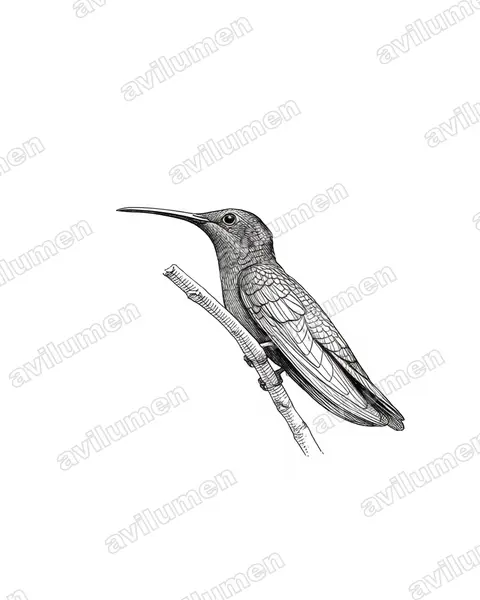
Ink 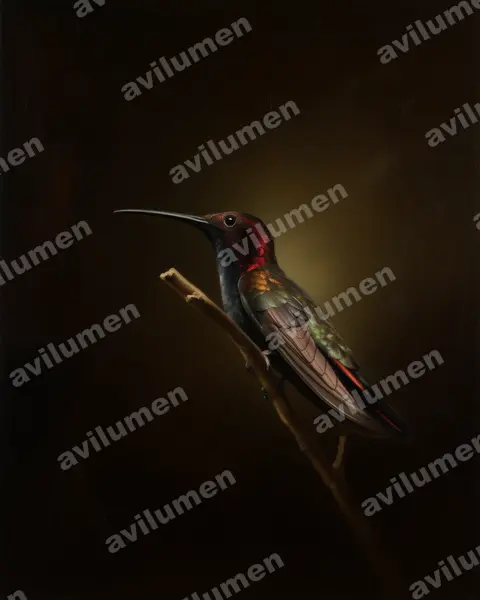
Oil 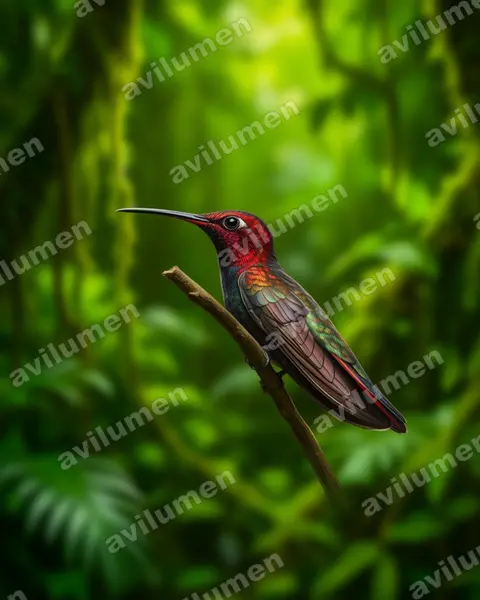
Realistic 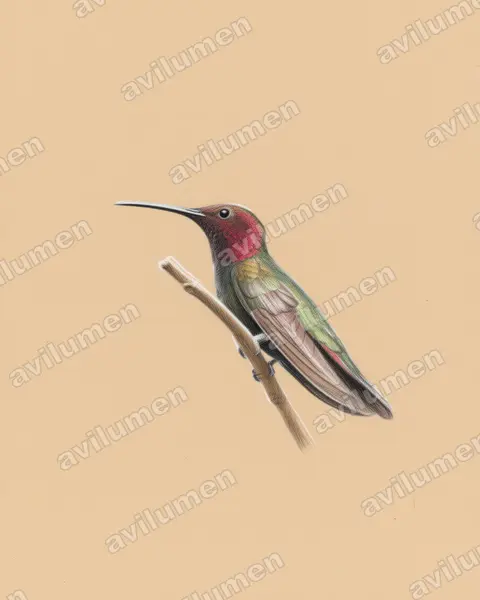
Colored pencil
Illustrations based on the photograph by Charles J. Sharp (CC BY-SA 4.0), from Wikimedia Commons.
Digital editions
HD Digital Art Pack — Jamaican mango
Digital download: 6 high-resolution illustrations of the Jamaican mango (Anthracothorax mango), print-ready. This is a digital file; no animal or physical item is included.
AI Avatar — Jamaican mango
Generate an avatar fusing your face with the Jamaican mango (Anthracothorax mango). Delivered digitally in 8K, watermark-free. Digital product; no animals are sold or brokered.
Instant download. No live birds are sold.
Frequently asked questions
- Is Anthracothorax mango (Jamaican mango) endangered?
- The IUCN Red List places Anthracothorax mango, commonly known as the Jamaican mango, in the «Least concern» category. «Least concern» means it is not currently threatened.
- What family does Anthracothorax mango (Jamaican mango) belong to?
- Anthracothorax mango (Jamaican mango) belongs to the family Trochilidae, in the order Apodiformes.
- What colour is Anthracothorax mango (Jamaican mango)?
- The plumage of Anthracothorax mango (Jamaican mango) combines these colours: Green and Brown.
More from the same family
 Least concern
Emerald-chinned Hummingbird
Abeillia abeillei
The emerald-chinned hummingbird is a species of hummingbird in the "emeralds", tribe Trochilini of subfamily Trochilinae.
from $1.99
 Least concern
Speckled hummingbird
Adelomyia melanogenys
The speckled hummingbird is a species of hummingbird. It is the only member of the genus Adelomyia. It inhabits Neotropical montane cloud forests at elevations of 1,000–2,500 meters and is confined to the Andes of Argentina, Bolivia, Peru, Ecuador, Colombia and Venezuela; as well as to some isolated montane forests in western Ecuador and Venezuela.
from $1.99
 Vulnerable
Purple-backed sunbeam
Aglaeactis aliciae
The purple-backed sunbeam is a bird species in the family Trochilidae. It is found only in Peru.
from $1.99
 Near threatened
White-tufted sunbeam
Aglaeactis castelnaudii
The white-tufted sunbeam is a species of hummingbird in the family Trochilidae. It is found only in Peru. Its natural habitats are subtropical or tropical moist montane forest and subtropical or tropical high-altitude shrubland.
from $1.99