Chestnut-breasted coronet
Boissonneaua matthewsii
Avilumen editorial team ·

The chestnut-breasted coronet is a species of hummingbird in the "brilliants", tribe Heliantheini in subfamily Lesbiinae. It is found in Colombia, Ecuador, and Peru.
The chestnut-breasted coronet (Boissonneaua matthewsii) is a species of hummingbird in the "brilliants", tribe Heliantheini in subfamily Lesbiinae. It is found in Colombia, Ecuador, and Peru.
Taxonomy and systematics
The chestnut-breasted coronet shares genus Boissonneaua with two other coronets, the buff-tailed (B. flavescens) and velvet-purple (B. jardini). It is monotypic.
Description
The chestnut-breasted coronet is 10.5 to 13 cm (4.1 to 5.1 in) long and weighs about 6.5 to 8.3 g (0.23 to 0.29 oz). Both sexes have a short, straight, black bill, a white spot behind the eye, and a notched tail. Males have metallic green upperparts. Their throat has yellowish green speckles on a buff base and the rest of the underparts are reddish chestnut with some green speckles on the flanks. The central tail feathers are bronzy and the rest reddish chestnut with bronzy tips. The female's plumage is almost identical, but with somewhat paler underparts and less speckling on the throat.
Distribution and habitat
The chestnut-breasted coronet is found from extreme southeastern Colombia south along the east slope of the Andes through Ecuador and Peru as far as Cuzco Department. It also occurs on the west slope of the Andes from central Ecuador into northwestern Peru. It inhabits the interior and edges of humid montane forest and also gardens near the forest. In elevation it ranges between 1,600 and 3,300 m (5,250 and 10,830 ft) in Ecuador, though is most numerous between 1,900 and 2,700 m (6,230 and 8,860 ft). In Peru it occurs between 1,500 and 3,300 m (4,920 and 10,830 ft).
Movement
The chestnut-breasted coronet's movements, if any, have not been documented.
Feeding
The chestnut-breasted coronet is highly territorial and defends clusters of flowers from other nectar-feeding birds. It typically forages from the mid-story to the canopy. It feeds by clinging to the flower, holding its wings open for a second or two after landing. In addition to feeding on nectar it captures small insects by hawking from a perch.
Breeding
The chestnut-breasted coronet's breeding phenology has not been described. It is assumed to make a cup nest like other closely related hummingbirds.
Vocalization
One description of chestnut-breasted coronet vocalizations is "a high, thin, liquid tip, a rapid, sweet trill, and various squeaky notes."
Status
The IUCN has assessed the chestnut-breasted coronet as being of Least Concern. It has a large range, but its population size and trend are not known. No immediate threats have been identified. It is considered uncommon to fairly common in Ecuador and uncommon to common in Peru. "Human activity has little short-term direct effect on Chestnut-breasted Coronet, other than the local effects of habitat destruction".
Text adapted from Wikipedia · CC BY-SA 4.0
Where it lives
Distribution

Taxonomy
- Order
- Apodiformes
- Family
- Trochilidae
- Genus
- Boissonneaua
- Conservation status
- Least concern
Listen to its call
No recording yet
Illustration gallery
6 illustrations of Boissonneaua matthewsii (Chestnut-breasted coronet) in different styles, true to its real plumage. Shown watermarked; the art pack includes the high-resolution originals, ready to print.
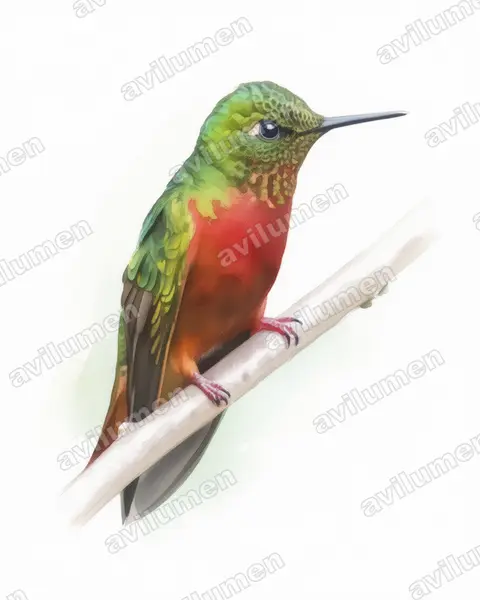
Watercolor 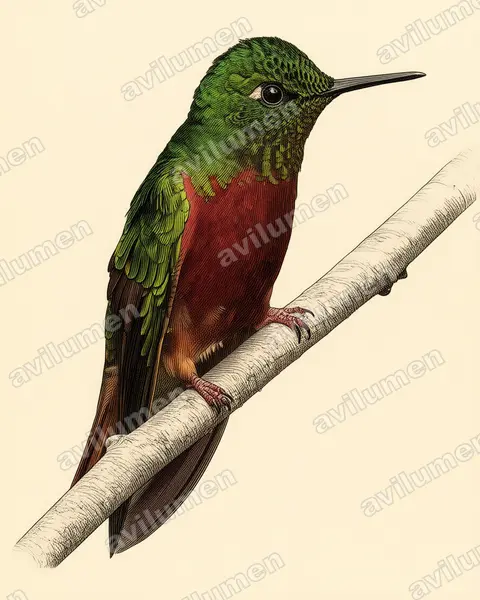
Vintage plate 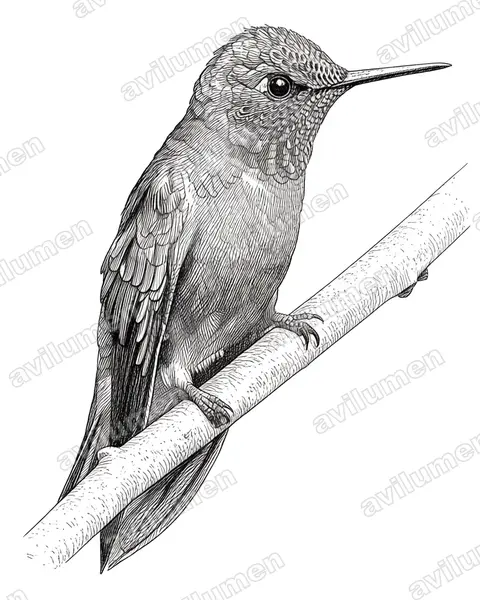
Ink 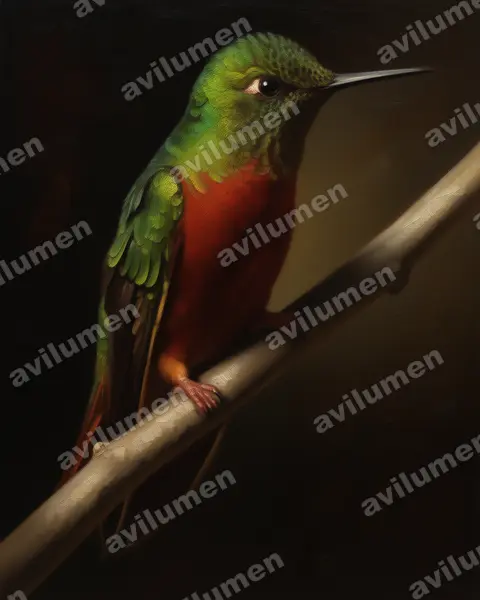
Oil 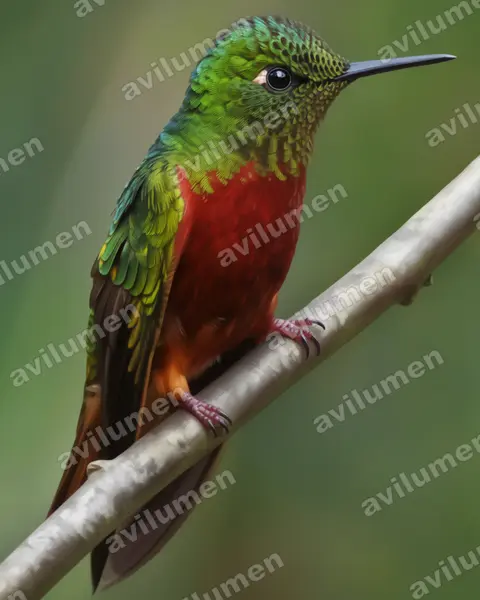
Realistic 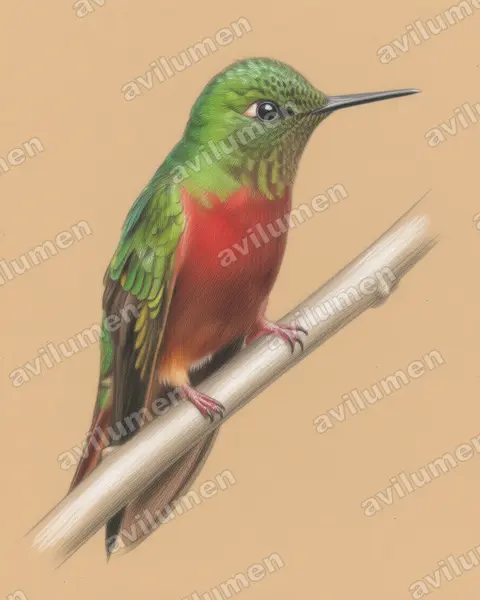
Colored pencil
Illustrations based on the photograph by Joseph C Boone (CC BY-SA 3.0), from Wikimedia Commons.
Digital editions
HD Digital Art Pack — Chestnut-breasted coronet
Digital download: 6 high-resolution illustrations of the Chestnut-breasted coronet (Boissonneaua matthewsii), print-ready. This is a digital file; no animal or physical item is included.
AI Avatar — Chestnut-breasted coronet
Generate an avatar fusing your face with the Chestnut-breasted coronet (Boissonneaua matthewsii). Delivered digitally in 8K, watermark-free. Digital product; no animals are sold or brokered.
Instant download. No live birds are sold.
Frequently asked questions
- Is Boissonneaua matthewsii (Chestnut-breasted coronet) endangered?
- The IUCN Red List places Boissonneaua matthewsii, commonly known as the Chestnut-breasted coronet, in the «Least concern» category. «Least concern» means it is not currently threatened.
- Where does Boissonneaua matthewsii (Chestnut-breasted coronet) live?
- Boissonneaua matthewsii (Chestnut-breasted coronet) is found in South America.
- What family does Boissonneaua matthewsii (Chestnut-breasted coronet) belong to?
- Boissonneaua matthewsii (Chestnut-breasted coronet) belongs to the family Trochilidae, in the order Apodiformes.
- What colour is Boissonneaua matthewsii (Chestnut-breasted coronet)?
- The plumage of Boissonneaua matthewsii (Chestnut-breasted coronet) combines these colours: Green and Brown.
More from the same family
 Least concern
Emerald-chinned Hummingbird
Abeillia abeillei
The emerald-chinned hummingbird is a species of hummingbird in the "emeralds", tribe Trochilini of subfamily Trochilinae.
from $1.99
 Least concern
Speckled hummingbird
Adelomyia melanogenys
The speckled hummingbird is a species of hummingbird. It is the only member of the genus Adelomyia. It inhabits Neotropical montane cloud forests at elevations of 1,000–2,500 meters and is confined to the Andes of Argentina, Bolivia, Peru, Ecuador, Colombia and Venezuela; as well as to some isolated montane forests in western Ecuador and Venezuela.
from $1.99
 Vulnerable
Purple-backed sunbeam
Aglaeactis aliciae
The purple-backed sunbeam is a bird species in the family Trochilidae. It is found only in Peru.
from $1.99
 Near threatened
White-tufted sunbeam
Aglaeactis castelnaudii
The white-tufted sunbeam is a species of hummingbird in the family Trochilidae. It is found only in Peru. Its natural habitats are subtropical or tropical moist montane forest and subtropical or tropical high-altitude shrubland.
from $1.99