Pink Cockatoo
Cacatua leadbeateri
Avilumen editorial team ·

The pink cockatoo, also known as Major Mitchell's cockatoo or Leadbeater's cockatoo, is a medium-sized cockatoo that inhabits arid and semiarid inland areas across Australia, with the exception of the north-east.
The pink cockatoo (Cacatua leadbeateri), also known as Major Mitchell's cockatoo or Leadbeater's cockatoo, is a medium-sized cockatoo that inhabits arid and semiarid inland areas across Australia, with the exception of the north-east.
Taxonomy and naming
Irish naturalist Nicholas Aylward Vigors described the species in 1831 as Plyctolophus leadbeateri. The scientific name commemorates the London naturalist and taxidermist Benjamin Leadbeater, who had given Vigors what would become the type specimen. Edward Lear painted it in his 1832 work Illustrations of the Family of Psittacidae, or Parrots. Citing Lear, William Swainson gave it the name Plyctolophus erythropterus.
The pink cockatoo is more closely related to Cacatua than is the galah. Its lineage diverged around the time of or shortly after the acquisition of the long crest, probably the former, as this crest type is not found in all Cacatua cockatoos, so must have been present in an early or incipient stage at the time of the divergence of the pink cockatoo's ancestors. Like the galah, this species has not lost the ability to deposit diluted pigment dyes in its body plumage, although it does not produce melanin colouration anymore, resulting in a lighter bird overall compared to the galah. Indeed, disregarding the crest, the pink cockatoo looks almost like a near-leucistic version of that species. Another indication of the early divergence of this species from the "white" cockatoo lineage is the presence of features found otherwise only in corellas, such as its plaintive yodeling cry, as well as others, which are unique to pink and the true white cockatoos, for example the large crest and rounded wing shape.
In 2023, this species was reclassified into the genus Cacatua by the International Ornithological Congress; although it represents a very basally diverging member of the clade, it shares close morphological, behavioural, and vocal features to other members of the genus. Due to this, the former genus Lophochroa may be better considered a monotypic subgenus of Cacatua.
Prior to 2023, "Major Mitchell's cockatoo" was designated the official name for this species by the International Ornithologists' Union (IOC). "Pink cockatoo" was its official name (with Major Mitchell as an alternative) in the 1926 official RAOU checklist, and was reinstated as the official name in 2023 following the IOC's taxonomic change. The bird became linked to Major Thomas Mitchell after he described the species in glowing terms in his books on his expeditions, calling it the "cockatoo of the interior". Mitchell himself called it the red-top cockatoo. Before this John Gould had called it Leadbeater's cockatoo (derived from the species name) in 1848, as had Lear in 1832. Gould added that people of the Swan River Colony called it pink cockatoo, and recorded an indigenous name Jak-kul-yak-kul. Other names include desert cockatoo, and chockalott, chock-a-lock, joggle-joggle, and wee juggler, the last anglicised from the Wiradjuri wijugla. In Central Australia south of Alice Springs, the Pitjantjatjara term is kakalyalya. Names recorded from South Australia include kukkalulla (Kokatha dialect of Western Desert language), nkuna and ungkuna (Arrernte), yangkunnu (Barngarla), and yangwina (Wirangu), and yel-le-lek (from the Wimmera), and cal-drin-ga (from the lower Murray).
BirdLife Australia officially renamed Major Mitchell's cockatoo back to "pink cockatoo" in 2023, due to Mitchell's involvement in the massacre of Aboriginal people at Mount Dispersion and a general trend to make species names more culturally inclusive.
Description
The pink cockatoo has a soft-textured white and salmon-pink plumage and large, bright red and yellow crest. Its former name referenced Major Thomas Mitchell, who wrote, "Few birds more enliven the monotonous hues of the Australian forest than this beautiful species whose pink-coloured wings and flowing crest might have embellished the air of a more voluptuous region." Pink cockatoo females and males are almost identical. The males are usually bigger. The female has a broader yellow stripe on the crest and develops a red eye when mature.
Reproduction and lifespan
The bird reaches sexual maturity around 3–4 years old. The oldest recorded pink cockatoo died at 83 years old.
Distribution and habitat
In contrast to those of the galah, populations of pink cockatoos have declined rather than increased as a result of man-made changes to the arid interior of Australia. Where galahs readily occupy cleared and part-cleared land, pink cockatoos require extensive woodlands, particularly favouring conifers (Callitris spp.), sheoak (Allocasuarina spp.) and eucalypts. Unlike other cockatoos, pink cockatoo pairs will not nest close to one another, so they cannot tolerate fragmented, partly cleared habitats, and their range is contracting.
In the Mallee region of Victoria where the galah and pink cockatoo can be found to be nesting in the same area, the two species have interbred and produced hybridised offspring occasionally.
The pink cockatoo is usually found in pairs or small groups, and feeds both on the ground and in trees.
Australia
The pink cockatoo is listed as endangered under the Environment Protection and Biodiversity Conservation Act 1999.
Victoria
The pink cockatoo is listed as a threatened species on the Victorian Flora and Fauna Guarantee Act (1988). Under this Act, an Action Statement for the recovery and future management of this species has been prepared.
On the 2013 advisory list of threatened vertebrate fauna in Victoria, this species is listed as vulnerable.
Aviculture
"Cookie" was a pink cockatoo and a beloved resident of Illinois' Brookfield Zoo near Chicago from the time the zoo opened in 1934 until his death on 27 August 2016. Cookie was 83 years old and he had been retired from public display since 2009 due to ill health prior to his death.
Text adapted from Wikipedia · CC BY-SA 4.0
Distribution

Taxonomy
- Order
- Psittaciformes
- Family
- Cacatuidae
- Genus
- Cacatua
- Conservation status
- Least concern
Listen to its call
No recording yet
Care guide
Cockatoo and Cockatiel Care Guide: Diet and Housing
How to care for a cockatoo or cockatiel: diet, cage size, feather dust, health, behavior, breeding and CITES legal status. A practical guide for bird owners.
Read the guide →Illustration gallery
6 illustrations of Cacatua leadbeateri (Pink Cockatoo) in different styles, true to its real plumage. Shown watermarked; the art pack includes the high-resolution originals, ready to print.
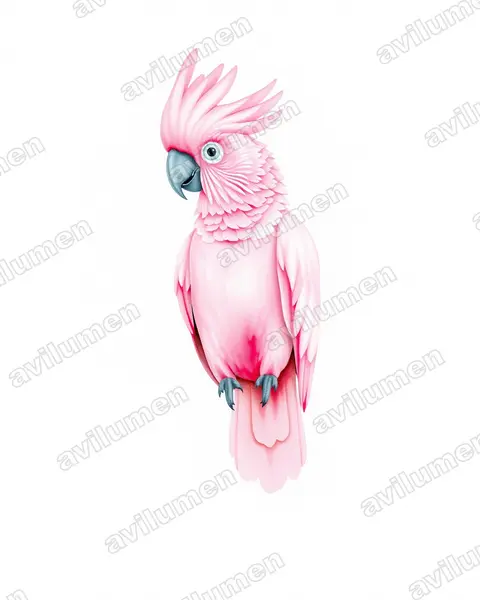
Watercolor 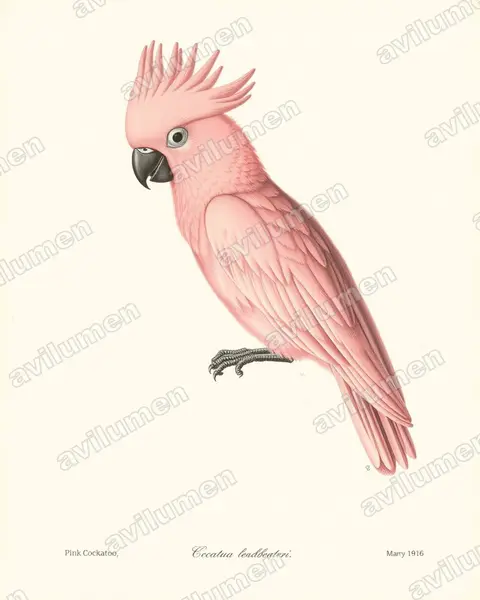
Vintage plate 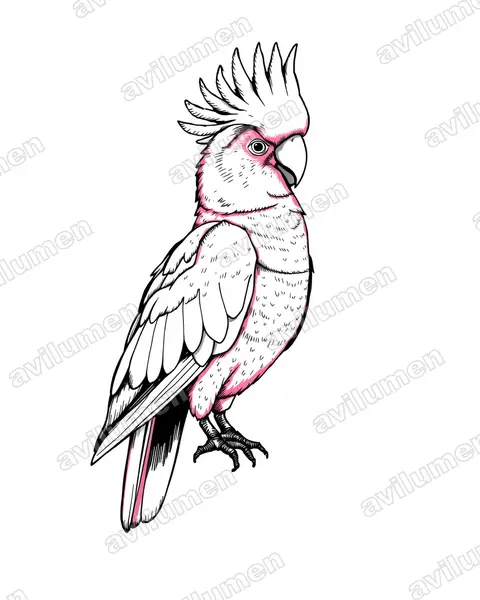
Ink 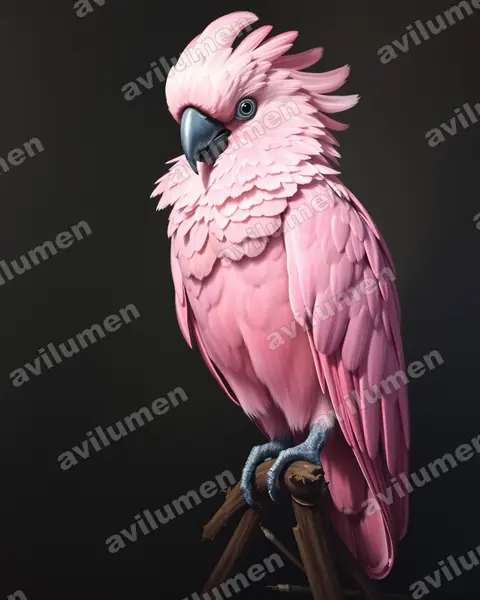
Oil 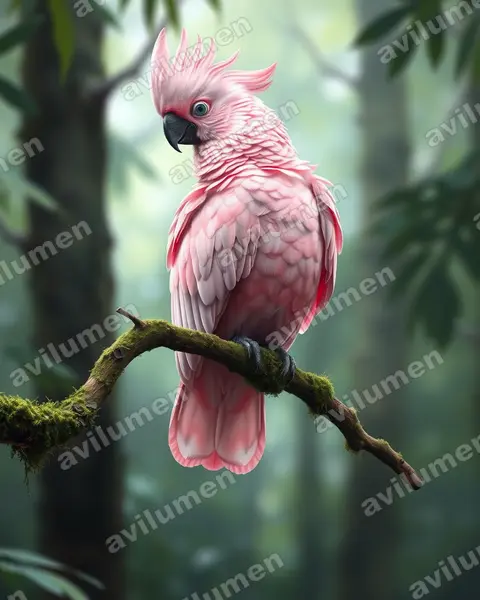
Realistic 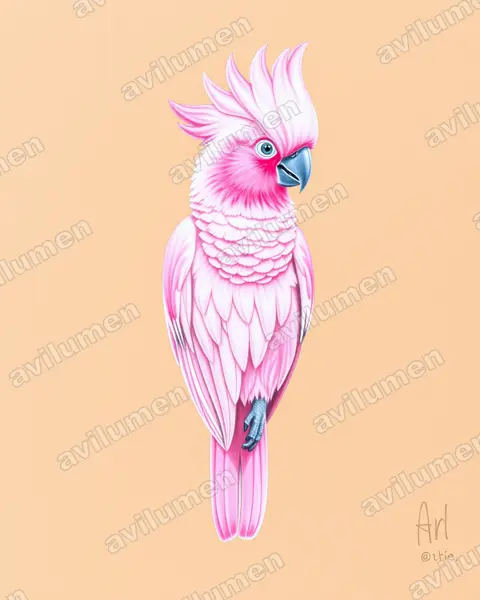
Colored pencil
Digital editions
HD Digital Art Pack — Pink Cockatoo
Digital download: 6 high-resolution illustrations of the Pink Cockatoo (Cacatua leadbeateri), print-ready. This is a digital file; no animal or physical item is included.
AI Avatar — Pink Cockatoo
Generate an avatar fusing your face with the Pink Cockatoo (Cacatua leadbeateri). Delivered digitally in 8K, watermark-free. Digital product; no animals are sold or brokered.
Instant download. No live birds are sold.
Frequently asked questions
- Is Cacatua leadbeateri (Pink Cockatoo) endangered?
- The IUCN Red List places Cacatua leadbeateri, commonly known as the Pink Cockatoo, in the «Least concern» category. «Least concern» means it is not currently threatened.
- Where does Cacatua leadbeateri (Pink Cockatoo) live?
- Cacatua leadbeateri (Pink Cockatoo) is found in Australia.
- What family does Cacatua leadbeateri (Pink Cockatoo) belong to?
- Cacatua leadbeateri (Pink Cockatoo) belongs to the family Cacatuidae, in the order Psittaciformes.
- What colour is Cacatua leadbeateri (Pink Cockatoo)?
- The plumage of Cacatua leadbeateri (Pink Cockatoo) combines these colours: Pink and White.
More from the same family
 Endangered
White Cockatoo
Cacatua alba
The white cockatoo, also known as the umbrella cockatoo, is a medium-sized all-white cockatoo endemic to tropical rainforest on islands of Indonesia. When surprised, it extends a large and striking head crest, which has a semicircular shape. The wings and tail have a pale yellow or lemon color which is exposed when they fly.
from $1.99
 Least concern
Solomons Cockatoo
Cacatua ducorpsii
The Solomons corella, also known as Solomons cockatoo, Ducorps's cockatoo or broad-crested corella, is a species of cockatoo endemic to the Solomon Islands archipelago. This small white cockatoo is larger than the Tanimbar corella yet smaller than the umbrella cockatoo. The species is common across most of the Solomons, absent only from Makira in the south.
from $1.99
 Least concern
Sulphur-crested Cockatoo
Cacatua galerita
The sulphur-crested cockatoo is a relatively large white cockatoo found in wooded habitats in Australia, New Guinea, and some of the islands of Indonesia. They can be locally very numerous, leading to them sometimes being considered pests. As highly intelligent birds, they are well known in aviculture, although they can be demanding pets.
from $1.99
 Near threatened
Tanimbar Corella
Cacatua goffiniana
The Tanimbar corella, also known as Goffin's cockatoo or Tanimbar cockatoo, is a species of cockatoo endemic to forests of Yamdena, Larat, and Selaru, all islands in the Tanimbar Islands archipelago in Indonesia. It has been introduced to the Kai Islands, Indonesia; Puerto Rico; and Singapore.
from $1.99