Magenta-throated woodstar
Calliphlox bryantae
Avilumen editorial team ·

The magenta-throated woodstar is a species of hummingbird in tribe Mellisugini of subfamily Trochilinae, the "bee hummingbirds". It is found in Costa Rica and Panama.
The magenta-throated woodstar (Philodice bryantae) is a species of hummingbird in tribe Mellisugini of subfamily Trochilinae, the "bee hummingbirds". It is found in Costa Rica and Panama.
Taxonomy and systematics
The magenta-throated woodstar has in the past been included in genera Nesophlox and Calliphlox. The International Ornithological Committee (IOC) and the Clements taxonomy have moved it to genus Philodice which it shares with the purple-throated woodstar (P. mitchellii). However, the North American Classification Committee of the American Ornithological Society and BirdLife International's Handbook of the Birds of the World retain both of them in Calliphlox.
The magenta-throated woodstar is monotypic.
Description
The male magenta-throated woodstar is about 9.0 cm (3.5 in) long and weighs about 3.3 g (0.12 oz). Females are about 7.5 cm (3.0 in) and weigh about 3.5 g (0.12 oz). Both sexes have a short, straight, black bill and a small white spot behind the eye. Both have bronzy green upperparts with some rufous spangles and a white band across the upper chest, though the male's is broader and brighter. Adult males have a metallic purple gorget, a green breast and flanks, and a rufous belly with a white or buffy patch on either side of the rump. Females have a buffy throat and a green breast and flanks with some rufous mixed in. The male's central tail feathers are short with black tips. Each pair outward from them are progressively longer; they are black with cinnamon-rufous inner webs. The adult female's central and outermost pairs of tail feathers are shorter than the intermediate ones, giving a "double rounded" look. The feathers are rufous with a black band near the end and buffy cinnamon tips. Immature birds are like the adult female, but paler below and with buff fringes on the upperparts plumage.
Distribution and habitat
The magenta-throated woodstar is found from northern Coast Rica into western Panama as far as Veraguas Province. It mostly occurs on the Pacific slope. It inhabits semi-open to open landscapes in the Talamancan montane ecoregion; examples include forest edges and clearings, thinned woodland, secondary forest, and shrubby pastures. In elevation it ranges between 700 and 1,850 m (2,300 and 6,100 ft) in Costa Rica and in Panama occurs between 1,100 and 1,750 m (3,600 and 5,700 ft).
Movement
The magenta-throated woodstar apparently makes local movements because at some sites it is present only part of the year. The details, however, are lacking.
Feeding
The magenta-throated woodstar feeds on nectar from a variety of flowering plants, shrubs, and trees. Both sexes may attempt to defend feeding territories, leading to chasing and other agonistic behavior. The male usually holds his long tail cocked and closed while feeding but opens it wide when displaying aggressively. In addition to feeding on nectar the species captures small arthropods by hawking from a perch or gleaning from foliage.
Breeding
The magenta-throated woodstar's breeding season in Costa Rica spans from November to March or April but has not been defined in Panama. Males give a diving display flight alone or in loose groups (possibly at leks). The species' nest has not been described and the incubation period and time to fledging are unknown.
Vocalization
The magenta-throated woodstar's song is "a low-pitched, rapid medley of sputtering and gurgling notes." Their calls include "a low-pitched dry rolling 'drr'", "a dry 'cht'", and "a low-pitched, whistled 'tew'." The last is given during chases.
Status
The IUCN originally assessed the magenta-throated woodstar as Near Threatened but since 2004 has rated it as being of Least Concern. It has a restricted range. Its population is estimated at between 20,000 and 50,000 mature individuals but is believed to be decreasing. It is considered locally common, at least seasonally, and appears able to tolerate some forest clearance.
Text adapted from Wikipedia · CC BY-SA 4.0
Distribution

Taxonomy
- Order
- Apodiformes
- Family
- Trochilidae
- Genus
- Calliphlox
- Conservation status
- Least concern
Listen to its call
No recording yet
Illustration gallery
6 illustrations of Calliphlox bryantae (Magenta-throated woodstar) in different styles, true to its real plumage. Shown watermarked; the art pack includes the high-resolution originals, ready to print.
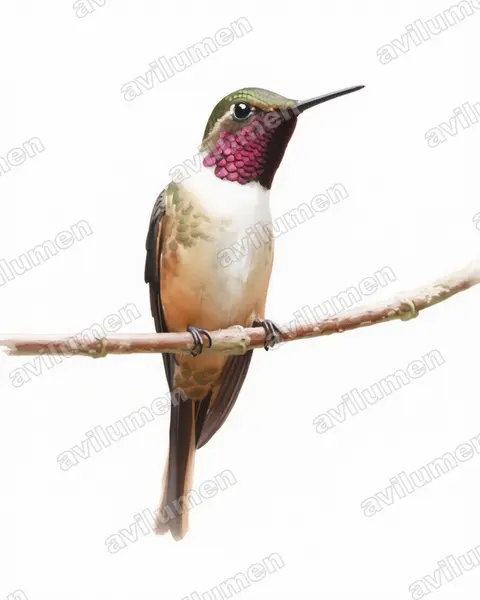
Watercolor 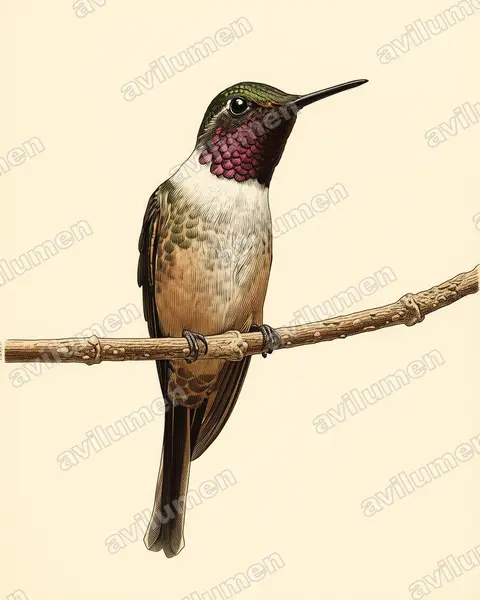
Vintage plate 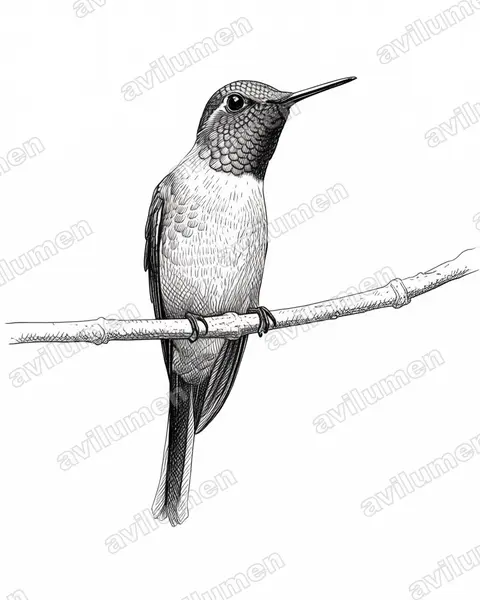
Ink 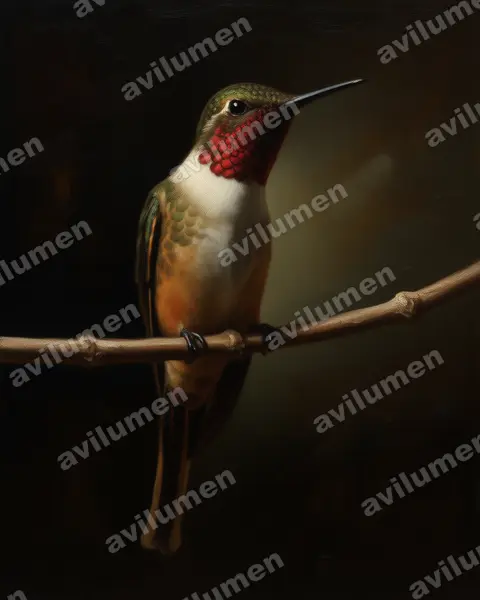
Oil 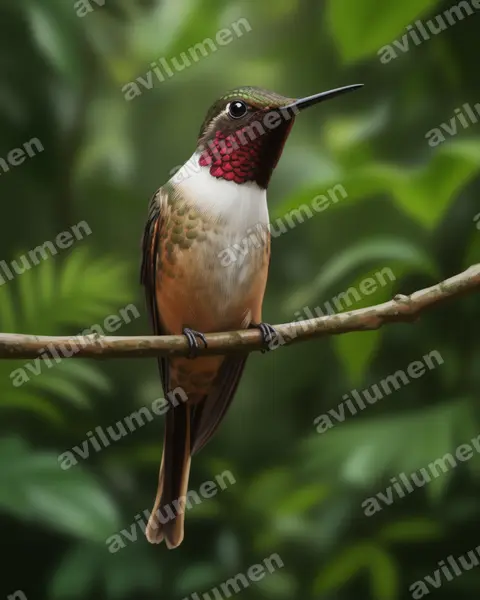
Realistic 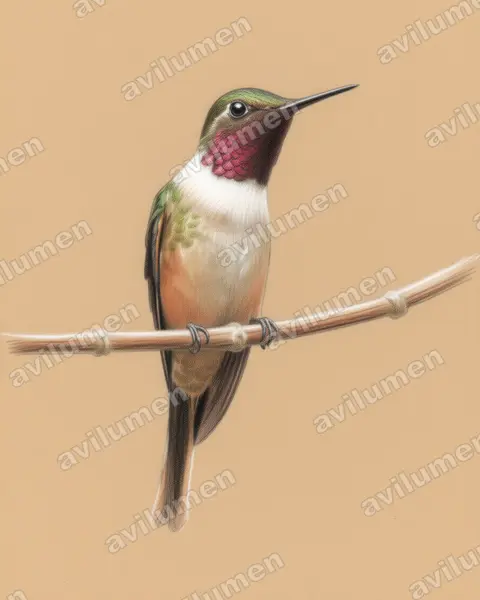
Colored pencil
Illustrations based on the photograph by Basar (CC BY-SA 3.0), from Wikimedia Commons.
Digital editions
HD Digital Art Pack — Magenta-throated woodstar
Digital download: 6 high-resolution illustrations of the Magenta-throated woodstar (Calliphlox bryantae), print-ready. This is a digital file; no animal or physical item is included.
AI Avatar — Magenta-throated woodstar
Generate an avatar fusing your face with the Magenta-throated woodstar (Calliphlox bryantae). Delivered digitally in 8K, watermark-free. Digital product; no animals are sold or brokered.
Instant download. No live birds are sold.
Frequently asked questions
- Is Calliphlox bryantae (Magenta-throated woodstar) endangered?
- The IUCN Red List places Calliphlox bryantae, commonly known as the Magenta-throated woodstar, in the «Least concern» category. «Least concern» means it is not currently threatened.
- What family does Calliphlox bryantae (Magenta-throated woodstar) belong to?
- Calliphlox bryantae (Magenta-throated woodstar) belongs to the family Trochilidae, in the order Apodiformes.
- What colour is Calliphlox bryantae (Magenta-throated woodstar)?
- The plumage of Calliphlox bryantae (Magenta-throated woodstar) combines these colours: Violet and Pink.
More from the same family
 Least concern
Emerald-chinned Hummingbird
Abeillia abeillei
The emerald-chinned hummingbird is a species of hummingbird in the "emeralds", tribe Trochilini of subfamily Trochilinae.
from $1.99
 Least concern
Speckled hummingbird
Adelomyia melanogenys
The speckled hummingbird is a species of hummingbird. It is the only member of the genus Adelomyia. It inhabits Neotropical montane cloud forests at elevations of 1,000–2,500 meters and is confined to the Andes of Argentina, Bolivia, Peru, Ecuador, Colombia and Venezuela; as well as to some isolated montane forests in western Ecuador and Venezuela.
from $1.99
 Vulnerable
Purple-backed sunbeam
Aglaeactis aliciae
The purple-backed sunbeam is a bird species in the family Trochilidae. It is found only in Peru.
from $1.99
 Near threatened
White-tufted sunbeam
Aglaeactis castelnaudii
The white-tufted sunbeam is a species of hummingbird in the family Trochilidae. It is found only in Peru. Its natural habitats are subtropical or tropical moist montane forest and subtropical or tropical high-altitude shrubland.
from $1.99