Red-tailed Black Cockatoo
Calyptorhynchus banksii
Avilumen editorial team ·

The red-tailed black cockatoo also known as Banksian- or Banks' black cockatoo, is a large black cockatoo native to Australia. Adult males have a characteristic pair of bright red panels on the tail that gives the species its name. It is more common in the drier parts of the continent. Five subspecies are recognised, differing chiefly in beak size.
The red-tailed black cockatoo (Calyptorhynchus banksii) also known as Banksian- or Banks' black cockatoo, is a large black cockatoo native to Australia. Adult males have a characteristic pair of bright red panels on the tail that gives the species its name. It is more common in the drier parts of the continent. Five subspecies are recognised, differing chiefly in beak size. Although the more northerly subspecies are widespread, the two southern subspecies, the forest red-tailed black cockatoo and the south-eastern red-tailed black cockatoo are under threat.
The species is usually found in eucalyptus woodlands, or along water courses. In the more northerly parts of the country, these cockatoos are commonly seen in large flocks. They are seed eaters and cavity nesters, and as such depend on trees with fairly large diameters, generally Eucalyptus. Populations in southeastern Australia are threatened by deforestation and other habitat alterations. Of the black cockatoos, the red-tailed is the most adaptable to aviculture, although black cockatoos are much rarer and much more expensive in aviculture outside Australia.
Taxonomy and naming
The species complex was first described by the ornithologist John Latham in 1790 as Psittacus banksii, commemorating English botanist Sir Joseph Banks. The red-tailed black cockatoo also has the distinction of being the first bird from Eastern Australia illustrated by a European, as a female, presumably collected at Endeavour River in north Queensland, was sketched by Banks' draughtsman Sydney Parkinson in 1770. Narrowly predating Latham, English naturalist George Shaw described Psittacus magnificus from a specimen collected somewhere in the Port Jackson (now Sydney) region. For many years, the species was referred to as Calyptorhynchus magnificus, proposed by Gregory Mathews in 1927 as Shaw's name had predated Latham's 1790 description. For several decades, Mathews' proposal was accepted by many authorities, although it was unclear whether the original Port Jackson reference had actually referred to the red-tailed black or, more likely, the glossy black cockatoo. In 1994, an application to conserve Calyptorhynchus banksii as the scientific name was accepted by the ICZN. The red-tailed black cockatoo is the type species of the genus Calyptorhynchus, the name of which is derived from the Greek calypto-/καλυπτο- "hidden" and rhynchus/ρυγχος "beak". The change was first made by Anselme Gaëtan Desmarest in 1826.
In 1827, Jennings proposed the name Psittacus niger for the bird. The binomial combination had already been used by Carl Linnaeus for the lesser vasa parrot in 1758, and by Johann Friedrich Gmelin for the palm cockatoo in 1788; it was thus invalid even though both other species were already known by different names at the time. Alternate common names include Banks' black cockatoo, Banksian black cockatoo, or simply black cockatoo. Indigenous people of the central Cape York Peninsula have several names for the bird: (minha) pachang in Pakanh; (inh -) inhulg in Uw Oykangand; and (inh -) anhulg in Uw Olkola. (The bracketed prefix (inh- or minha) is a qualifier meaning 'meat' or 'animal'.) Ngarnarrh or karnamarr are terms used by the Kunwinjku of Arnhem Land. In Central Australia, southwest of Alice Springs, the Pitjantjatjara term for the subspecies C. b. samueli is iranti. Karrak is a Noongar term derived from the call for the southwestern race C. b. naso. In the language of the Bungandidj of south-eastern South Australia and western Victoria this bird was called treen.
Classification
The red-tailed black cockatoo's closest relative is the glossy black cockatoo; the two species form the subgenus Calyptorhynchus within the genus of the same name. They are distinguished from the other black cockatoos of the subgenus Zanda by their significant sexual dimorphism and calls of the juveniles; one a squeaking begging call, the other a vocalization when swallowing food.
A 1999 mtDNA phylogenetic study of cockatoos utilizing among others, the red-tailed black cockatoo supported the hypotheses that cockatoos originated in Australia before the Paleogene and Neogene periods (66 mya, marking the end of the Mesozoic, to 2.6 mya) and that the genus Cacatua diversified in two separate radiations to the islands of Indonesia, New Guinea, and the South Pacific. It concluded that the first extant cockatoo to diverge from the ancestral cockatoos was the palm cockatoo, followed by a subclade containing the black cockatoos.
A 2008 mitochondrial and nuclear DNA phylogenetic study of the parrots, cockatoos and related taxa by utilizing among others the yellow-tailed black cockatoo, provides confirmatory evidence for a Gondwanaland origin of the ancestral parrots in the Cretaceous period, and an Australasia divergence of the ancestral cockatoos from the parrots in either late Cretaceous (66 mya) or Paleogene (45 mya) periods depending on baseline assumptions.
Five subspecies are recognised; they differ mainly in the size and shape of the beak, the overall bird size and female colouration:
C. b. banksii is found in Queensland and, rarely, in far northern New South Wales; it is the largest subspecies by overall body size and has a moderate-sized bill. It merges with subspecies macrorhynchus around the Gulf of Carpentaria. It has disappeared from much of its former range in northern New South Wales and southeast Queensland.
C. b. graptogyne, (Endangered) known as the south-eastern red-tailed black cockatoo, is found in southwestern Victoria and southeastern South Australia in an area bordered by Mount Gambier to the west, Portland to the south, Horsham to the northeast and Bordertown to the north. The smallest of the five subspecies, it was only recognised as distinct in the 1980s. It is predominantly dependent on stands of Eucalyptus baxteri (brown stringybark), Eucalyptus camaldulensis (river redgum) and Allocasuarina luehmannii (buloke) for feeding and nesting. These tree species have been all threatened by land clearing and most remaining are on private land; possibly only 500–1000 individuals remain. The subspecies and its habitat are the subject of a national recovery plan. In 2007 local landowners are being reimbursed for assisting in regenerating suitable habitat.
C. b. macrorhynchus, given the name great-billed cockatoo by Mathews, is found across northern Australia. Although thought to be widespread and abundant, this subspecies has been little studied. It is also large and has a large beak, as its subspecific name implies. Females lack red colouration in their tails.
C. b. naso (Vulnerable) is known as the forest red-tailed black cockatoo and is found in the southwest corner of Western Australia between Perth and Albany. This form has a larger bill, and favours marri (Corymbia (formerly Eucalyptus) calophylla), jarrah (E. marginata) and karri (E. diversicolor). Two of the most significant threats to this subspecies are illegal shooting and feral honeybees.
C. b. samueli exists in four scattered populations: in central coastal Western Australia from the Pilbara south to the northern Wheatbelt in the vicinity of Northam, and inland river courses in Central Australia, southwestern Queensland and the upper Darling River system in Western New South Wales. Birds of this subspecies are generally smaller with smaller bills than the nominate banksii.
Description
Red-tailed black cockatoos are around 60 centimetres (24 in) in length and sexually dimorphic. The male's plumage is all black with a prominent black crest made up of elongated feathers from the forehead and crown. The bill is dark grey. The tail is also black with two lateral bright red panels. Females are black with yellow-orange stripes in the tail and chest, and yellow grading to red spots on the cheeks and wings. The bill is pale and horn-coloured. The underparts are barred with fine yellow over a black base. Male birds weigh between 670 and 920 grams (1.48 and 2.03 lb), while females weigh slightly less at 615–870 grams (1.356–1.918 lb). In common with other cockatoos and parrots, red-tailed black cockatoos have zygodactyl feet, two toes facing forward and two backward, that allow them to grasp objects with one foot while standing on the other, for feeding and manipulation. Black cockatoos are almost exclusively left-footed (along with nearly all other cockatoos and most parrots).
Juvenile red-tailed black cockatoos resemble females until puberty, which occurs around four years of age, but have paler yellow barred underparts. As the birds reach maturity, males gradually replace their yellow tail feathers with red ones; the complete process takes around four years.
As with other cockatoos, the red-tailed black cockatoo can be very long-lived in captivity; in 1938, ornithologist Neville Cayley reported one over fifty years old at Taronga Zoo. Another bird residing at London and Rotterdam Zoos was 45 years and 5 months of age when it died in 1979.
Several calls of red-tailed black cockatoos have been recorded. The bird's contact call is a rolling metallic krur-rr or kree, which may carry long distances and is always given while flying; its alarm call is sharp. Displaying males vocalize a sequence of soft growling followed by a repetitive kred-kred-kred-kred.
Distribution and habitat
The red-tailed black cockatoo principally occurs across the drier parts of Australia. It is widespread and abundant in a broad band across the northern half of the country, where it has been considered an agricultural pest, with more isolated distribution in the south. It is found in a wide variety of habitats, from shrublands and grasslands through eucalypt, sheoak and Acacia woodlands, to dense tropical rainforests. The bird is dependent on large, old eucalypts for nesting hollows, although the specific gums used vary in different parts of the country.
Cockatoos are not wholly migratory, but they do exhibit regular seasonal movements in different parts of Australia. In the northern parts of the Northern Territory, they largely leave areas of high humidity in the summer wet season. In other parts of the country cockatoo seasonal movements tend to follow food sources, a pattern recorded in Northern Queensland, and New South Wales. In southwest Western Australia, both extant subspecies appear to have a north–south pattern; northwards after breeding in the case of subspecies naso, while movements by subspecies samueli in the wheatbelt can be irregular and unrelated to the seasons.
Behaviour
Red-tailed black cockatoos are diurnal, raucous and noisy, and are often seen flying high overhead in small flocks, sometimes mixed with other cockatoos. Flocks of up to 500 birds are generally only seen in the north or when the birds are concentrated at some food source. Otherwise, they are generally rather shy of humans. In northern and central Australia, birds may feed on the ground, while the two southern subspecies, graptogyne and naso, are almost exclusively arboreal. They tend to fly rather slowly with intermittent deep flapping wingbeats, markedly different from the shallow wingbeats of the similar glossy black cockatoo. They also often fly at considerable height.
Breeding
The male red-tailed black cockatoo courts by puffing up crest and cheek feathers, and hiding the beak; it then sings and struts, ending in a jump and a flash of red tail feathers toward the female who will most often reply by defensively biting him. Breeding generally takes place from May to September except in the case of the South-eastern subspecies, which nests during summer (December to February). Pairs of the subspecies samueli in the Wheatbelt region of Western Australia may produce two broods, while those of South-eastern subspecies only produce one. Nesting takes place in large vertical tree hollows of tall trees. Isolated trees are generally chosen, so birds can fly to and from them relatively unhindered. The same tree may be used for many years. Hollows can be 1 to 2 metres (3–7 ft) deep and 0.25–0.5 metres (10–20 in) wide, with a base of woodchips. A clutch consists of one or two white, lustreless eggs, although the second chick is in most cases neglected and perishes in infancy.
Feeding
Although red-tailed black cockatoos feed on a wide variety of native and introduced grains, the mainstay of their diet is eucalyptus seeds. There is a specific relationship between the species and larger-fruited species of gums. These vary across Australia but include the marri in Southwest Western Australia, Darwin woollybutt E. miniata across the north of the country, E. baxteri in Victoria and the bloodwood species Corymbia polycarpa and C. intermedia in Queensland. Cockatoos bite off branchlets with clusters of seed capsules, then hold them with their feet while chewing and harvesting seeds before littering the ground with debris. Among other seeds and nuts consumed are those of Acacia, Allocasuarina, Banksia, Grevillea and Hakea, as well as berries and fruits. They may also consume insects, but very rarely. Cockatoos have adapted to eating some introduced plants such as the doublegee (Emex australis). There is some evidence of consumption of wild radish (Raphanus raphanistrum), wild turnip (Brassica tournefortii) and melon (Citrullus or Cucumis). Red-tailed black cockatoos have been implicated as agricultural pests of peanut and other crops at Lakeland Downs in Far North Queensland. Here the cockatoos, in flocks of up to several hundred birds, have learned to sever the peanut plants above ground level before pulling the peanuts out of the ground by their stems and shelling them. They also damage electrical cables on pivot irrigators.
Conservation status
Text adapted from Wikipedia · CC BY-SA 4.0
Distribution

Taxonomy
- Order
- Psittaciformes
- Family
- Cacatuidae
- Genus
- Calyptorhynchus
- Conservation status
- Least concern
Listen to its call
No recording yet
Care guide
Cockatoo and Cockatiel Care Guide: Diet and Housing
How to care for a cockatoo or cockatiel: diet, cage size, feather dust, health, behavior, breeding and CITES legal status. A practical guide for bird owners.
Read the guide →Illustration gallery
6 illustrations of Calyptorhynchus banksii (Red-tailed Black Cockatoo) in different styles, true to its real plumage. Shown watermarked; the art pack includes the high-resolution originals, ready to print.
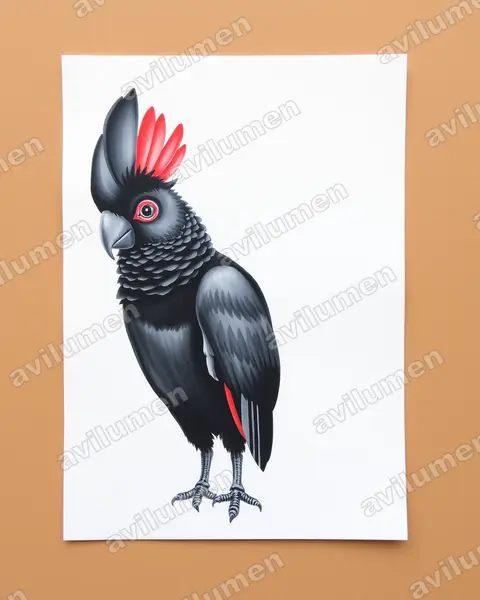
Watercolor 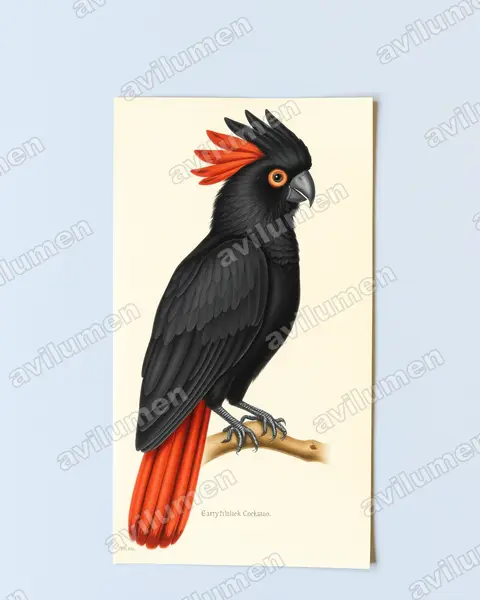
Vintage plate 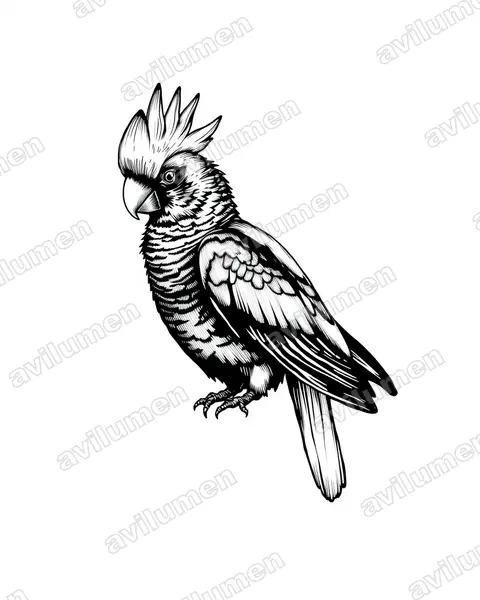
Ink 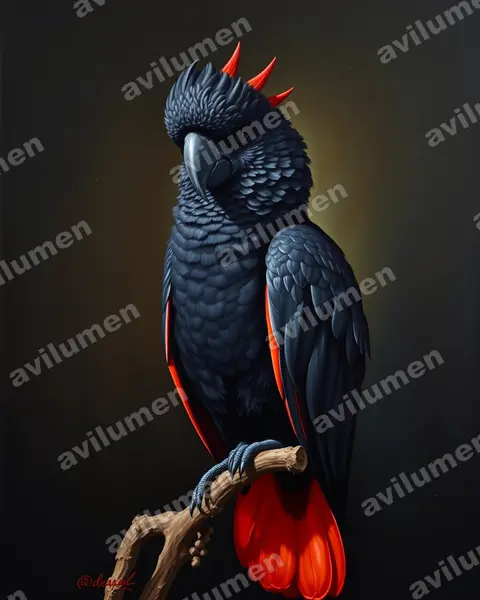
Oil 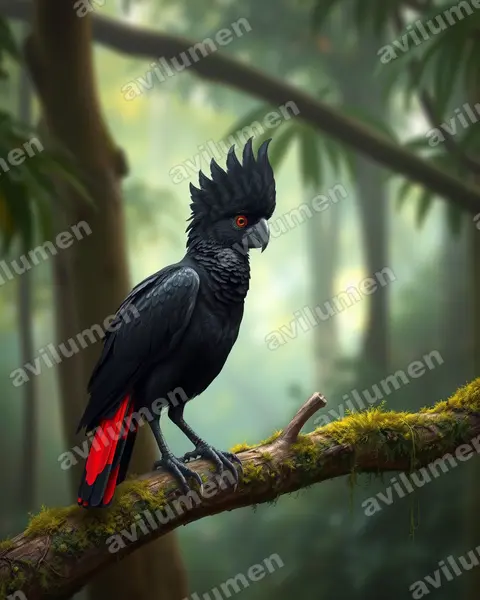
Realistic 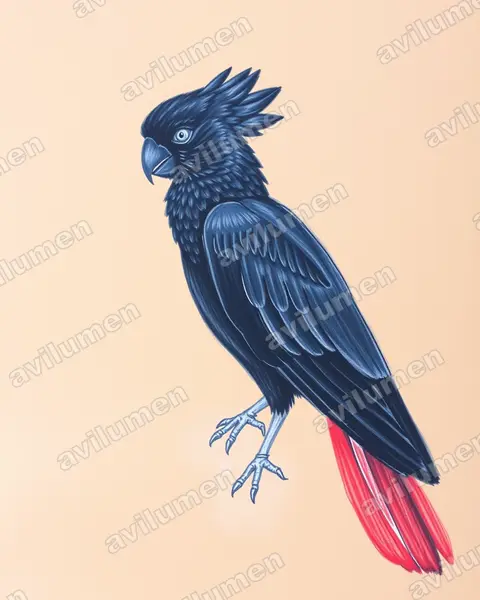
Colored pencil
Digital editions
HD Digital Art Pack — Red-tailed Black Cockatoo
Digital download: 6 high-resolution illustrations of the Red-tailed Black Cockatoo (Calyptorhynchus banksii), print-ready. This is a digital file; no animal or physical item is included.
AI Avatar — Red-tailed Black Cockatoo
Generate an avatar fusing your face with the Red-tailed Black Cockatoo (Calyptorhynchus banksii). Delivered digitally in 8K, watermark-free. Digital product; no animals are sold or brokered.
Instant download. No live birds are sold.
Frequently asked questions
- Is Calyptorhynchus banksii (Red-tailed Black Cockatoo) endangered?
- The IUCN Red List places Calyptorhynchus banksii, commonly known as the Red-tailed Black Cockatoo, in the «Least concern» category. «Least concern» means it is not currently threatened.
- Where does Calyptorhynchus banksii (Red-tailed Black Cockatoo) live?
- Calyptorhynchus banksii (Red-tailed Black Cockatoo) is found in Australia.
- What family does Calyptorhynchus banksii (Red-tailed Black Cockatoo) belong to?
- Calyptorhynchus banksii (Red-tailed Black Cockatoo) belongs to the family Cacatuidae, in the order Psittaciformes.
- What colour is Calyptorhynchus banksii (Red-tailed Black Cockatoo)?
- The plumage of Calyptorhynchus banksii (Red-tailed Black Cockatoo) combines these colours: Black and Red.
More from the same family
 Endangered
White Cockatoo
Cacatua alba
The white cockatoo, also known as the umbrella cockatoo, is a medium-sized all-white cockatoo endemic to tropical rainforest on islands of Indonesia. When surprised, it extends a large and striking head crest, which has a semicircular shape. The wings and tail have a pale yellow or lemon color which is exposed when they fly.
from $1.99
 Least concern
Solomons Cockatoo
Cacatua ducorpsii
The Solomons corella, also known as Solomons cockatoo, Ducorps's cockatoo or broad-crested corella, is a species of cockatoo endemic to the Solomon Islands archipelago. This small white cockatoo is larger than the Tanimbar corella yet smaller than the umbrella cockatoo. The species is common across most of the Solomons, absent only from Makira in the south.
from $1.99
 Least concern
Sulphur-crested Cockatoo
Cacatua galerita
The sulphur-crested cockatoo is a relatively large white cockatoo found in wooded habitats in Australia, New Guinea, and some of the islands of Indonesia. They can be locally very numerous, leading to them sometimes being considered pests. As highly intelligent birds, they are well known in aviculture, although they can be demanding pets.
from $1.99
 Near threatened
Tanimbar Corella
Cacatua goffiniana
The Tanimbar corella, also known as Goffin's cockatoo or Tanimbar cockatoo, is a species of cockatoo endemic to forests of Yamdena, Larat, and Selaru, all islands in the Tanimbar Islands archipelago in Indonesia. It has been introduced to the Kai Islands, Indonesia; Puerto Rico; and Singapore.
from $1.99