Grey-breasted sabrewing
Campylopterus largipennis
Avilumen editorial team ·

The grey-breasted sabrewing is a species of hummingbird in the "emeralds", tribe Trochilini of subfamily Trochilinae. It is found in Bolivia, Brazil, Ecuador, the Guianas, Peru, and Venezuela.
The grey-breasted sabrewing (Campylopterus largipennis) is a species of hummingbird in the "emeralds", tribe Trochilini of subfamily Trochilinae. It is found in Bolivia, Brazil, Ecuador, the Guianas, Peru, and Venezuela.
Taxonomy and systematics
The grey-breasted sabrewing was described by the French polymath Georges-Louis Leclerc, Comte de Buffon in 1780 in his Histoire Naturelle des Oiseaux from a specimen collected in Cayenne, French Guiana. The bird was also illustrated in a hand-colored plate engraved by François-Nicolas Martinet in the Planches Enluminées D'Histoire Naturelle which was produced under the supervision of Edme-Louis Daubenton to accompany Buffon's text. Neither the plate caption nor Buffon's description included a scientific name but in 1783 the Dutch naturalist Pieter Boddaert coined the binomial name Trochilus largipennis in his catalogue of the Planches Enluminées. The grey-breasted sabrewing is now placed in the genus Campylopterus that was erected by the English naturalist William Swainson in 1827. The generic name combines the Ancient Greek kampulos meaning "curved" or "bent" and -pteros meaning "-winged". The specific epithet largipennis combines the Latin largus meaning "ample" and -pennis meaning "-winged".
The further taxonomy of the grey-breasted sabrewing is unsettled. The International Ornithological Committee (IOC) assigns three subspecies, the nominate C. l. largipennis (Boddaert, 1783); C. l. obscurus Gould, 1848; and C. l. aequatorialis Gould, 1861. The Clements taxonomy and BirdLife International's Handbook of the Birds of the World (HBW) recognize only two by including aequatorialis within obscurus. In addition, C. l. obscurus has been suggested as a separate species.
What are now the outcrop sabrewing (C. calcirupicola) and Diamantina sabrewing (C. diamantinensis) were formerly treated as subspecies of the grey-breasted.
Description
The grey-breasted sabrewing is a large hummingbird, 12.4 to 14.9 cm (4.9 to 5.9 in) long. Males weigh 9 to 10 g (0.32 to 0.35 oz) and females about 7 to 8 g (0.25 to 0.28 oz). The sexes have almost identical plumage. Their bill is slightly decurved; the maxilla is black and the mandible pinkish with a black tip. The nominate subspecies' upperparts are dark shining green and the underparts dark gray. They have a white spot behind the eye. Their central pair of tail feathers is green and the rest bluish black on their inner half and white on the outer. Subspecies C. l. obscurus (with C. l. aequatorialis) is smaller than the nominate and its outer tail feathers' ends are usually gray rather than white.
Distribution and habitat
The three subspecies of grey-breasted sabrewing recognized by the IOC are distributed thus:
C. l. largipennis, eastern Venezuela, the Guianas, and northern Brazil as far west as the Rio Negro
C. l. obscurus, northeastern Brazil
C. l. aequatorialis, from eastern Colombia and northwestern Brazil south through eastern Ecuador and Peru into northern Bolivia
The species inhabits humid primary and secondary forest, clearings within them, and plantations. In elevation it ranges between 100 and 800 m (330 and 2,600 ft).
Movement
The grey-breasted sabrewing is a year-round resident throughout its range.
Feeding
The grey-breasted sabrewing forages for nectar at a variety of flowering plants, usually at low to medium heights. Males defend feeding territories. In addition to nectar, the species captures small insects by hawking from a perch.
Breeding
The grey-breasted sabrewing's breeding seasons differ greatly among the parts of its large range. It makes a cup nest of moss lined with soft seed material and decorates the outside with lichen. It places it like a saddle on a horizontal branch or attaches it to hanging twigs, typically near waterfalls or running streams and within about 1 m (3 ft) of the ground. The incubation period and time to fledging are not known.
Vocalization
The grey-breasted sabrewing makes "repeated short chik or trzik" calls and "occasionally a faster stuttering series." What is thought to be its song is the "same call note delivered in a more regular continuous series."
Status
The IUCN has assessed the grey-breasted sabrewing as being of Least Concern. It has a very large range and an estimated population of at least three million mature individuals, though the latter is believed to be decreasing. Its habitat is slowly being converted to agriculture, urbanization, and mining.
Text adapted from Wikipedia · CC BY-SA 4.0
Where it lives
Plumage colours
Distribution

Taxonomy
- Order
- Apodiformes
- Family
- Trochilidae
- Genus
- Campylopterus
- Conservation status
- Least concern
Listen to its call
No recording yet
Illustration gallery
6 illustrations of Campylopterus largipennis (Grey-breasted sabrewing) in different styles, true to its real plumage. Shown watermarked; the art pack includes the high-resolution originals, ready to print.
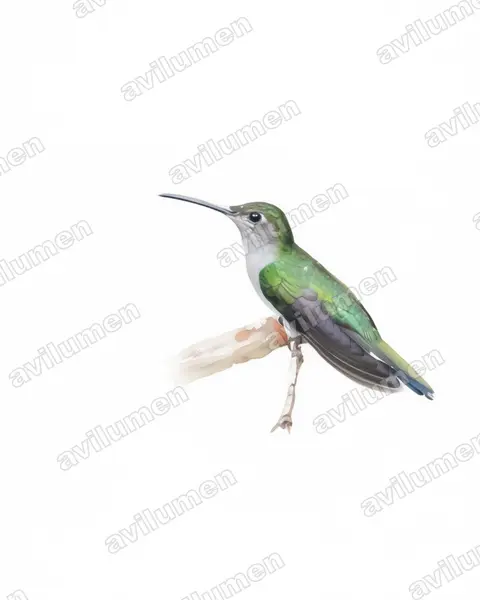
Watercolor 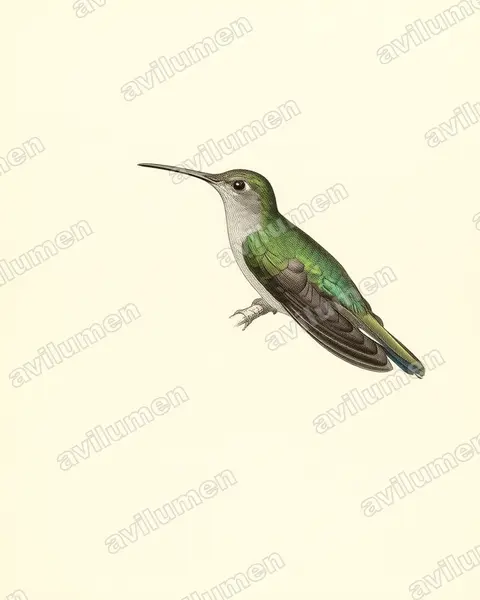
Vintage plate 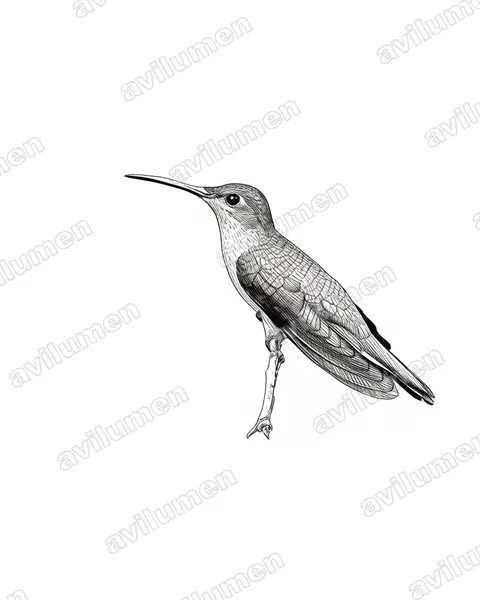
Ink 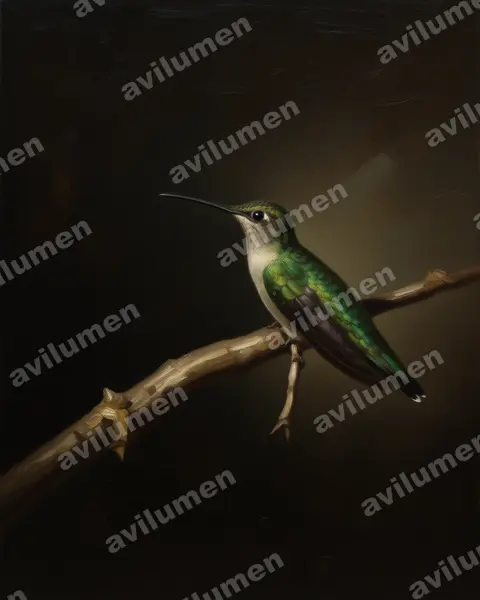
Oil 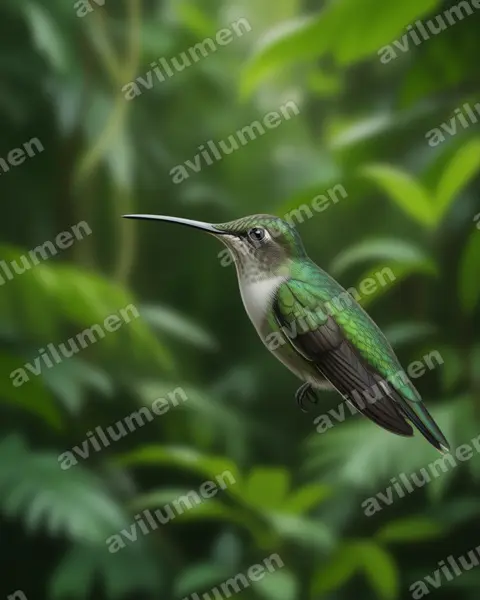
Realistic 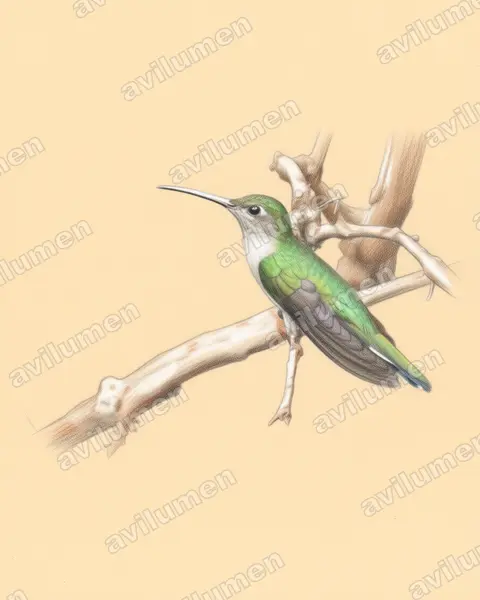
Colored pencil
Illustrations based on the photograph by Hector Bottai (CC BY-SA 4.0), from Wikimedia Commons.
Digital editions
HD Digital Art Pack — Grey-breasted sabrewing
Digital download: 6 high-resolution illustrations of the Grey-breasted sabrewing (Campylopterus largipennis), print-ready. This is a digital file; no animal or physical item is included.
AI Avatar — Grey-breasted sabrewing
Generate an avatar fusing your face with the Grey-breasted sabrewing (Campylopterus largipennis). Delivered digitally in 8K, watermark-free. Digital product; no animals are sold or brokered.
Instant download. No live birds are sold.
Frequently asked questions
- Is Campylopterus largipennis (Grey-breasted sabrewing) endangered?
- The IUCN Red List places Campylopterus largipennis, commonly known as the Grey-breasted sabrewing, in the «Least concern» category. «Least concern» means it is not currently threatened.
- Where does Campylopterus largipennis (Grey-breasted sabrewing) live?
- Campylopterus largipennis (Grey-breasted sabrewing) is found in Brazil and South America.
- What family does Campylopterus largipennis (Grey-breasted sabrewing) belong to?
- Campylopterus largipennis (Grey-breasted sabrewing) belongs to the family Trochilidae, in the order Apodiformes.
- What colour is Campylopterus largipennis (Grey-breasted sabrewing)?
- The plumage of Campylopterus largipennis (Grey-breasted sabrewing) combines these colours: Green.
More from the same family
 Least concern
Emerald-chinned Hummingbird
Abeillia abeillei
The emerald-chinned hummingbird is a species of hummingbird in the "emeralds", tribe Trochilini of subfamily Trochilinae.
from $1.99
 Least concern
Speckled hummingbird
Adelomyia melanogenys
The speckled hummingbird is a species of hummingbird. It is the only member of the genus Adelomyia. It inhabits Neotropical montane cloud forests at elevations of 1,000–2,500 meters and is confined to the Andes of Argentina, Bolivia, Peru, Ecuador, Colombia and Venezuela; as well as to some isolated montane forests in western Ecuador and Venezuela.
from $1.99
 Vulnerable
Purple-backed sunbeam
Aglaeactis aliciae
The purple-backed sunbeam is a bird species in the family Trochilidae. It is found only in Peru.
from $1.99
 Near threatened
White-tufted sunbeam
Aglaeactis castelnaudii
The white-tufted sunbeam is a species of hummingbird in the family Trochilidae. It is found only in Peru. Its natural habitats are subtropical or tropical moist montane forest and subtropical or tropical high-altitude shrubland.
from $1.99