Black-tipped Cotinga
Carpodectes hopkei
Avilumen editorial team ·

The black-tipped cotinga is a species of bird in the family Cotingidae. It is found in Colombia, Ecuador, and Panama.
The black-tipped cotinga (Carpodectes hopkei) is a species of bird in the family Cotingidae. It is found in Colombia, Ecuador, and Panama.
Taxonomy and systematics
The black-tipped cotinga shares genus Carpodectes with the yellow-billed cotinga (C. antoniae) and the snowy cotinga (C. nitidus). One early twentieth century author treated them as conspecific but they have been otherwise treated as separate species. The three form a superspecies. The black-tipped cotinga is monotypic.
At least one twentieth century author called Carpodectes hopkei the white cotinga.
Description
The black-tipped cotinga is 22 to 25 cm (8.7 to 9.8 in) long. The species is sexually dimorphic. Adult males are almost entirely white. They have a very faint gray tinge on their crown, back, and tail and small blackish spots on the tips of the outer primaries and innermost pair of tail feathers. Their flight feathers are wide and have rounded tips. Adult females have a dark grayish head and upperparts and a blackish tail. Their wings are mostly blackish with white edges on the coverts and inner flight feathers. Their breast is pale gray that fades to white towards the vent. Their secondaries are much thinner than the male's. Both sexes have an orange to dark red iris and blackish legs and feet. Their black bill has a wide base, a ridged culmen, and a notch on the tip of the maxilla. Immature birds of both sexes resemble adult females. Subadult males have almost adult plumage but have more dark markings on the wing feathers and black tips on most tail feathers.
Distribution and habitat
The black-tipped cotinga is found from Darién Province in southeastern Panama south in the lowlands through western Colombia into northwestern Ecuador as far as northern Pichincha Province. There are also scattered sightings further south in Ecuador. It primarily inhabits the canopy of humid forest in the tropical zone and occasionally is found in nearby secondary woodland. In elevation it ranges from sea level to 1,000 m (3,300 ft) in Panama and to 1,200 m (3,900 ft) in Colombia; it is found mostly below 500 m (1,600 ft) in Ecuador.
Movement
Though the black-tipped cotinga is believed to be a year-round resident, some seasonal movements are suspected.
Feeding
The black-tipped cotinga feeds mostly on fruits though details are lacking. It does seem to favor those of Cecropia trees. It sometimes forages in groups of up to about six individuals.
Breeding
Males make a display fight during which they flap their wings very slowly. Nothing else is known about the species' breeding biology.
Vocalization
As of October 2025 xeno-canto had only two recordings of black-tipped cotinga calls; the Cornell Lab's Macaulay Library had one of them but no others. No song is known for the species.
Status
The IUCN originally in 1994 assessed the black-tipped cotinga as Near Threatened but since 2000 as being of Least Concern. Its estimated population of between 20,000 and 50,000 mature individuals is believed to be decreasing. No immediate threats have been identified. It is considered rare to locally fairly common and occurs in some protected areas. However, its population has been "undoubtedly reduced by recent destruction of lowland forest, especially in NW Ecuador".
Text adapted from Wikipedia · CC BY-SA 4.0
Where it lives
Plumage colours
Distribution

Taxonomy
- Order
- Passeriformes
- Family
- Cotingidae
- Genus
- Carpodectes
- Conservation status
- Least concern
Listen to its call
No recording yet
Illustration gallery
6 illustrations of Carpodectes hopkei (Black-tipped Cotinga) in different styles, true to its real plumage. Shown watermarked; the art pack includes the high-resolution originals, ready to print.
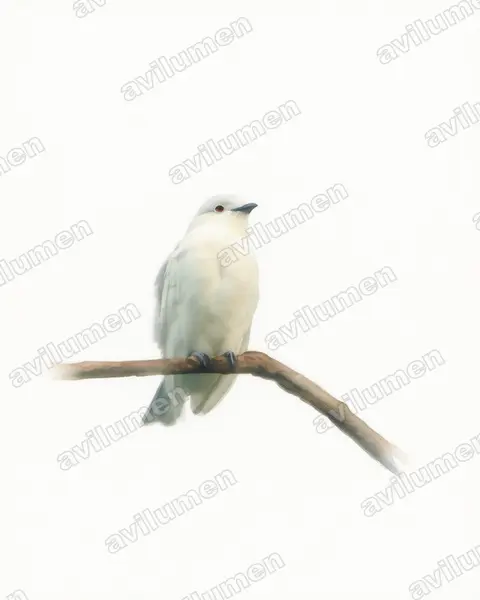
Watercolor 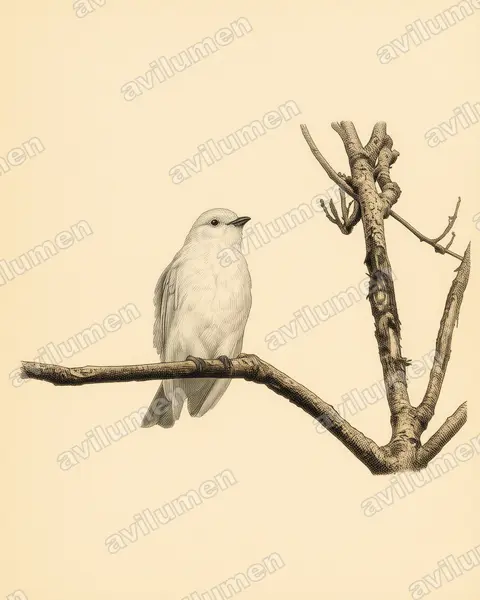
Vintage plate 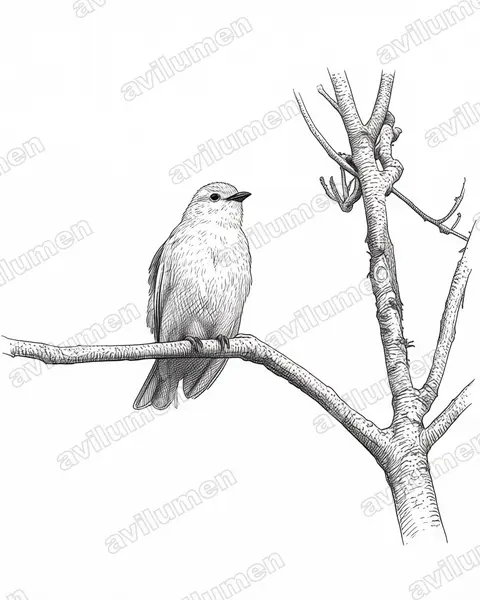
Ink 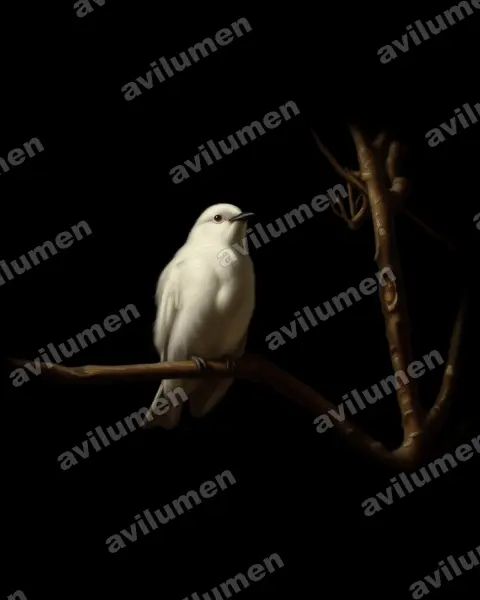
Oil 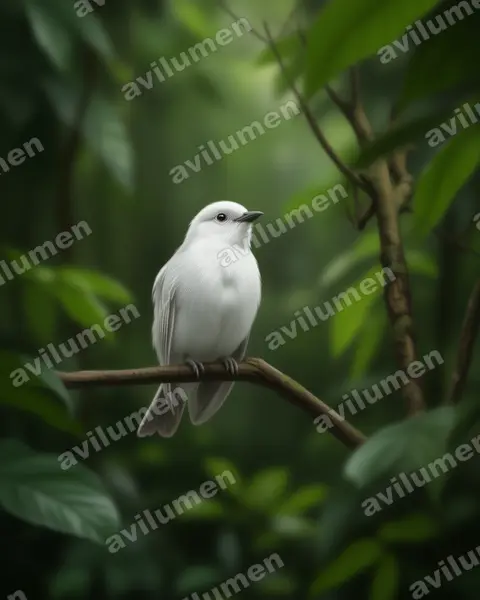
Realistic 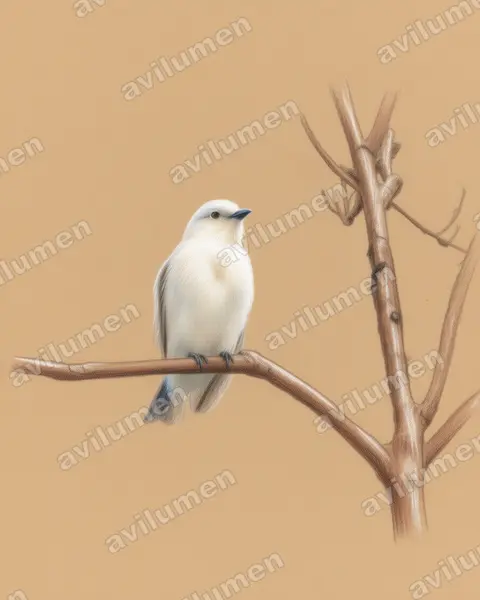
Colored pencil
Illustrations based on the photograph by Nick Athanas (CC BY-SA 2.0), from Wikimedia Commons.
Digital editions
HD Digital Art Pack — Black-tipped Cotinga
Digital download: 6 high-resolution illustrations of the Black-tipped Cotinga (Carpodectes hopkei), print-ready. This is a digital file; no animal or physical item is included.
AI Avatar — Black-tipped Cotinga
Generate an avatar fusing your face with the Black-tipped Cotinga (Carpodectes hopkei). Delivered digitally in 8K, watermark-free. Digital product; no animals are sold or brokered.
Instant download. No live birds are sold.
Frequently asked questions
- Is Carpodectes hopkei (Black-tipped Cotinga) endangered?
- The IUCN Red List places Carpodectes hopkei, commonly known as the Black-tipped Cotinga, in the «Least concern» category. «Least concern» means it is not currently threatened.
- Where does Carpodectes hopkei (Black-tipped Cotinga) live?
- Carpodectes hopkei (Black-tipped Cotinga) is found in South America.
- What family does Carpodectes hopkei (Black-tipped Cotinga) belong to?
- Carpodectes hopkei (Black-tipped Cotinga) belongs to the family Cotingidae, in the order Passeriformes.
- What colour is Carpodectes hopkei (Black-tipped Cotinga)?
- The plumage of Carpodectes hopkei (Black-tipped Cotinga) combines these colours: Black.
More from the same family
 Least concern
Scaled Fruiteater
Ampelioides tschudii
The scaled fruiteater is a species of bird in the family Cotingidae. It is the only member of the genus Ampelioides. This bird is found in Bolivia, Colombia, Ecuador, Peru, and Venezuela, where its natural habitat is the high elevation tropical forests of the Andes mountains. The scaled fruiteater is a chunky, short-tailed, flat-headed bird measuring 19–20 cm (7.5–7.9 in) in length.
from $1.99
 Least concern
Red-crested Cotinga
Ampelion rubrocristatus
The red-crested cotinga is a species of bird in the family Cotingidae. It is found in Bolivia, Colombia, Ecuador, Peru, and Venezuela.
from $1.99
 Least concern
Chestnut-crested Cotinga
Ampelion rufaxilla
The chestnut-crested cotinga is a species of bird in the family Cotingidae. It is found in Bolivia, Colombia, Ecuador, and Peru.
from $1.99
 Critically endangered
Kinglet Calyptura
Calyptura cristata
The kinglet calyptura is a small Critically Endangered passerine bird in the family Tyrannidae, the tyrant flycatchers. It is endemic to southeastern Brazil.
from $1.99