White-vented plumeleteer
Chalybura buffonii
Avilumen editorial team ·

The white-vented plumeleteer is a species of hummingbird in the "emeralds", tribe Trochilini of subfamily Trochilinae. It is found in Colombia, Ecuador, Panama, Peru, and Venezuela.
The white-vented plumeleteer (Chalybura buffonii) is a species of hummingbird in the "emeralds", tribe Trochilini of subfamily Trochilinae. It is found in Colombia, Ecuador, Panama, Peru, and Venezuela.
Taxonomy and systematics
Most taxonomic systems assign five subspecies to the white-vented plumeleteer:
C. b. micans Bangs & Barbour, 1922
C. b. buffonii Lesson, RP, (1832)
C. b. aeneicauda Lawrence, 1865
C. b. caeruleogaster Gould, (1847)
C. b. intermedia Hartert, EJO & Hartert, CBE, 1894
However, BirdLife International's Handbook of the Birds of the World (HBW) assigns C. b. intermedia as a subspecies of bronze-tailed plumeleteer (C. urochrysia).
Both C. b. caeruleogaster and C. b. intermedia have at times been proposed as separate species.
Description
The white-vented plumeleteer is 10.5 to 12 cm (4.1 to 4.7 in) long. Males weigh 6 to 7.3 g (0.21 to 0.26 oz) and females 5.9 to 7.9 g (0.21 to 0.28 oz). All of the subspecies except intermedia have a black bill and black feet; that one has a pinkish base to the mandible and pale pink to red feet.
Males of the nominate subspecies C. b. buffonii have mostly dark metallic green upperparts with a bronzy tinge to the crown and coppery bronze uppertail coverts. Their upper breast is bluish, lower breast bright metallic green, the lower belly whitish, and the undertail coverts long and white. Their tail is blue-black with a bronze gloss on the central feathers. Nominate females are paler metallic green above and gray below with green speckles on the side. Their tail is like the males' with the addition of dull gray tips on the outer feathers.
Subspecies C. b. micans is larger than the nominate. Males' central tail feathers are a deeper blue and females' undersides are a clearer gray. C. b. aeneicauda males are a more golden-green below than the nominate and their central tail feathers are bright bronze-green to copper-bronze. Females have pale gray underparts with sparse green flecks. C. b. caeruleogaster is the largest subspecies. The male has a bluish green throat and belly and a blue breast. Females have gray underparts with no flecking. C. b. intermedia males have a greenish-blue breast, a gray belly, and a dark blue tail.
Distribution and habitat
The subspecies of white-vented plumeleteer are distributed thus:
C. b. micans, central and eastern Panama, western Colombia, and Colombia's Cauca River and far upper Magdalena River valleys
C. b. buffonii, from central Colombia's upper and middle Magdalena valley east through extreme northeastern Colombia into northwestern Venezuela
C. b. aeneicauda, Colombia's lower Magdalena valley and Santa Marta region and east into western and north-central Venezuela
C. b. caeruleogaster, eastern slope of Colombia's Eastern Andes
C. b. intermedia, southwestern Ecuador and northwestern Peru
The white-vented plumeleteer inhabits a variety of landscapes including the edges and interiors of dry, moist, and wet forests, semi-open woodlands, secondary forest, and scrublands. The subspecies differ somewhat in their requirements; only caeruleogaster and sometimes buffonii frequent the interior of wet forest. In elevation the species ranges from sea level to as high as 2,000 m (6,600 ft).
Movement
The white-vented plumeleteer is not known to migrate or make seasonal movements.
Feeding
The white-vented plumeleteer forages for nectar at a wide variety of flowering plants from the understory almost to the canopy. It mostly forages by trap-lining, visiting a circuit of flowers, but also aggressively defends rich patches. In addition to nectar it catches small arthropods by hawking from a perch, hovering, and hover-gleaning from vegetation and spider webs.
Breeding
The white-vented plumeleteer's breeding seasons vary across its range, including September in Panama, February to August in the Magdalena valley, June to November in the Eastern Andes, and perhaps year-round in parts of Venezuela. Its nest is a cup of plant down bound with spiderweb with moss and lichen on the outside. Nests have been found on tree branches as high as 2.5 m (8 ft) above the ground. The only nest that was closely monitored held two eggs and its single hatchling fledged in 21 days.
Vocalization
The white-vented plumeleteer's song has not been described in words, but it is known to make "chip" notes while foraging.
Status
The IUCN has assessed the white-vented plumeleteer as being of least concern. It has a large range and an estimated population of at least 500,000 mature individuals, though the latter is believed to be decreasing. No immediate threats have been identified. It is considered uncommon to fairly common in most areas and seems to be able to tolerate some habitat disturbance. Deforestation of C. b. caeruleogaster's range is extensive, however.
Text adapted from Wikipedia · CC BY-SA 4.0
Where it lives
Distribution

Taxonomy
- Order
- Apodiformes
- Family
- Trochilidae
- Genus
- Chalybura
- Conservation status
- Least concern
Listen to its call
No recording yet
Illustration gallery
6 illustrations of Chalybura buffonii (White-vented plumeleteer) in different styles, true to its real plumage. Shown watermarked; the art pack includes the high-resolution originals, ready to print.
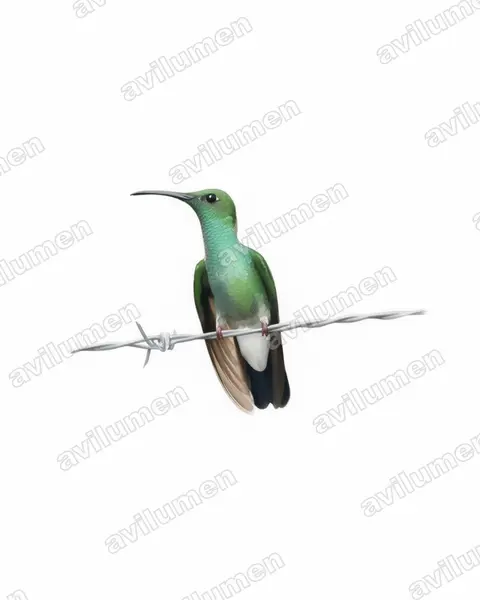
Watercolor 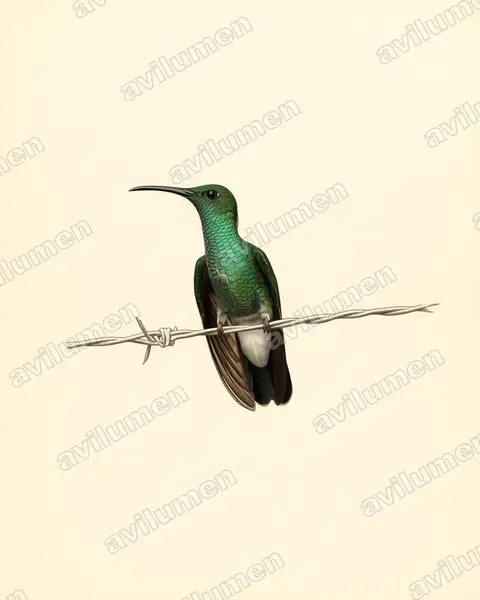
Vintage plate 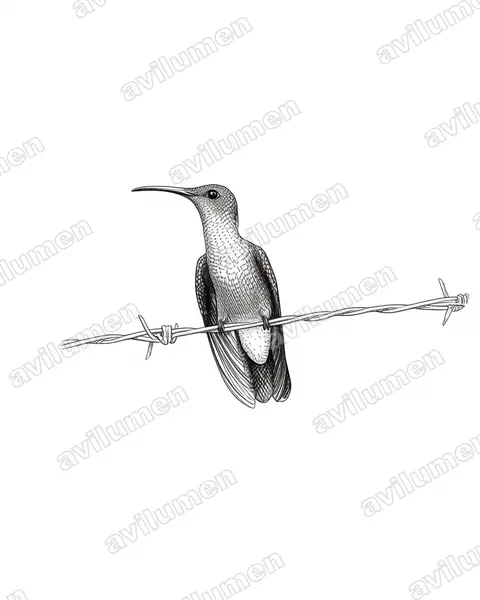
Ink 
Oil 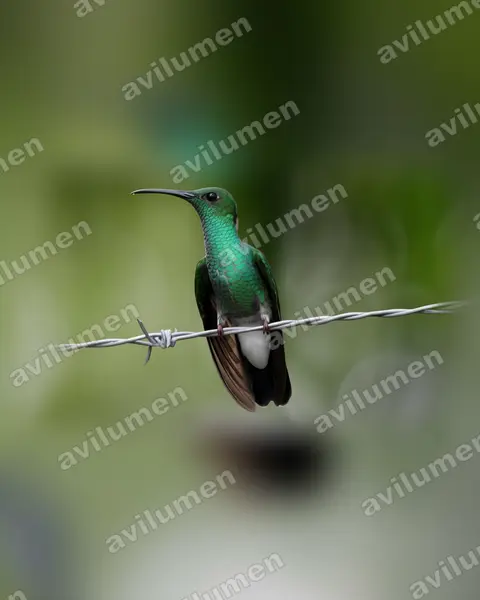
Realistic 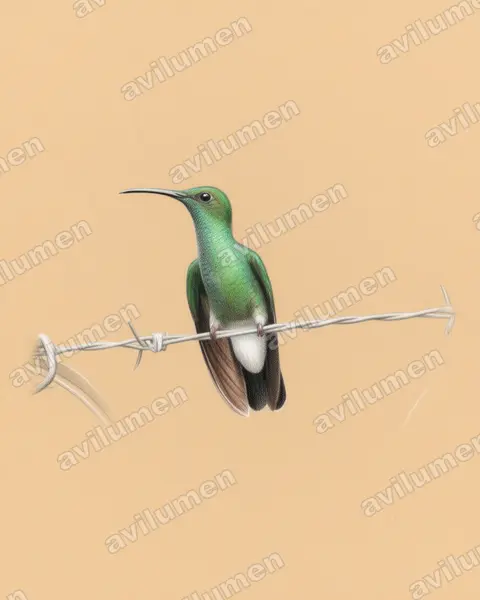
Colored pencil
Illustrations based on the photograph by Dominic Sherony (CC BY-SA 2.0), from Wikimedia Commons.
Digital editions
HD Digital Art Pack — White-vented plumeleteer
Digital download: 6 high-resolution illustrations of the White-vented plumeleteer (Chalybura buffonii), print-ready. This is a digital file; no animal or physical item is included.
AI Avatar — White-vented plumeleteer
Generate an avatar fusing your face with the White-vented plumeleteer (Chalybura buffonii). Delivered digitally in 8K, watermark-free. Digital product; no animals are sold or brokered.
Instant download. No live birds are sold.
Frequently asked questions
- Is Chalybura buffonii (White-vented plumeleteer) endangered?
- The IUCN Red List places Chalybura buffonii, commonly known as the White-vented plumeleteer, in the «Least concern» category. «Least concern» means it is not currently threatened.
- Where does Chalybura buffonii (White-vented plumeleteer) live?
- Chalybura buffonii (White-vented plumeleteer) is found in South America.
- What family does Chalybura buffonii (White-vented plumeleteer) belong to?
- Chalybura buffonii (White-vented plumeleteer) belongs to the family Trochilidae, in the order Apodiformes.
- What colour is Chalybura buffonii (White-vented plumeleteer)?
- The plumage of Chalybura buffonii (White-vented plumeleteer) combines these colours: White and Green.
More from the same family
 Least concern
Emerald-chinned Hummingbird
Abeillia abeillei
The emerald-chinned hummingbird is a species of hummingbird in the "emeralds", tribe Trochilini of subfamily Trochilinae.
from $1.99
 Least concern
Speckled hummingbird
Adelomyia melanogenys
The speckled hummingbird is a species of hummingbird. It is the only member of the genus Adelomyia. It inhabits Neotropical montane cloud forests at elevations of 1,000–2,500 meters and is confined to the Andes of Argentina, Bolivia, Peru, Ecuador, Colombia and Venezuela; as well as to some isolated montane forests in western Ecuador and Venezuela.
from $1.99
 Vulnerable
Purple-backed sunbeam
Aglaeactis aliciae
The purple-backed sunbeam is a bird species in the family Trochilidae. It is found only in Peru.
from $1.99
 Near threatened
White-tufted sunbeam
Aglaeactis castelnaudii
The white-tufted sunbeam is a species of hummingbird in the family Trochilidae. It is found only in Peru. Its natural habitats are subtropical or tropical moist montane forest and subtropical or tropical high-altitude shrubland.
from $1.99