Bronze-tailed plumeleteer
Chalybura urochrysia
Avilumen editorial team ·

The bronze-tailed plumeleteer is a species of hummingbird in the "emeralds", tribe Trochilini of subfamily Trochilinae. It is found in Colombia, Costa Rica, Ecuador, Nicaragua, and Panama.
The bronze-tailed plumeleteer (Chalybura urochrysia) is a species of hummingbird in the "emeralds", tribe Trochilini of subfamily Trochilinae. It is found in Colombia, Costa Rica, Ecuador, Nicaragua, and Panama.
Taxonomy
The bronze-tailed plumeleteer was formally described and illustrated in 1861 by the English ornithologist John Gould based on a specimen that had been supplied by the Polish collector Józef Warszewicz. Gould coined the binomial name Hypuroptila urochrysia but mistakenly gave the locality as the "neighbourhood of Panama". The locality has been redesignated as western Columbia. The bronze-tailed plumeleteer is now placed with the white-vented plumeleteer in the genus Chalybura that was introduced in 1854 by Ludwig Reichenbach. The genus name combines the Ancient Greek χαλυψ/khalups, χαλυβος/khalubos meaning "steel" with ουρα/oura meaning "tail". The specific epithet combines the Ancient Greek ουρα/oura meaning "tail" with χρυσεος/khruseos meaning "golden".
Three subspecies are recognised:
C. u. melanorrhoa Salvin, 1865 – Nicaragua and Costa Rica
C. u. isaurae (Gould, 1861) – east, west Panama and northwest Colombia
C. u. urochrysia (Gould, 1861) – southeast Panama, central north, west Colombia to northwest Ecuador
Most taxonomic systems assign three subspecies to the bronze-tailed plumeleteer, the nominate C. u. urochrysia, C. u. melanorrhoa, and C. u. isaurae. However, BirdLife International's Handbook of the Birds of the World (HBW) adds C. u. intermedia, which the others treat as a subspecies of the white-vented plumeleteer (C. buffonii). Subspecies melanorrhoa and isaurae have at times been suggested as separate species.
Description
The bronze-tailed plumeleteer is 10.5 to 12 cm (4.1 to 4.7 in) long. Males weigh about 7.1 g (0.25 oz) and females about 6.1 g (0.22 oz). Both sexes of all subspecies have a black maxilla and tip of the mandible; the rest of the mandible is dull pink to dark red. Males of the nominate subspecies have metallic green upperparts and glittering green underparts, with long fluffy white undertail coverts. Their tails are bronze-green. Females are also metallic green above but gray below with green flecks on the side. Their undertail coverts are grayish white and their outer tail feathers tipped with gray. Immature birds resemble the adults with buffy to cinnamon fringing on the feathers of the crown, nape, and rump.
Males of subspecies C. u. melanorrhoa have darker green upperparts than the nominate, with purplish bronze uppertail coverts. Their underparts are darker with a dusky bronze belly and shorter, sooty blackish, undertail coverts. Their tail is purplish black. Females are a darker gray below than the nominate and have more green flecking. Males of subspecies C. u. isaurae have a blue throat and breast, a bluish green belly, and a brighter bronze tail than the nominate. Females have pale gray underparts with little or no green flecks.
Distribution and habitat
Subspecies C. u. melanorrhoa of the bronze-tailed plumeleteer is the northernmost. It is found from eastern Nicaragua into Costa Rica and has a few records in eastern Honduras. C. u. isaurae is found on the Caribbean slope and locally on the Pacific slope of Panama and into extreme northwestern Colombia. The nominate is found from eastern Panama's Darién Province through north-central and western Colombia into northwestern Ecuador. The species inhabits the interior and edges of humid forest, mature secondary forest, and semi-open landscapes such as banana plantations and gardens. It shuns open areas. In elevation, it ranges from sea level to 700 m (2,300 ft) in Costa Rica and up to 900 m (3,000 ft) in Colombia.
(Note that the map includes the southwestern Ecuador range of the intermedia subspecies of white-vented plumeleteer.)
Movement
Subspecies C. u. melanorrhoa of bronze-tailed plumeleteer is known to make local seasonal movements, probably to find flowering plants. Movements of the other two subspecies, if any, are not known.
Feeding
The bronze-tailed plumeleteer mostly forages for nectar from the understory to the mid-strata, but will visit epiphytes in the sub-canopy. It especially favors Heliconia and aggressively defends patches of them and other rich nectar sources. It has also been documented to feed on Renealmia, Costus, Psychotria, Malvaviscus, Acanthaceae, Inga, and others. In addition to nectar, it captures small arthropods mainly by hawking from a perch but also by gleaning from foliage.
Breeding
The bronze-tailed plumeleteer breeds in Costa Rica between December and June, though mostly from February to April. In Colombia, it also appears to breed between February and April. Its nest is best known from Costa Rica; there it makes a deep cup nest of pale plant down and fibers bound with spiderweb and covered on the outside with moss and some lichen. It typically places it in a shrub about 0.5 to 1.5 m (2 to 5 ft) above the ground, often near a stream or trail.
Vocalization
What is thought to be the bronze-tailed plumeleteer's song is "a soft, nasal, scratchy, trilled phrase, ter-twee-ee-ee-ee-ee....ter-twee-ee-ee...". It makes "a drawn-out descending chattering trill" when chasing and also "loud chup and chip notes".
Status
The International Union for Conservation of Nature follows HBW taxonomy and so includes the intermedia subspecies of white-vented plumeleteer with this species. It has assessed the bronze-tailed plumeleteer as being of Least Concern, though its population size is not known and is believed to be decreasing. Much of its habitat has been destroyed in Central America but it is still locally common at many sites.
Text adapted from Wikipedia · CC BY-SA 4.0
Where it lives
Distribution

Taxonomy
- Order
- Apodiformes
- Family
- Trochilidae
- Genus
- Chalybura
- Conservation status
- Least concern
Listen to its call
No recording yet
Illustration gallery
6 illustrations of Chalybura urochrysia (Bronze-tailed plumeleteer) in different styles, true to its real plumage. Shown watermarked; the art pack includes the high-resolution originals, ready to print.
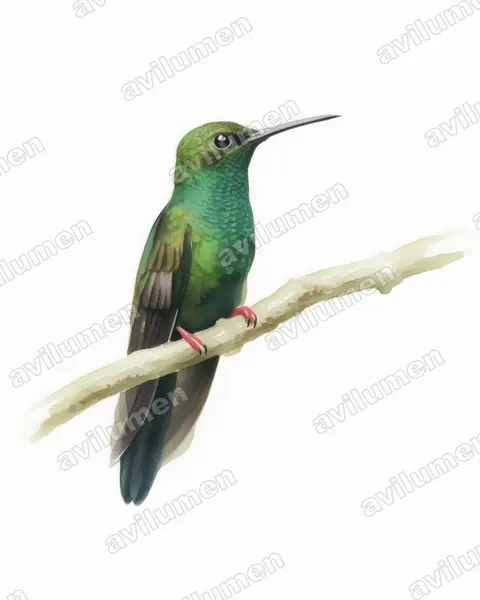
Watercolor 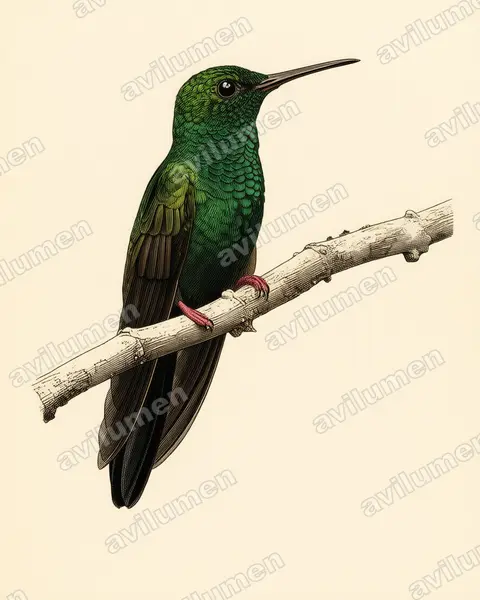
Vintage plate 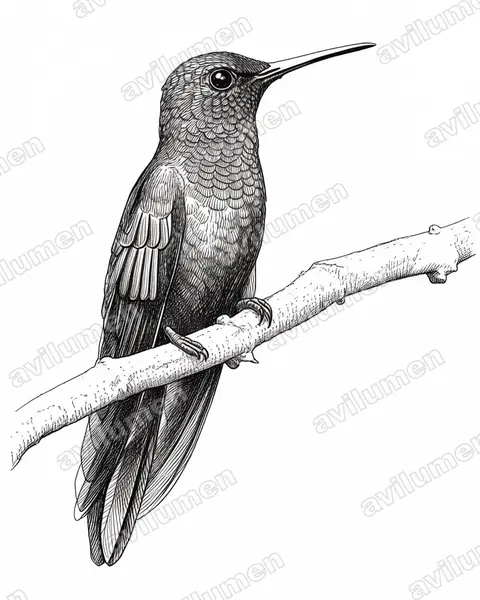
Ink 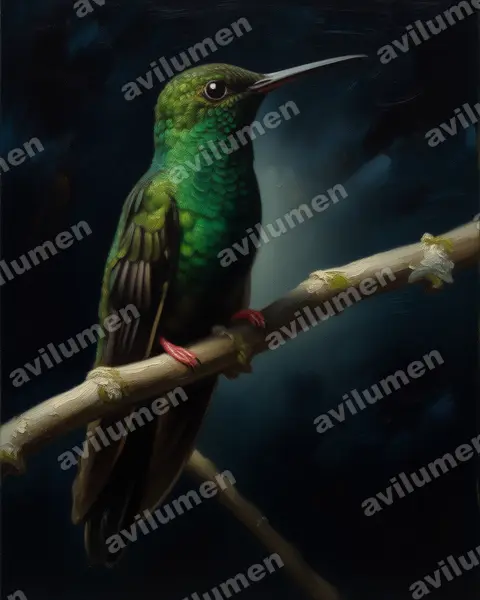
Oil 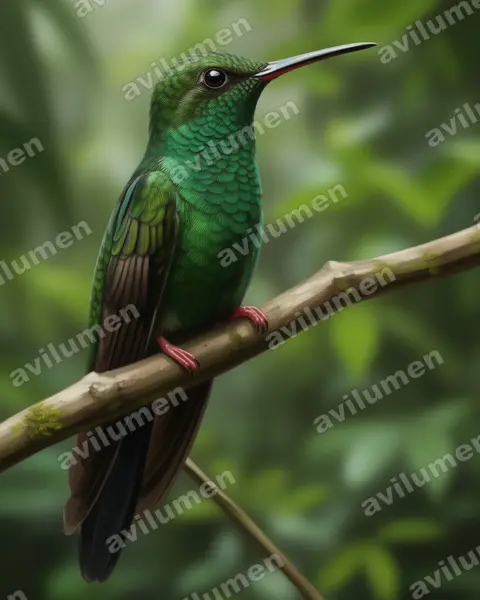
Realistic 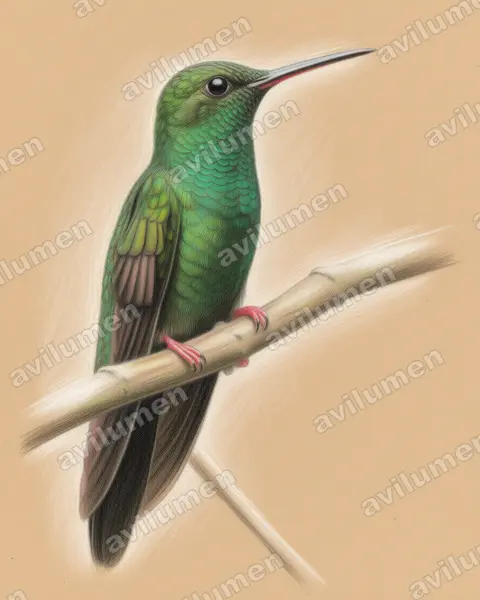
Colored pencil
Illustrations based on the photograph by (Hans Hillewaert) (CC BY-SA 3.0), from Wikimedia Commons.
Digital editions
HD Digital Art Pack — Bronze-tailed plumeleteer
Digital download: 6 high-resolution illustrations of the Bronze-tailed plumeleteer (Chalybura urochrysia), print-ready. This is a digital file; no animal or physical item is included.
AI Avatar — Bronze-tailed plumeleteer
Generate an avatar fusing your face with the Bronze-tailed plumeleteer (Chalybura urochrysia). Delivered digitally in 8K, watermark-free. Digital product; no animals are sold or brokered.
Instant download. No live birds are sold.
Frequently asked questions
- Is Chalybura urochrysia (Bronze-tailed plumeleteer) endangered?
- The IUCN Red List places Chalybura urochrysia, commonly known as the Bronze-tailed plumeleteer, in the «Least concern» category. «Least concern» means it is not currently threatened.
- Where does Chalybura urochrysia (Bronze-tailed plumeleteer) live?
- Chalybura urochrysia (Bronze-tailed plumeleteer) is found in South America.
- What family does Chalybura urochrysia (Bronze-tailed plumeleteer) belong to?
- Chalybura urochrysia (Bronze-tailed plumeleteer) belongs to the family Trochilidae, in the order Apodiformes.
- What colour is Chalybura urochrysia (Bronze-tailed plumeleteer)?
- The plumage of Chalybura urochrysia (Bronze-tailed plumeleteer) combines these colours: Brown and Green.
More from the same family
 Least concern
Emerald-chinned Hummingbird
Abeillia abeillei
The emerald-chinned hummingbird is a species of hummingbird in the "emeralds", tribe Trochilini of subfamily Trochilinae.
from $1.99
 Least concern
Speckled hummingbird
Adelomyia melanogenys
The speckled hummingbird is a species of hummingbird. It is the only member of the genus Adelomyia. It inhabits Neotropical montane cloud forests at elevations of 1,000–2,500 meters and is confined to the Andes of Argentina, Bolivia, Peru, Ecuador, Colombia and Venezuela; as well as to some isolated montane forests in western Ecuador and Venezuela.
from $1.99
 Vulnerable
Purple-backed sunbeam
Aglaeactis aliciae
The purple-backed sunbeam is a bird species in the family Trochilidae. It is found only in Peru.
from $1.99
 Near threatened
White-tufted sunbeam
Aglaeactis castelnaudii
The white-tufted sunbeam is a species of hummingbird in the family Trochilidae. It is found only in Peru. Its natural habitats are subtropical or tropical moist montane forest and subtropical or tropical high-altitude shrubland.
from $1.99