Amazon Kingfisher
Chloroceryle amazona
Avilumen editorial team ·

The Amazon kingfisher is a species of "water kingfisher" in subfamily Cerylinae of family Alcedinidae. It is found in the lowlands of the American tropics from southern Mexico south through Central America to northern Argentina.
The Amazon kingfisher (Chloroceryle amazona) is a species of "water kingfisher" in subfamily Cerylinae of family Alcedinidae. It is found in the lowlands of the American tropics from southern Mexico south through Central America to northern Argentina.
Taxonomy and systematics
The first formal description of the Amazon kingfisher was by the English ornithologist John Latham in 1790 under the binomial name Alcedo amazona. The current genus Chloroceryle was erected by Johann Jakob Kaup in 1848. The species is monotypic.
Description
The Amazon kingfisher is about 30 cm (12 in) long. Males weigh 98 to 121 g (3.5 to 4.3 oz) and females 125 to 140 g (4.4 to 4.9 oz). It has the typical kingfisher shape, with a shaggy crest and long heavy bill. The bill is black with some pale yellow at the base of the mandible and its legs and feet are dark grey. Adult males have dark bronzy green upperparts divided by a white collar. They have a white chin and throat, a rich rufous breast with dark green sides, and a white belly with dark green streaks on the side. Adult females lack the rufous breast but the green of the sides extends across the breast almost to its middle. Juvenile males have a buffy rufous breast and both sexes have buff spots on the upperwing coverts and a large yellow patch on their bill.
Distribution and habitat
The Amazon kingfisher is found from the Mexican states of Sinaloa and Tamaulipas south through Central America into Colombia and Venezuela and separately east of the Andes in every South American country except Chile, reaching as far south as central Argentina. It has been recorded as a vagrant to Aruba, Curaçao, Trinidad, and Texas. It inhabits large rivers, both slow- and fast-flowing, and the wooded shores of lakes and freshwater lagoons. It also occasionally occurs in brackish lagoons, mangroves, and tidal estuaries. It favors open landscapes rather than dense forest. In elevation it is mostly found below 1,200 m (3,900 ft) but occurs as high as 2,500 m (8,200 ft) in Venezuela.
Movement
The Amazon kingfisher is generally believed to be sedentary but there are records of vagrancy.
Feeding
The Amazon kingfisher usually hunts from a perch from which it dives into water for its prey. Occasionally it hovers before diving. Its diet is mostly fish, especially those of family Characidae, and crustaceans.
Breeding
The Amazon kingfisher's breeding season varies geographically. It is generally in the first half of the year in Central America but has not been detailed elsewhere. Both members of a pair excavate a slightly inclined burrow in a river bank or similar feature; it is typically up to 1.6 m (5.2 ft) long and has a nest chamber at the end. The clutch size is three or four eggs. Most incubation at night is by the female and during the day by the male. The incubation period is about 22 days and fledging occurs 29 to 30 days after hatch.
Vocalization
The Amazon kingfisher makes a "[l]oud, harsh, repeated 'tek' or 'klek'" and a "staccato 'chrit'" that may be extended into a rattle. It also makes "frog-like" calls. Another vocalization is "an accelerating series of clear notes...'see see see...su su su su'" that is thought to be a greeting or alarm call.
Status
The IUCN has assessed the Amazon kingfisher as being of Least Concern. It has an extremely large range. Its estimated population of at least a half million mature individuals is, however, believed to be decreasing. No immediate threats have been identified.
Text adapted from Wikipedia · CC BY-SA 4.0
Where it lives
Plumage colours
Distribution

Taxonomy
- Order
- Coraciiformes
- Family
- Alcedinidae
- Genus
- Chloroceryle
- Conservation status
- Least concern
Listen to its call
No recording yet
Illustration gallery
6 illustrations of Chloroceryle amazona (Amazon Kingfisher) in different styles, true to its real plumage. Shown watermarked; the art pack includes the high-resolution originals, ready to print.
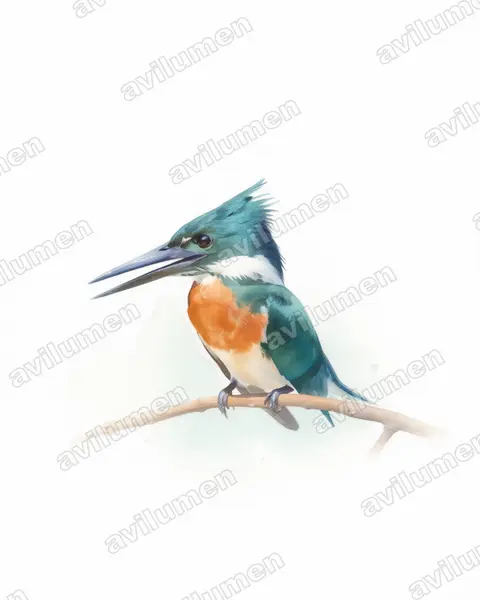
Watercolor 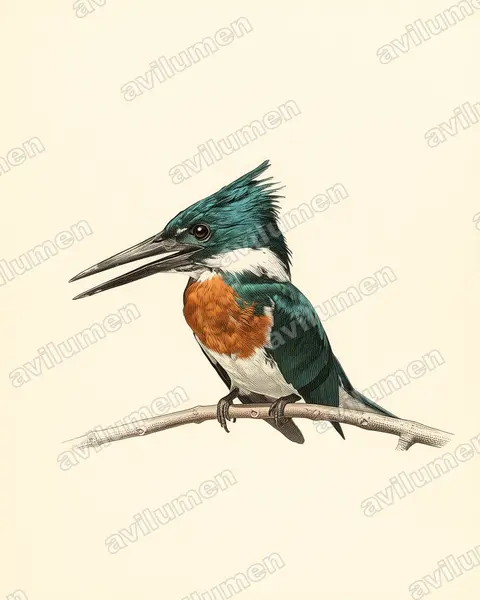
Vintage plate 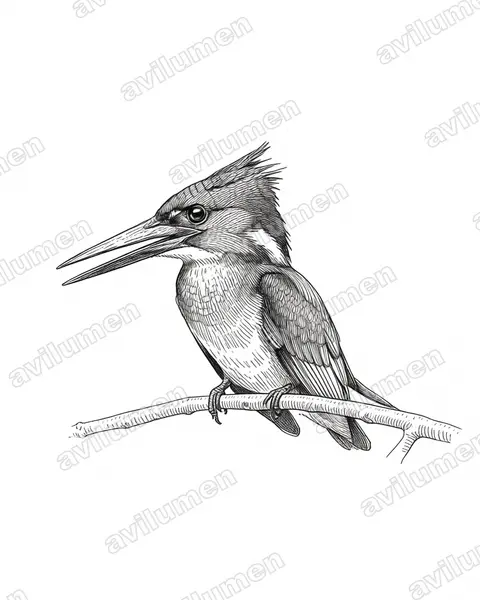
Ink 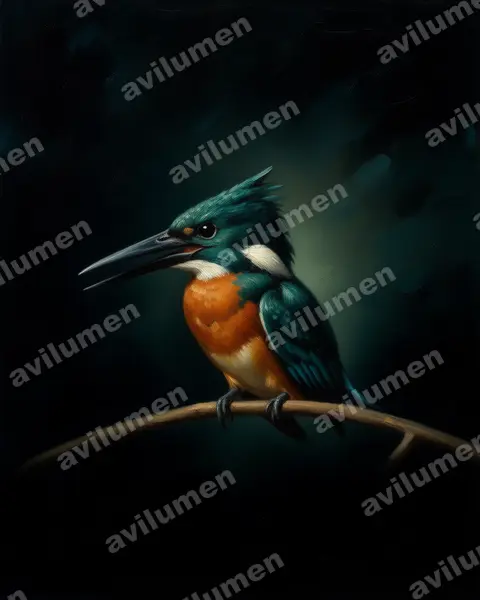
Oil 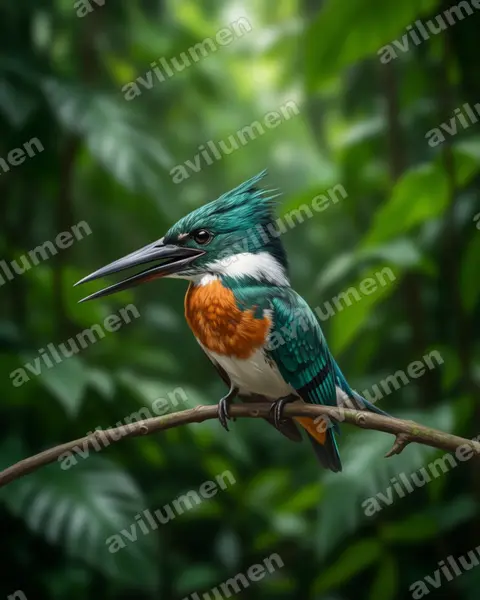
Realistic 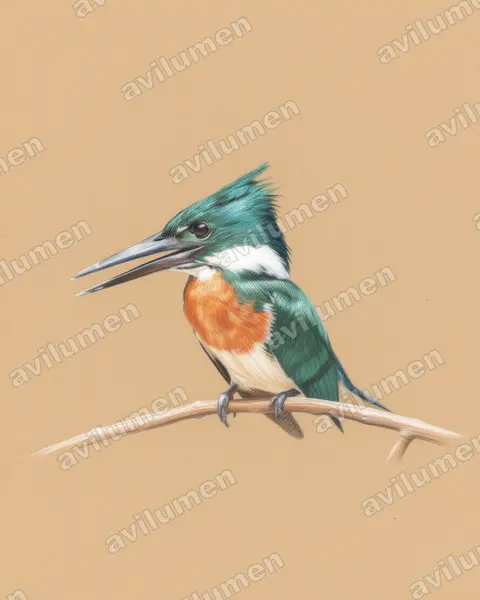
Colored pencil
Illustrations based on the photograph by Andreas Trepte (CC BY-SA 4.0), from Wikimedia Commons.
Digital editions
HD Digital Art Pack — Amazon Kingfisher
Digital download: 6 high-resolution illustrations of the Amazon Kingfisher (Chloroceryle amazona), print-ready. This is a digital file; no animal or physical item is included.
AI Avatar — Amazon Kingfisher
Generate an avatar fusing your face with the Amazon Kingfisher (Chloroceryle amazona). Delivered digitally in 8K, watermark-free. Digital product; no animals are sold or brokered.
Instant download. No live birds are sold.
Frequently asked questions
- Is Chloroceryle amazona (Amazon Kingfisher) endangered?
- The IUCN Red List places Chloroceryle amazona, commonly known as the Amazon Kingfisher, in the «Least concern» category. «Least concern» means it is not currently threatened.
- Where does Chloroceryle amazona (Amazon Kingfisher) live?
- Chloroceryle amazona (Amazon Kingfisher) is found in Brazil and South America.
- What family does Chloroceryle amazona (Amazon Kingfisher) belong to?
- Chloroceryle amazona (Amazon Kingfisher) belongs to the family Alcedinidae, in the order Coraciiformes.
- What colour is Chloroceryle amazona (Amazon Kingfisher)?
- The plumage of Chloroceryle amazona (Amazon Kingfisher) combines these colours: Green.
More from the same family
 Least concern
Moustached Kingfisher
Actenoides bougainvillei
The moustached kingfisher, also called Bougainville moustached kingfisher, is a species of bird in the family Alcedinidae. It is endemic to Bougainville Island in Papua New Guinea. An estimated 1,300–7,000 mature individuals are left.
from $1.99
 Near threatened
Rufous-collared Kingfisher
Actenoides concretus
The rufous-collared kingfisher is a species of bird in the family Alcedinidae. It is found in Brunei, Indonesia, Malaysia, Myanmar, and Thailand. Its natural habitats are subtropical or tropical moist lowland forest and subtropical or tropical moist montane forest. It is threatened by habitat loss.
from $1.99
 Least concern
Hombron's Kingfisher
Actenoides hombroni
The blue-capped kingfisher, also known as Hombron's kingfisher, is a species of bird in the family Alcedinidae endemic to the Philippines and found only on Mindanao. It is one of the most colorful kingfishers in the country having a dark blue cap and wings with rufous spots, a striped rufous belly, white chin and red bill.
from $1.99
 Least concern
Spotted Wood Kingfisher
Actenoides lindsayi
The spotted wood kingfisher or spotted kingfisher is a species of bird in the family Alcedinidae. It is endemic to the Philippines found on the islands of Luzon, Catanduanes, Marinduque, Negros and Panay where its natural habitat is tropical moist lowland forests.
from $1.99