Collared inca
Coeligena torquata
Avilumen editorial team ·

The collared inca is a species of hummingbird found in humid Andean forests from western Venezuela through Colombia and Ecuador to Peru. It is very distinctive in having a white chest-patch and white on the tail. Like other hummingbirds it takes energy from flower nectar, while the plant benefits from the symbiotic relationship by being pollinated. Its protein source is small arthropods such as insects.
The collared inca (Coeligena torquata) is a species of hummingbird found in humid Andean forests from western Venezuela through Colombia and Ecuador to Peru. It is very distinctive in having a white chest-patch and white on the tail. Like other hummingbirds it takes energy from flower nectar (especially from bromeliads), while the plant benefits from the symbiotic relationship by being pollinated. Its protein source is small arthropods such as insects. It is normally solitary and can be found at varying heights above the ground, often in the open.
Taxonomy
The collared inca is a member of subfamily Lesbiinae, the so-called "typical hummingbirds", of family Trochilidae. The family is placed by some taxonomic systems in the order Apodiformes, which contains swifts as well as hummingbirds. Others assign hummingbirds and swifts to order Caprimulgiformes.
Subspecies
Collared incas found in different parts of their range tend to have certain morphological features characteristic of that region, and are considered separate subspecies. The species' taxonomy is unsettled.
The International Ornithological Committee (IOC) and the Clements taxonomy recognize these five subspecies:
C. t. torquata (Boissonneau, 1840) – Colombia, east slope of Andes in Ecuador, and part of Peru.
C. t. fulgidigula (Gould, 1854) – West slope in Ecuador. Greener than typical. Patch on male's forehead shimmering blue. Male's chin metallic turquoise.
C. t. margaretae Zimmer, J.T., 1948 – Central Amazonas Region of Peru to the Pasco Region of Peru. Two-part (shimmering green and blue) forehead patch in male. Female has white and green-spotted chin.
C. t. insectivora (Tschudi, 1844) – Pasco Region to the Ayacucho Region of Peru.
C. t. eisenmanni Weske, 1985 – Within a relatively small area to the northwest of Cusco, Peru. Both sexes have some coppery uppertail coverts. Male has black head except for crown. Female has rufous chin.
The South American Classification Committee of the American Ornithological Society (SACC) includes three additional subspecies: C. t. conradii (Bourcier, 1847), C. t. omissa (Zimmer, J.T., 1948), and C. t. inca (Gould, 1852). The IOC and Clements treat conradii as the species green inca and the other two as Gould's inca. BirdLife International's Handbook of the Birds of the World (HBW) recognizes the green inca and Gould's inca, and in addition separates C. t. eisenmanni as the species Vilcabamba inca. The SACC is seeking proposals for recognizing these taxa as species.
Description
10–14 centimetres (3.9–5.5 in) in length, with a rather long (3–3.5 centimetres (1.2–1.4 in)), straight, black beak. Under most lighting conditions Coeligena torquata torquata appears black except for a very large and distinctive white chest-patch. However, in ideal lighting other features can be discerned: a shimmering metallic violet forehead patch in males, white thighs, fleshy-dusky feet, shimmering green throat in males, dull and containing some white in females, and some dark green mixed in with the black of the body. The tail of both sexes is black except for white on the basal half of the outer four rectrices, and part of the underside. The female is slightly lighter green overall than the male and has a slightly smaller chest-patch
Vocalizations are infrequent. Quiet, low-pitched, reedy whistle "tu-tee." Longer series of "pip... pip..." Very quiet spitting sound when foraging.
Distribution and habitat
Humid subtropical and temperate forest regions, including cloud forests on both slopes of the Andes from Venezuela to Bolivia between 1,800 metres (5,900 ft) and 3,000 metres (9,800 ft), usually above 2,100 metres (6,900 ft) in Ecuador. It typically forages below half the height of the canopy, and can most often be found around thickets near the forest edge.
It is fairly common throughout most of its range. No reasons for concern have been claimed.
Diet
Like other hummingbirds, the collared inca obtains most of its energy from nectar, which it drinks while it in turn pollinates the flower, and feeds on insects and other small insect-like arthropods as a source of protein. It seems to prefer epiphytes. It is a solitary trap-liner, meaning that it forages alone by flying a routine route between several flowers.
Breeding
Two single females of other Coeligena species have been observed caring for two offspring each. The nests were 1–2 metres (3.3–6.6 ft) above ground, about 7 centimetres (2.8 in) tall and wide, with an interior cup about 3 centimetres (1.2 in) deep and wide, and were composed of seed down and other materials. The eggs were completely white and measured about 1.5x1 cm. The mother visited once or twice every hour, to feed the young for a period of 9–55 seconds.
Status
The IUCN has assessed the collared inca as being of Least Concern. It has a large range but its population size is not known and is believed to be decreasing. No immediate threats have been identified.
Text adapted from Wikipedia · CC BY-SA 4.0
Where it lives
Distribution

Taxonomy
- Order
- Apodiformes
- Family
- Trochilidae
- Genus
- Coeligena
- Conservation status
- Least concern
Listen to its call
No recording yet
Illustration gallery
6 illustrations of Coeligena torquata (Collared inca) in different styles, true to its real plumage. Shown watermarked; the art pack includes the high-resolution originals, ready to print.
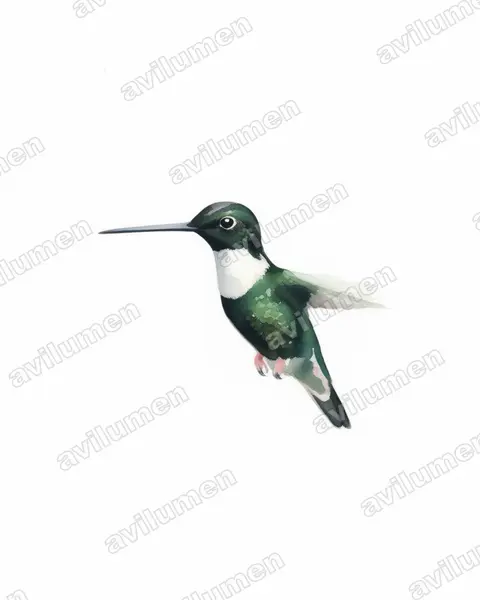
Watercolor 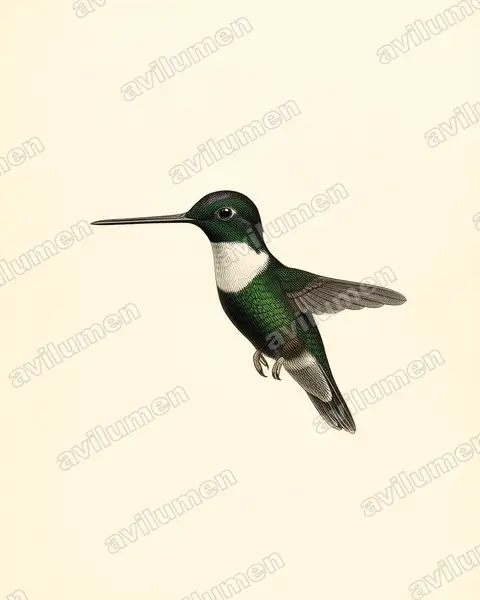
Vintage plate 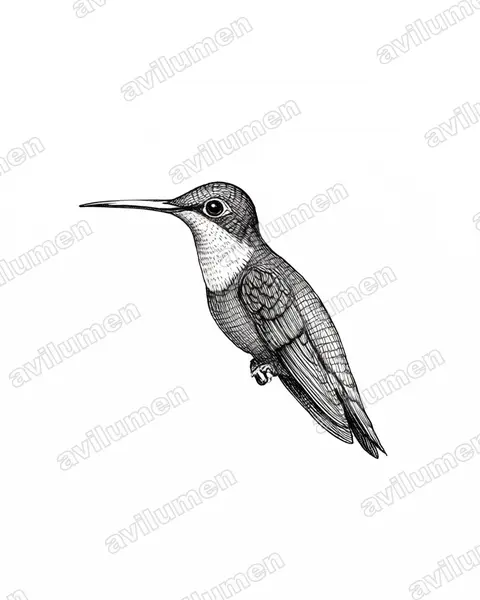
Ink 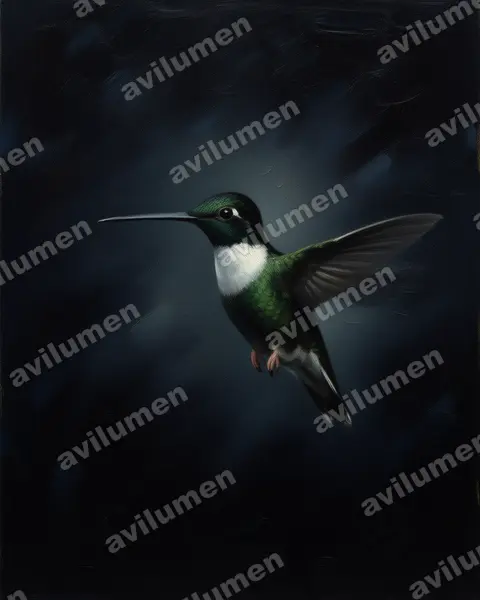
Oil 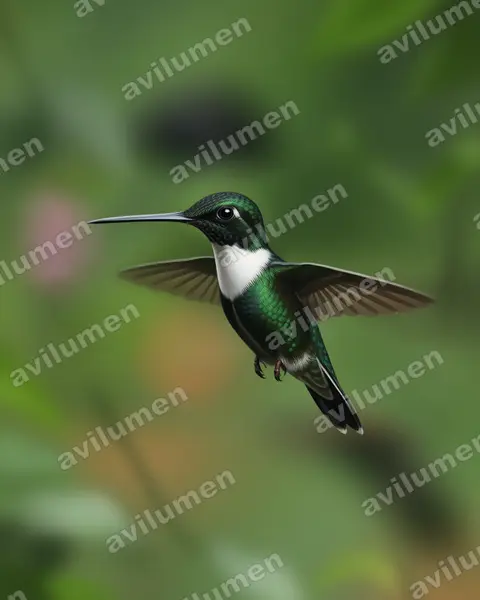
Realistic 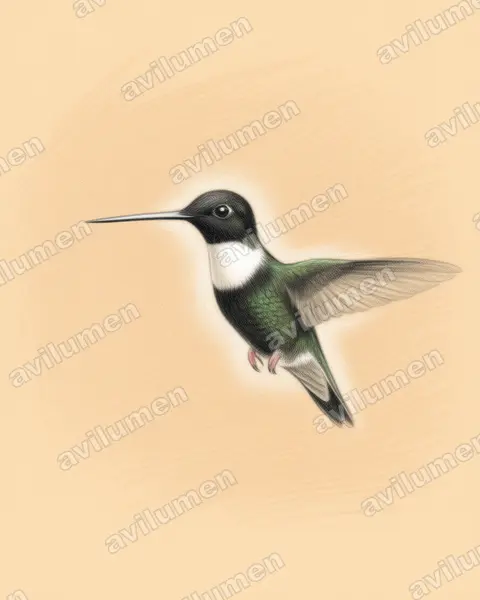
Colored pencil
Illustrations based on the photograph by Soler97 at English Wikipedia (Original text: Tad Boniecki) (Public domain), from Wikimedia Commons.
Digital editions
HD Digital Art Pack — Collared inca
Digital download: 6 high-resolution illustrations of the Collared inca (Coeligena torquata), print-ready. This is a digital file; no animal or physical item is included.
AI Avatar — Collared inca
Generate an avatar fusing your face with the Collared inca (Coeligena torquata). Delivered digitally in 8K, watermark-free. Digital product; no animals are sold or brokered.
Instant download. No live birds are sold.
Frequently asked questions
- Is Coeligena torquata (Collared inca) endangered?
- The IUCN Red List places Coeligena torquata, commonly known as the Collared inca, in the «Least concern» category. «Least concern» means it is not currently threatened.
- Where does Coeligena torquata (Collared inca) live?
- Coeligena torquata (Collared inca) is found in Peru and South America.
- What family does Coeligena torquata (Collared inca) belong to?
- Coeligena torquata (Collared inca) belongs to the family Trochilidae, in the order Apodiformes.
- What colour is Coeligena torquata (Collared inca)?
- The plumage of Coeligena torquata (Collared inca) combines these colours: Green and White.
More from the same family
 Least concern
Emerald-chinned Hummingbird
Abeillia abeillei
The emerald-chinned hummingbird is a species of hummingbird in the "emeralds", tribe Trochilini of subfamily Trochilinae.
from $1.99
 Least concern
Speckled hummingbird
Adelomyia melanogenys
The speckled hummingbird is a species of hummingbird. It is the only member of the genus Adelomyia. It inhabits Neotropical montane cloud forests at elevations of 1,000–2,500 meters and is confined to the Andes of Argentina, Bolivia, Peru, Ecuador, Colombia and Venezuela; as well as to some isolated montane forests in western Ecuador and Venezuela.
from $1.99
 Vulnerable
Purple-backed sunbeam
Aglaeactis aliciae
The purple-backed sunbeam is a bird species in the family Trochilidae. It is found only in Peru.
from $1.99
 Near threatened
White-tufted sunbeam
Aglaeactis castelnaudii
The white-tufted sunbeam is a species of hummingbird in the family Trochilidae. It is found only in Peru. Its natural habitats are subtropical or tropical moist montane forest and subtropical or tropical high-altitude shrubland.
from $1.99