Great Blue Turaco
Corythaeola cristata
Avilumen editorial team ·

The great blue turaco is a bird species of the family Musophagidae. At 70–76 cm (28–30 in) in length, it is the largest species of turaco. It has predominantly grey-blue plumage with an upright blue-black crest around 10 cm (3.9 in) high. The male and female have similar plumage. It is widespread throughout the African tropical rainforest.
The great blue turaco (Corythaeola cristata) is a bird species of the family Musophagidae. At 70–76 cm (28–30 in) in length, it is the largest species of turaco. It has predominantly grey-blue plumage with an upright blue-black crest around 10 cm (3.9 in) high. The male and female have similar plumage. It is widespread throughout the African tropical rainforest.
Taxonomy
French ornithologist Louis Pierre Vieillot described the great blue turaco as Musophaga cristata in 1816, before German ornithologist Ferdinand Heine placed it in its own genus in 1860.
The great blue turaco is the sole member of the subfamily Corythaeolinae within the turaco family. Its closest relatives are the go-away birds and plantain eaters of the genus Crinifer. The common ancestor of both diverged from the ancestor of all other turaco species.
"Great blue turaco" has been designated the official common name by the International Ornithologists' Union (IOC). It is also called the blue plantain eater.
Distribution and habitat
The species ranges from Guinea in the west, and east across the sub-Saharan nations to the Imatong Mountains in South Sudan; it also occurs in Uganda, Rwanda, Tanzania and western Kenya, south to the Democratic Republic of Congo and Angola. It inhabits rainforests and gallery forests. It has also adapted to areas cleared by humans and can thrive in these areas.
Description
Generally, the great blue turaco is 70–76 cm (28–30 in) in length with a mass of 800–1,231 g (1.764–2.714 lb). The adult great blue turaco has predominantly grey-blue upperparts with an upright blue-black crest, white chin, yellow-green lower breast and yellow belly darkening to chestnut brown posteriorly. The undertail coverts are chestnut, and the undertail is black and yellowish. The yellow bill has an orange-red tip, the eyes are brown, and surrounded by a ring of black bare skin. The legs and feet are black with yellow soles. The sexes have similar plumage.
Behaviour
The great blue turaco is gregarious, with birds forming small troops of some six or seven individuals.
Feeding
The great blue turaco eats leaves, flowers, as well as fruit of many plant species, including those of the genera Musanga, Cissus, Ficus (such as Ficus capensis) Polyalthia, Heisteria, Dacryodes, Pachypodanthium, Uapaca, Strombosia, Trichilia, Drypetes, Viscum, Beilschmiedia, Coelocaryon, Croton, and Pycnanthus. In Kenya, it has been recorded eating mitzeeri (Bridelia micrantha) in April, loquat (Eriobotrya japonica) in July, guava (Psidium guajava) in September and Cordia africana over November and December. Fieldwork in Rwanda revealed leaves constituted around 25% of its diet, being eaten more often when fruit is less abundant. The species also play a role in seed dispersal as it generally passes seed in its faeces some distance from parent trees.
Breeding
The species nests in trees between 8 and 25 metres (26 and 82 ft) above the ground, and the nest is a platform of sticks. Both sexes incubate the clutch of two (rarely one or three) eggs over 29–31 days. The eggs are white or greenish-white and almost round, measuring 46–50 mm by 41–43 mm (1.8–2.0 in by 1.6–1.7 in).
Interactions with humans
Highly regarded as food in West Africa, it is often hunted and eaten by local people. The BaMbala and related tribes around the town of Kikwit in the DRC, call the great blue turaco kolonvo. The meat is popular in smaller villages, and the long tail feathers are prized for decorations. The Mbuti people of the Ituri Rainforest in the Democratic Republic of the Congo consider the great blue turaco (which they call kulkoko) to be associated with okapis, which they would warn of danger by calling loudly. They also believe that eating the species while pregnant may result in a difficult delivery or birth deformity. It is also a clan totem animal and as such, cannot be eaten by members of that clan; if they do eat it their teeth are said to fall out.
Text adapted from Wikipedia · CC BY-SA 4.0
Taxonomy
- Order
- Musophagiformes
- Family
- Musophagidae
- Genus
- Corythaeola
- Conservation status
- Least concern
Listen to its call
No recording yet
Illustration gallery
6 illustrations of Corythaeola cristata (Great Blue Turaco) in different styles, true to its real plumage. Shown watermarked; the art pack includes the high-resolution originals, ready to print.
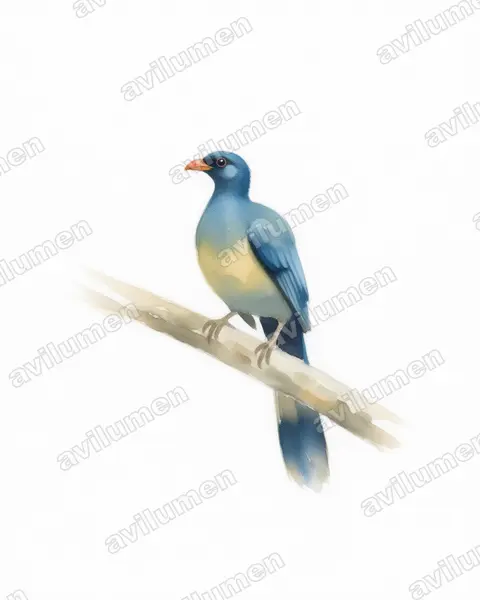
Watercolor 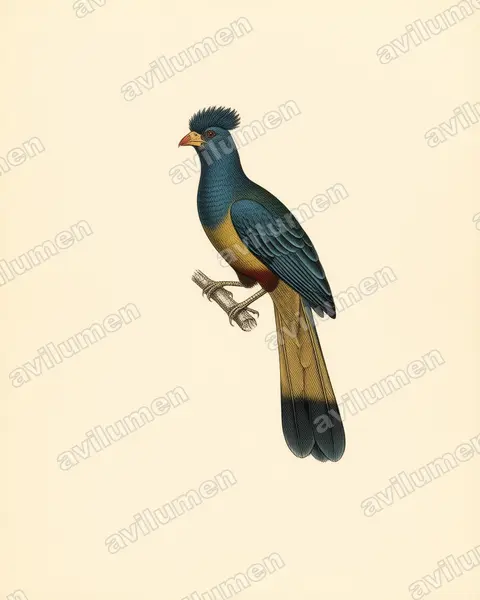
Vintage plate 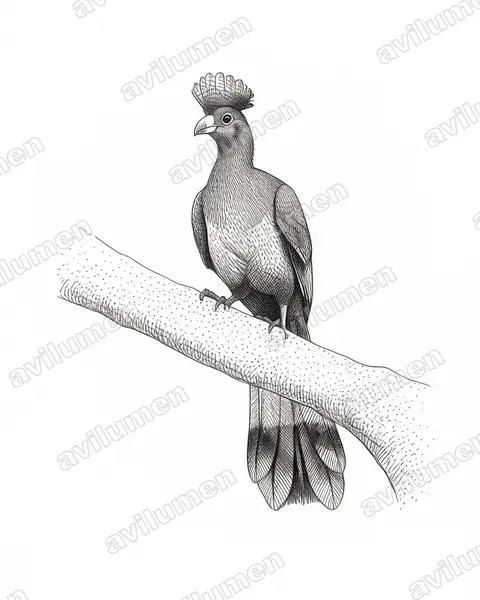
Ink 
Oil 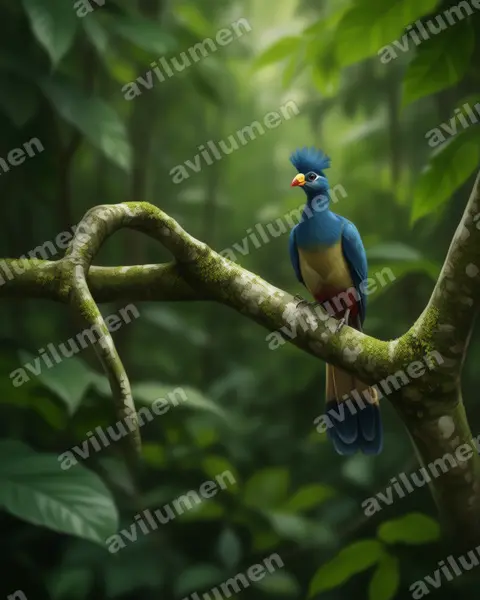
Realistic 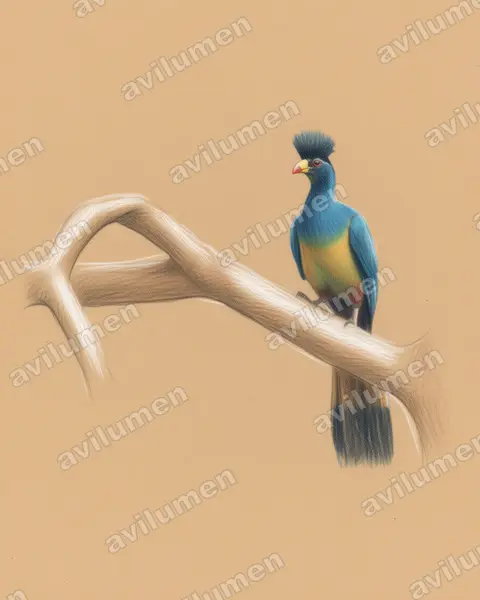
Colored pencil
Illustrations based on the photograph by Tom Tarrant (CC BY-SA 3.0), from Wikimedia Commons.
Digital editions
HD Digital Art Pack — Great Blue Turaco
Digital download: 6 high-resolution illustrations of the Great Blue Turaco (Corythaeola cristata), print-ready. This is a digital file; no animal or physical item is included.
AI Avatar — Great Blue Turaco
Generate an avatar fusing your face with the Great Blue Turaco (Corythaeola cristata). Delivered digitally in 8K, watermark-free. Digital product; no animals are sold or brokered.
Instant download. No live birds are sold.
Frequently asked questions
- Is Corythaeola cristata (Great Blue Turaco) endangered?
- The IUCN Red List places Corythaeola cristata, commonly known as the Great Blue Turaco, in the «Least concern» category. «Least concern» means it is not currently threatened.
- Where does Corythaeola cristata (Great Blue Turaco) live?
- Corythaeola cristata (Great Blue Turaco) is found in Africa.
- What family does Corythaeola cristata (Great Blue Turaco) belong to?
- Corythaeola cristata (Great Blue Turaco) belongs to the family Musophagidae, in the order Musophagiformes.
- What colour is Corythaeola cristata (Great Blue Turaco)?
- The plumage of Corythaeola cristata (Great Blue Turaco) combines these colours: Blue and Grey.
More from the same family
 Least concern
Grey Go-away-bird
Corythaixoides concolor
The grey go-away-bird, also known as grey lourie, grey loerie, or kwêvoël, is a bold and common turaco of the southern Afrotropics. They are present in arid to moist, open woodlands and thorn savanna, especially near surface water. They regularly form groups and parties that forage in tree tops, or dust bathe on the ground.
from $1.99
 Not evaluated
White-bellied go-away-bird
Corythaixoides leucogaster
The white-bellied go-away-bird is a bird of eastern Africa in the family Musophagidae, commonly known as turacos.
from $1.99
 Least concern
Bare-faced Go-away-bird
Corythaixoides personatus
The bare-faced go-away-bird is a species of bird in the family Musophagidae which is native to the eastern Afrotropics. It is named for its distinctive and uniquely bare, black face.
from $1.99
 Least concern
Western Plantain-eater
Crinifer piscator
The western plantain-eater, also known as the grey plantain-eater or western grey plantain-eater, is a large member of the turaco family, a group of large arboreal passerine-like birds restricted to Africa.
from $1.99