White-bellied go-away-bird
Corythaixoides leucogaster
Avilumen editorial team ·

The white-bellied go-away-bird is a bird of eastern Africa in the family Musophagidae, commonly known as turacos.
The white-bellied go-away-bird (Crinifer leucogaster) is a bird of eastern Africa in the family Musophagidae, commonly known as turacos.
Taxonomy
German naturalist Eduard Rüppell described this species in 1842.
The white-bellied go-away-bird is placed in the bird family Musophagidae ("banana-eaters"), which includes plantain-eaters and other go-away-birds. Although traditionally, this group was placed within cuckoos in the order Cuculiformes, recent genetic analysis have strongly supported separate placement in the full order of Musophagiformes.
They are semi-zygodactylous meaning the fourth (outer) toe can be switched back and forth. Musophagidae often have prominent crests and long tails. Some species are renowned for their bright pigments.
There is an ongoing discussion over generic-level classification: C. leucogaster is often referred to as being in the genus Corythaixoides or Criniferoides. Most earlier taxonomic treatments place it within Corythaixoide, however many concluded that it required the genus, Crinifer.
Description
This species averages 51 cm (20") in length. Its long, pointed grey and black tail with a white median band is characteristic of the species. It has a white under-wing patch, visible in flight. The adult has a grey head and leading to a dark grey to blackish pointed crest with an approximate length of 6 cm. The belly and under-tail coverts are white, giving the bird the first part of its name "white-bellied".
The bill is black in male, pea-green in the female (becoming yellowish during the breeding season). Females also tend to be larger, weighing 225g - 250g, where as males only weighed 170g - 225g. The juvenile is similar to adults, with the plumage being more brown, especially on wing-coverts.
Typical calls are a nasal haa-haa-haa, like bleating of a sheep, and a single or repeated gwa (or g'away), this distinctive call is where the bird gets the latter part of its name "go-away". It flies from tree to tree in loose straggling groups, calling loudly.
Distribution and habitat
Their habitat consists of hot acacia-steppe, savanna, and woodland areas. It avoids deep forest, but the species has been seen at a range of elevations, from sea level up to 2000m.
Go-away birds are limited to their local ranges due to water availability, but the species occurs across a vast area in and around the Horn of Africa. It is found in Burundi, Djibouti, Eritrea, Ethiopia, northern and eastern Kenya, Rwanda, Somalia, South Sudan, northeastern Uganda, and southwards into the eastern plateau of Tanzania.
Behavior
The white-bellied go-away-bird is sedentary in its range, wandering locally when searching for water and food sources. They are gregarious birds that do not migrate but move in family groups of up to 10. They are territorial and a breeding pair likely maintains its territory year round.
Feeding
The white-bellied go-away-birds feed primarily on plant matter such as fruits, flowers, nectar, seeds and buds of acacias. The species is also known to eat some invertebrates, such as winged termites found when foraging. The species are very agile climbers, allowing for easy foraging in the tree tops. As a result of these feeding habits the White-bellied Go-away-bird is considered a pest in some regions, raiding orchards and plantations of fruiting trees and vegetable crops.
Breeding
During the breeding season (which usually starts with the rainy season), white-bellied go-away-birds become much more vocal. This varies according to range. The birds exhibit courtship behaviour, including chases from tree to tree and displays, where the birds bow and flick the long tail whilst raising and lowering the crest. The black and white pattern is enhanced by these postures and this is believed to be the purpose of the patterning. The white-bellied go-away-bird is monogamous and mutual feeding has been recorded between partners.
The nest is placed in acacia-type tree, 3-12m above the ground. The female lays 2–3 pale bluish eggs. Both sexes incubate for approximately 4 weeks. The first flight of chicks occurs approximately 4–5 weeks after hatching. However, they still depend on parents for food for several weeks after fledging.
Conservation status
The population of white-bellied go-away-birds has not been quantified. Its conservation status is stated to be "of least concern". This is because the population is not believed to be below 10,000 mature individuals and the bird has a wide distribution of over 3 million km2, meaning it does not meet vulnerability criteria. Furthermore, the population appears stable and not to be in decline.
Text adapted from Wikipedia · CC BY-SA 4.0
Taxonomy
- Order
- Musophagiformes
- Family
- Musophagidae
- Genus
- Crinifer
- Conservation status
- Not evaluated
Listen to its call
No recording yet
Illustration gallery
6 illustrations of Corythaixoides leucogaster (White-bellied go-away-bird) in different styles, true to its real plumage. Shown watermarked; the art pack includes the high-resolution originals, ready to print.
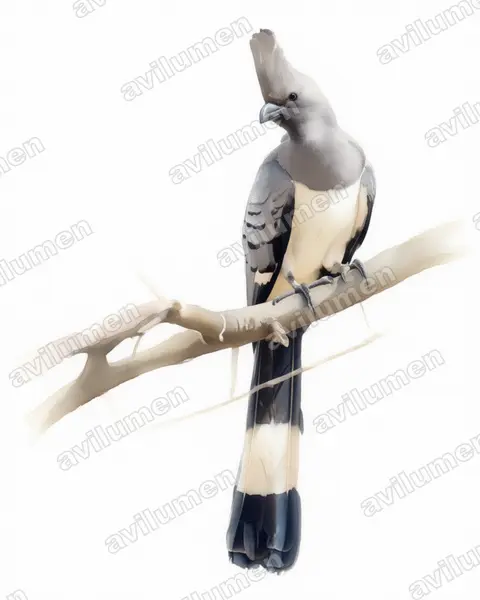
Watercolor 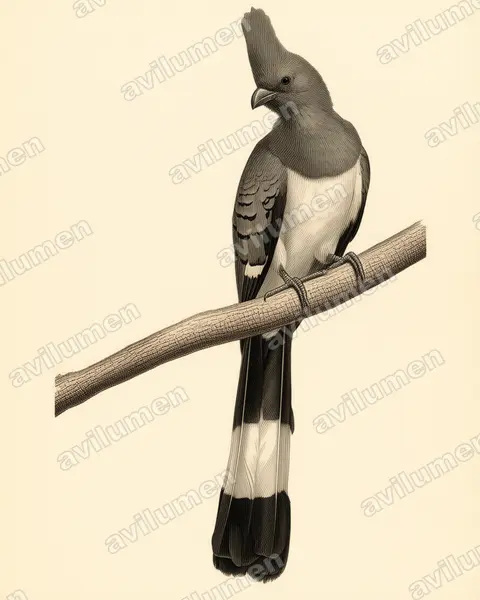
Vintage plate 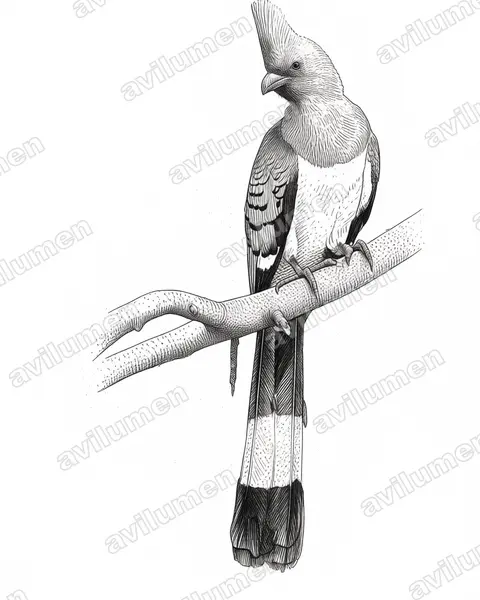
Ink 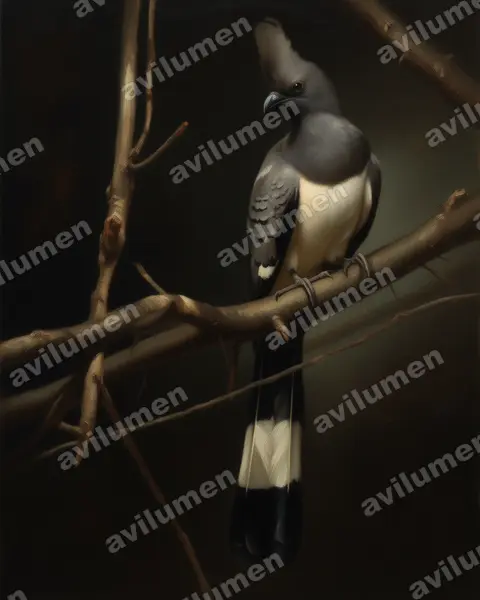
Oil 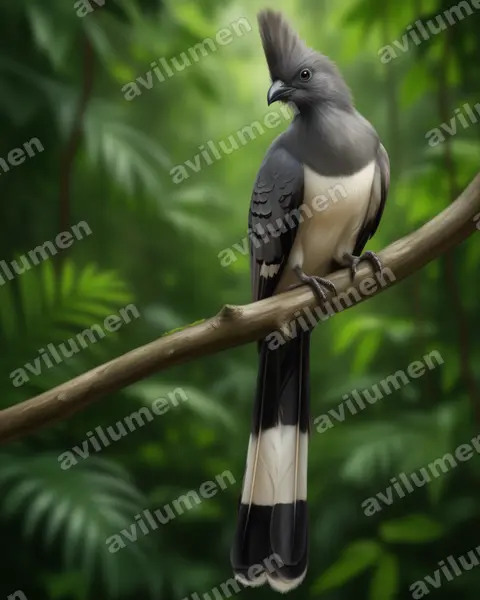
Realistic 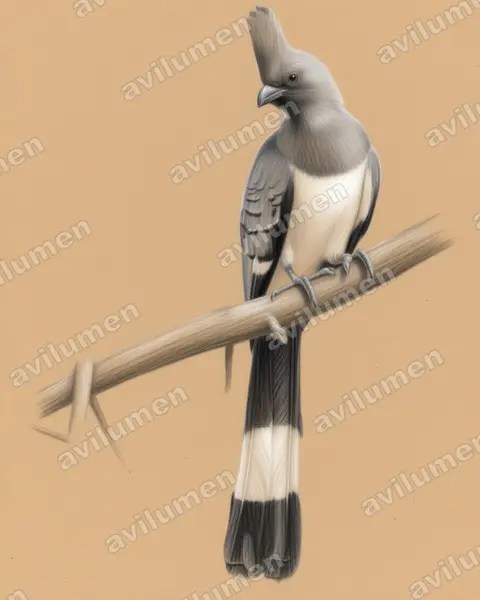
Colored pencil
Illustrations based on the photograph by Yathin S Krishnappa (CC BY-SA 3.0), from Wikimedia Commons.
Digital editions
HD Digital Art Pack — White-bellied go-away-bird
Digital download: 6 high-resolution illustrations of the White-bellied go-away-bird (Corythaixoides leucogaster), print-ready. This is a digital file; no animal or physical item is included.
AI Avatar — White-bellied go-away-bird
Generate an avatar fusing your face with the White-bellied go-away-bird (Corythaixoides leucogaster). Delivered digitally in 8K, watermark-free. Digital product; no animals are sold or brokered.
Instant download. No live birds are sold.
Frequently asked questions
- Is Corythaixoides leucogaster (White-bellied go-away-bird) endangered?
- The IUCN Red List places Corythaixoides leucogaster, commonly known as the White-bellied go-away-bird, in the «Not evaluated» category. «Not evaluated» means the IUCN has not yet assessed this species.
- Where does Corythaixoides leucogaster (White-bellied go-away-bird) live?
- Corythaixoides leucogaster (White-bellied go-away-bird) is found in Africa.
- What family does Corythaixoides leucogaster (White-bellied go-away-bird) belong to?
- Corythaixoides leucogaster (White-bellied go-away-bird) belongs to the family Musophagidae, in the order Musophagiformes.
- What colour is Corythaixoides leucogaster (White-bellied go-away-bird)?
- The plumage of Corythaixoides leucogaster (White-bellied go-away-bird) combines these colours: White and Grey.
More from the same family
 Least concern
Great Blue Turaco
Corythaeola cristata
The great blue turaco is a bird species of the family Musophagidae. At 70–76 cm (28–30 in) in length, it is the largest species of turaco. It has predominantly grey-blue plumage with an upright blue-black crest around 10 cm (3.9 in) high. The male and female have similar plumage. It is widespread throughout the African tropical rainforest.
from $1.99
 Least concern
Grey Go-away-bird
Corythaixoides concolor
The grey go-away-bird, also known as grey lourie, grey loerie, or kwêvoël, is a bold and common turaco of the southern Afrotropics. They are present in arid to moist, open woodlands and thorn savanna, especially near surface water. They regularly form groups and parties that forage in tree tops, or dust bathe on the ground.
from $1.99
 Least concern
Bare-faced Go-away-bird
Corythaixoides personatus
The bare-faced go-away-bird is a species of bird in the family Musophagidae which is native to the eastern Afrotropics. It is named for its distinctive and uniquely bare, black face.
from $1.99
 Least concern
Western Plantain-eater
Crinifer piscator
The western plantain-eater, also known as the grey plantain-eater or western grey plantain-eater, is a large member of the turaco family, a group of large arboreal passerine-like birds restricted to Africa.
from $1.99