Plum-throated Cotinga
Cotinga maynana
Avilumen editorial team ·

The plum-throated cotinga is a species of bird in the family Cotingidae. It is found in Bolivia, Brazil, Colombia, Ecuador, and Peru.
The plum-throated cotinga (Cotinga maynana) is a species of bird in the family Cotingidae. It is found in Bolivia, Brazil, Colombia, Ecuador, and Peru.
Taxonomy and systematics
In 1760 the French zoologist Mathurin Jacques Brisson included a description of the plum-throated cotinga in his Ornithologie based on a specimen collected in Maynas Province, Peru. He used the French name Le cotinga des Mayas and the Latin Cotinga Maynanensis. Although Brisson coined Latin names, these do not conform to the binomial system and are not recognized by the International Commission on Zoological Nomenclature. When in 1766 the Swedish naturalist Carl Linnaeus updated his Systema Naturae for the twelfth edition, he added 240 species that had been previously described by Brisson, one of which was the plum-throated cotinga. Linnaeus included a brief description, coined the binomial name Ampelis maynana and cited Brisson's work. This species is now placed in the genus Cotinga that was introduced by Brisson in 1760.
The plum-throated cotinga is monotypic.
Description
The plum-throated cotinga is 19 to 20.5 cm (7.5 to 8.1 in) long and weighs about 70 g (2.5 oz). The sexes are dramatically dimorphic. Adult males are mostly shiny turquoise-blue. Their throat has the eponymous plum-purple patch. Their remiges are black with a large white patch on the underside and wide blue edges toward the end; the wings appear mostly blue when folded. Their rectrices are blackish with wide blue edges and like the wings, the tail appears blue when folded. Their underparts have scattered purple patches and blackish undertail coverts. Adult females have dark grayish brown upperparts with fawn edges on the feathers. Their throat is fawn and their breast fawn with darker scaly markings. Their belly and undertail coverts are cinnamon-brown with darker mottling. Both sexes have a pale to darker yellow iris, a gray to blackish bill with a slightly hooked tip, and gray to blackish legs and feet. Immature birds of both sexes resemble adult females.
Distribution and habitat
The plum-throated cotinga is a bird of the upper Amazon Basin. Its range includes approximately the southeastern third of Colombia, the eastern third of Ecuador, eastern Peru, far northern Bolivia, and Brazil east roughly to a line from Mato Grosso do Sul north to Tocantins. It inhabits humid lowland rainforest, especially várzea and to a lesser extent terra firme. It seems to favor the latter in Colombia. In elevation it reaches 700 m (2,300 ft) in Colombia and Ecuador and locally up to 1,000 m (3,300 ft) in Peru.
Movement
The plum-throated cotinga is believed to be a year-round resident, but at least one author has speculated that it might make some short seasonal movements.
Feeding
The plum-throated cotinga feeds on a wide variety of fruits, with apparent favor to those of Psittacanthus mistletoes, Euterpe palms, and Ficus figs. It forages in pairs and small groups and also in company with spangled cotingas (C. cayana) where their ranges overlap. It primarily forages in the canopy though it will descend to the understory. It takes fruit while perched and with short flutter-flights from a perch.
Breeding
Males make a courtship display flight by dropping from a high perch, flying in the open, and returning to the perch. Nothing else is known about the plum-throated cotinga's breeding biology.
Vocal and non-vocal sounds
The plum-throated cotinga is not highly vocal. What is thought to be its call is "a quiet, deep, hollow, descending hoot: pooh". Its wings make a "sputtering sound" during display flight. This mechanical sound has also been described as "rattling, twittering, or whistling in quality".
Status
The IUCN has assessed the plum-throated cotinga as being of Least Concern. It has a large range; its population size is not known and is believed to be decreasing. No immediate threats have been identified. It is considered fairly common in Colombia and Ecuador, somewhat more common in Brazil, and uncommon in Peru. It occurs in several protected areas.
Text adapted from Wikipedia · CC BY-SA 4.0
Where it lives
Plumage colours
Distribution

Taxonomy
- Order
- Passeriformes
- Family
- Cotingidae
- Genus
- Cotinga
- Conservation status
- Least concern
Listen to its call
No recording yet
Illustration gallery
6 illustrations of Cotinga maynana (Plum-throated Cotinga) in different styles, true to its real plumage. Shown watermarked; the art pack includes the high-resolution originals, ready to print.
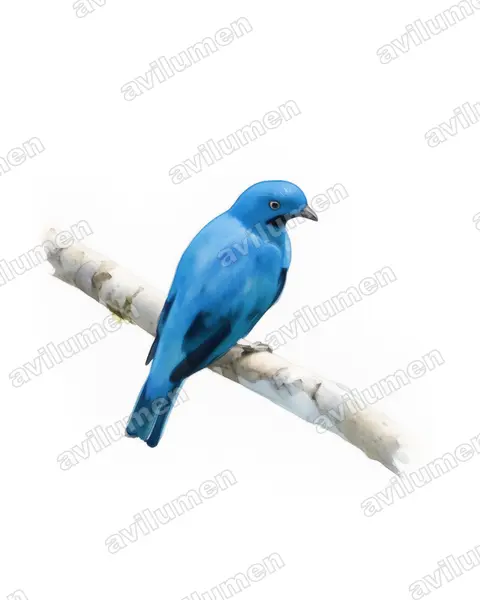
Watercolor 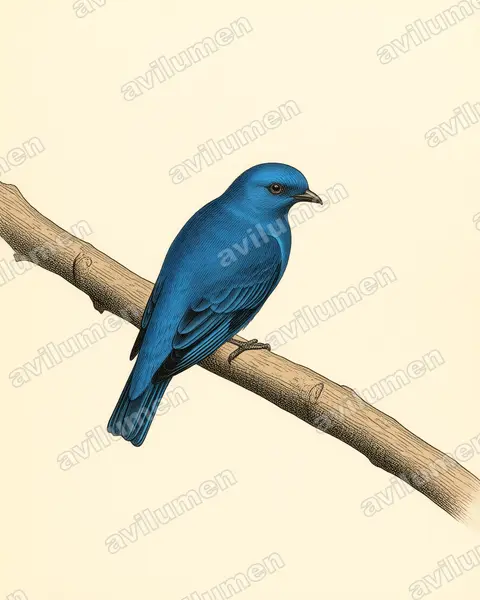
Vintage plate 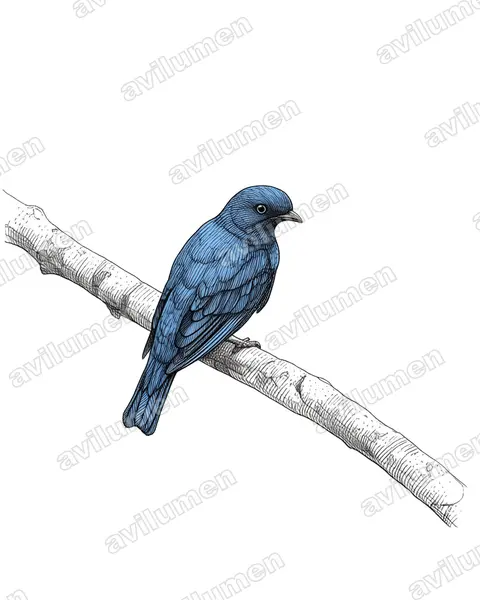
Ink 
Oil 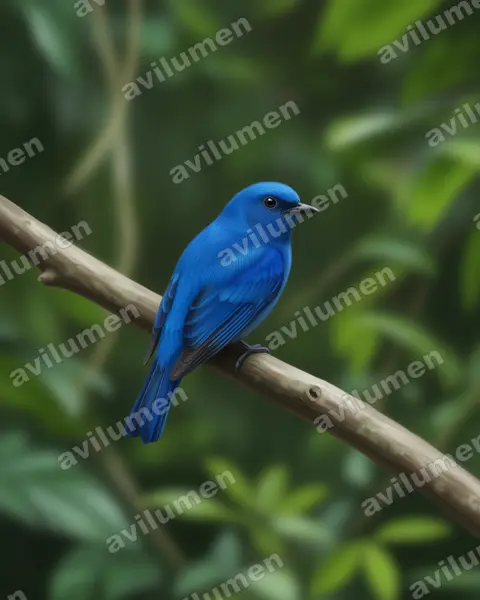
Realistic 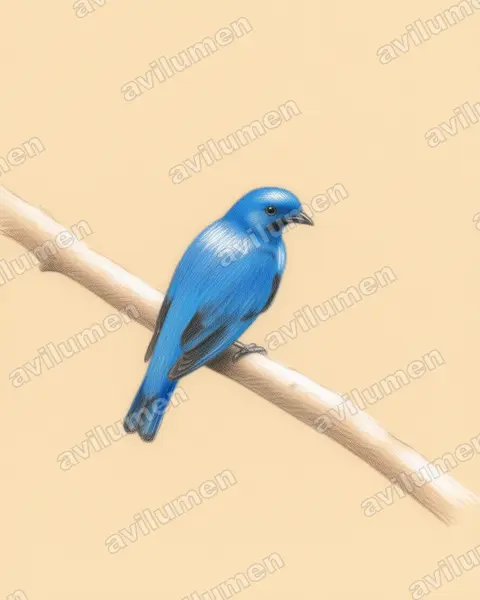
Colored pencil
Illustrations based on the photograph by Gregory "Slobirdr" Smith (CC BY-SA 2.0), from Wikimedia Commons.
Digital editions
HD Digital Art Pack — Plum-throated Cotinga
Digital download: 6 high-resolution illustrations of the Plum-throated Cotinga (Cotinga maynana), print-ready. This is a digital file; no animal or physical item is included.
AI Avatar — Plum-throated Cotinga
Generate an avatar fusing your face with the Plum-throated Cotinga (Cotinga maynana). Delivered digitally in 8K, watermark-free. Digital product; no animals are sold or brokered.
Instant download. No live birds are sold.
Frequently asked questions
- Is Cotinga maynana (Plum-throated Cotinga) endangered?
- The IUCN Red List places Cotinga maynana, commonly known as the Plum-throated Cotinga, in the «Least concern» category. «Least concern» means it is not currently threatened.
- Where does Cotinga maynana (Plum-throated Cotinga) live?
- Cotinga maynana (Plum-throated Cotinga) is found in Brazil and South America.
- What family does Cotinga maynana (Plum-throated Cotinga) belong to?
- Cotinga maynana (Plum-throated Cotinga) belongs to the family Cotingidae, in the order Passeriformes.
- What colour is Cotinga maynana (Plum-throated Cotinga)?
- The plumage of Cotinga maynana (Plum-throated Cotinga) combines these colours: Multicoloured.
More from the same family
 Least concern
Scaled Fruiteater
Ampelioides tschudii
The scaled fruiteater is a species of bird in the family Cotingidae. It is the only member of the genus Ampelioides. This bird is found in Bolivia, Colombia, Ecuador, Peru, and Venezuela, where its natural habitat is the high elevation tropical forests of the Andes mountains. The scaled fruiteater is a chunky, short-tailed, flat-headed bird measuring 19–20 cm (7.5–7.9 in) in length.
from $1.99
 Least concern
Red-crested Cotinga
Ampelion rubrocristatus
The red-crested cotinga is a species of bird in the family Cotingidae. It is found in Bolivia, Colombia, Ecuador, Peru, and Venezuela.
from $1.99
 Least concern
Chestnut-crested Cotinga
Ampelion rufaxilla
The chestnut-crested cotinga is a species of bird in the family Cotingidae. It is found in Bolivia, Colombia, Ecuador, and Peru.
from $1.99
 Critically endangered
Kinglet Calyptura
Calyptura cristata
The kinglet calyptura is a small Critically Endangered passerine bird in the family Tyrannidae, the tyrant flycatchers. It is endemic to southeastern Brazil.
from $1.99