Turquoise Cotinga
Cotinga ridgwayi
Avilumen editorial team ·

The turquoise cotinga or Ridgway's cotinga is a Vulnerable species of bird in the family Cotingidae. It is found in Costa Rica and Panama.
The turquoise cotinga or Ridgway's cotinga (Cotinga ridgwayi) is a Vulnerable species of bird in the family Cotingidae. It is found in Costa Rica and Panama.
Taxonomy and systematics
The turquoise cotinga is monotypic. It, the lovely cotinga (C. amabilis), and the blue cotinga (C. nattererii) form a superspecies. The plum-throated (C. maynana), purple-breasted (C. cotinga), and banded (C. maculata) cotingas may also be part of that clade.
Description
The turquoise cotinga is 17 to 18.5 cm (6.7 to 7.3 in) long and weighs about 51 to 66 g (1.8 to 2.3 oz). The sexes are dramatically dimorphic. Adult males have deep turquoise-blue upperparts. Their wings are black with thin to moderately wide blue edges on most feathers. Their tail is black; their turquoise-blue uppertail coverts are long and cover much of the tail. Their chin and throat and separately their breast and upper belly are purple. Adult females are larger than males. They have mostly dark brown upperparts with buffish white feather tips that produce a scalloped appearance. Their wings are mostly dusky brown with buffish white scallops on most coverts and cinnamon edges on the tertials. Their tail is dusky brown. Their underparts are mostly pale buff with grayish brown spots but their undertail coverts are unspotted. Both sexes have a dark brown iris and dark gray to blackish legs and feet. Their short wide bill has a black maxilla with a grayish base and a gray mandible with a black tip. Immature birds are similar to adult females but with buff edges on the flight feathers.
Distribution and habitat
The turquoise cotinga is found from the southern Gulf of Nicoya in west-central Costa Rica south along the Pacific slope into western Chiriquí Province in far western Panama. It inhabits the tropical zone where it is found in the interior of humid evergreen forest and secondary woodland. In Panama it occurs mostly below 900 m (3,000 ft) but reaches 1,800 m (5,900 ft) in Costa Rica..
Movement
The turquoise cotinga is believed to be a year-round resident but may make some irregular movements in response to fruit availability.
Feeding
The turquoise cotinga apparently feeds only on fruits; those of trees, Loranthaceae mistletoes, and Phytolacca pokeweed are known. Its foraging behavior has not been documented though it appears to be mostly a canopy dweller.
Breeding
The turquoise cotinga's one known nest held two eggs in March. It was a shallow cup made from plant fibers and strands of fungus, placed in a fork of a horizontal branch about 9 m (30 ft) above the ground in an isolated tree. The full nesting season, incubation period, time to fledging, and details of parental care are not known.
Vocal and non-vocal sounds
The turquoise cotinga is usually silent, but females make "a raucous shriek" distress call. Males' wings make a "soft twittering" sound in flight.
Status
The IUCN originally in 1988 assessed the turquoise cotinga as Threatened and since 1994 as Vulnerable. It has a restricted range and its estimated population of between 1250 and 2820 mature individuals is believed to be decreasing. "Agricultural conversion has resulted in near-complete deforestation in its Panamanian range. Forests within the range in Costa Rica are inadequately protected and similarly at risk of clearance." It is considered uncommon in Costa Rica. The most recent records in Costa Rica came from Las Cruces and Las Alturas Biological Stations, Carara National Park, and the Osa Peninsula (including Corcovado National Park). Panamanian records come from the Santa Clara area and at El Chorogo.
Text adapted from Wikipedia · CC BY-SA 4.0
Plumage colours
Distribution

Taxonomy
- Order
- Passeriformes
- Family
- Cotingidae
- Genus
- Cotinga
- Conservation status
- Vulnerable
Listen to its call
No recording yet
Illustration gallery
6 illustrations of Cotinga ridgwayi (Turquoise Cotinga) in different styles, true to its real plumage. Shown watermarked; the art pack includes the high-resolution originals, ready to print.
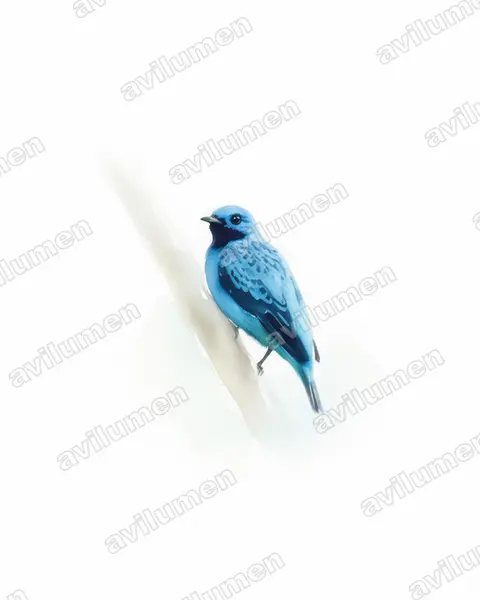
Watercolor 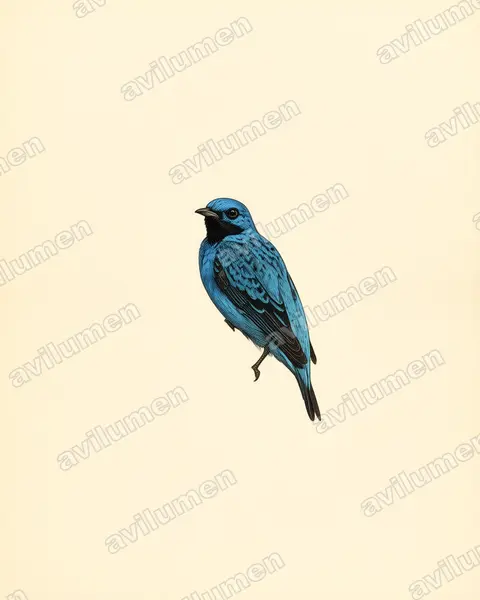
Vintage plate 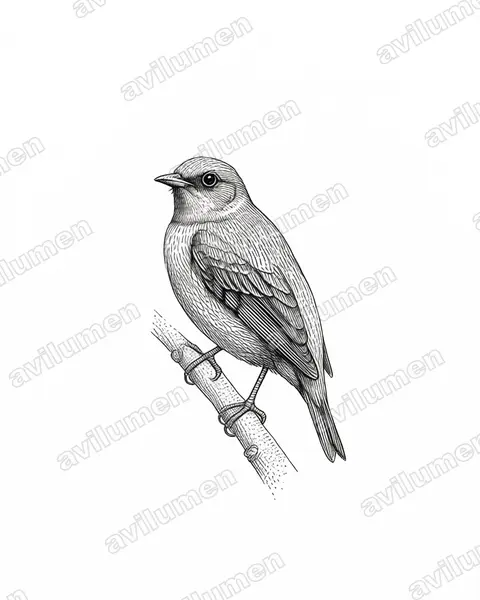
Ink 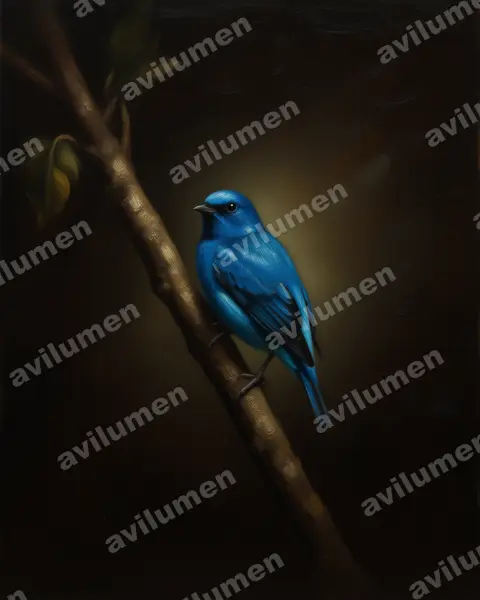
Oil 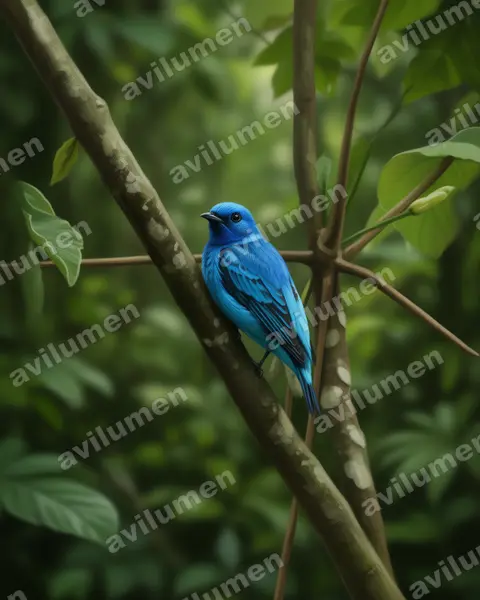
Realistic 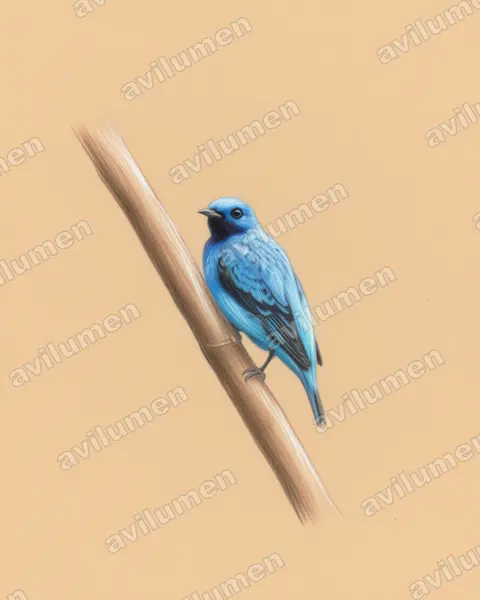
Colored pencil
Illustrations based on the photograph by Randall Leonardo Ortega Chaves (CC BY-SA 4.0), from Wikimedia Commons.
Digital editions
HD Digital Art Pack — Turquoise Cotinga
Digital download: 6 high-resolution illustrations of the Turquoise Cotinga (Cotinga ridgwayi), print-ready. This is a digital file; no animal or physical item is included.
AI Avatar — Turquoise Cotinga
Generate an avatar fusing your face with the Turquoise Cotinga (Cotinga ridgwayi). Delivered digitally in 8K, watermark-free. Digital product; no animals are sold or brokered.
Instant download. No live birds are sold.
Frequently asked questions
- Is Cotinga ridgwayi (Turquoise Cotinga) endangered?
- The IUCN Red List places Cotinga ridgwayi, commonly known as the Turquoise Cotinga, in the «Vulnerable» category. «Vulnerable» means it faces a high risk of extinction in the medium term.
- What family does Cotinga ridgwayi (Turquoise Cotinga) belong to?
- Cotinga ridgwayi (Turquoise Cotinga) belongs to the family Cotingidae, in the order Passeriformes.
- What colour is Cotinga ridgwayi (Turquoise Cotinga)?
- The plumage of Cotinga ridgwayi (Turquoise Cotinga) combines these colours: Multicoloured.
More from the same family
 Least concern
Scaled Fruiteater
Ampelioides tschudii
The scaled fruiteater is a species of bird in the family Cotingidae. It is the only member of the genus Ampelioides. This bird is found in Bolivia, Colombia, Ecuador, Peru, and Venezuela, where its natural habitat is the high elevation tropical forests of the Andes mountains. The scaled fruiteater is a chunky, short-tailed, flat-headed bird measuring 19–20 cm (7.5–7.9 in) in length.
from $1.99
 Least concern
Red-crested Cotinga
Ampelion rubrocristatus
The red-crested cotinga is a species of bird in the family Cotingidae. It is found in Bolivia, Colombia, Ecuador, Peru, and Venezuela.
from $1.99
 Least concern
Chestnut-crested Cotinga
Ampelion rufaxilla
The chestnut-crested cotinga is a species of bird in the family Cotingidae. It is found in Bolivia, Colombia, Ecuador, and Peru.
from $1.99
 Critically endangered
Kinglet Calyptura
Calyptura cristata
The kinglet calyptura is a small Critically Endangered passerine bird in the family Tyrannidae, the tyrant flycatchers. It is endemic to southeastern Brazil.
from $1.99