Olive Sunbird
Cyanomitra olivacea
Avilumen editorial team ·

The olive sunbird is a large African species of sunbird belonging to the family Nectariniidae which encompasses species of sunbirds, spiderhunters, and flowerpeckers, and sugarbirds.
The olive sunbird (Cyanomitra olivacea) is a large African species of sunbird belonging to the family Nectariniidae which encompasses species of sunbirds, spiderhunters, and flowerpeckers, and sugarbirds.
It has a large distribution that spans across central Africa from western countries including Senegal, Guinea, and Angola towards eastern countries including Ethiopia, Kenya, and Mozambique. This range also extends to southern African countries including South Africa and Zimbabwe. It is mainly nectarivorous and lives in a variety of forest, scrubland, and modified habitats.
Description
The olive sunbird is a large sunbird that ranges from 6.2-15 g in mass, 50–73 mm in wing length, 20–29 mm in bill length, 35–66 mm in tail length, and 12–15 cm in overall body size depending on the subspecies and sex.
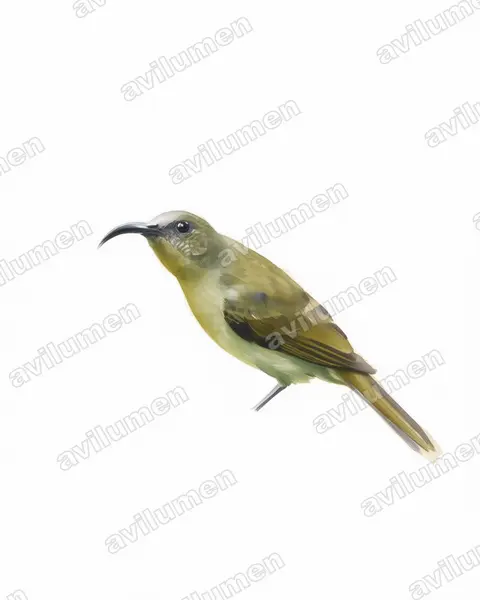
Its body colouration can vary from fully dark-olive to dull-olive with a paler olive-yellow or olive-grey underside. It has a long beak that curves downward and varies in colour from solid black to mottled grey, beige, and yellow-orange depending on the subspecies. Yellowish-orange pectoral tufts can be present in the males and females found in eastern subspecies while only males bear these tufts in western subspecies.
Olive sunbirds show morphological differences between forest-savanna boundaries despite minimal genetic variation. Adult males from forest-savanna boundary habitats had longer wings, legs, and bills than adult males found in forest habitats.
Taxonomy and systematics
It belongs to the order Passeriformes in the family Nectariniidae and the Genus of Cyanomitra. Historically, the olive sunbird was separated into two species: the eastern olive sunbird (Cyanomitra olivacea) and the western olive sunbird (Cyanomitra obscura). C. olivacea included races changamwensis, neglecta, alfredi, olivacina while C. obscura included races guineensis, cephaelis, ragazzii, granti, sclateri. These two groups were and still are customarily treated as two separate species based on the distinction that eastern females bear large, yellow pectoral tufts while western females lack them. Differences in vocalizations between the two groups also contribute to this notion. However, mitochondrial DNA (mtDNA) analysis and minimal plumage differentiation provide evidence that both groups belong to the same species (conspecific). Consequently, C. olivacea is officially regarded as one species that comprises 11 recognized subspecies.
Subspecies
The subspecies of C. olivacea are as follows.
#### Cyanomitra olivacea olivacea
The range of C.o. oviacea extends south from the southern KwaZulu-Natal towards the northern eastern Eastern Cape of South Africa.
Adult males and adult females look alike. They possess dark brown remiges that are outlined by yellow-green on the outer two primaries and dark brown rectrices with yellow-green margins except for the outermost feathers. They possess a yellowish-green breast and belly which transition into darker shades on the lower belly, undertail coverts, and sides of the body below the wings. They bear whitish-grey underwing coverts and "armpit" feathers with yellowish-green tips while most of their upper body exhibits a rich greenish-olive colour including their rump, neck, mantle, back, and uppertail coverts. They have brownish-black foreheads that extend to the back of the neck and sides of the face. The crown and forehead exhibit a faint metallic blue hue. The chin and throat are olive-green and are highlighted by orangish-yellow tints, in addition to the upper breast. They possess dark brown irises, black legs and bill, and bright yellow pectoral tufts that are occasionally blended with orange.
#### Cyanomitra olivacea guineensis
C. o. guineensis is distributed across eastern Senegal towards Ghana and Togo.
The male has similar colouring to C. o. olivacea but has a faint stripe above the eye with a buff patch in front of it. It also exhibits faint white speckling at the ears and cheeks and contains more greyish-olive colouring in its underparts. The majority of the beak is black but the lower segment is paler at the base than the beak of C. o. olivacea. The male also possesses white underwing coverts, yellowish-white feathers at the base of the wing, and brown legs with greenish-black feet. The female looks similar to the male but lacks pectoral tufts, possesses olive legs with yellow behind feet, and has an orangish-brown tinge to the base of the lower segment of the bill. The female also has a shorter tail than the male.
#### Cyanomitra olivacea cephaelis
C. o. cephaelis is distributed from eastern Benin to Central African Republic and its range extends southward towards northern Angola. It’s also found in the Gulf of Guinea around Príncipe.
The base of the lower segment of the bill has a more yellowish-beige tone than C. o. olivacea. Also exhibits a paler underside than C. o. olivacea. It’s similar overall to C. o. ragazzii but possesses a shorter bill and paler underparts with hints of yellowish-green.
#### Cyanomitra olivacea obscura
C. o. obscura's distribution is restricted to Bioko.
It differs from C. o. olivacea as it exhibits a pale underside but still contains yellow-green hues. Overall similar to C. o. cephaelis but its underparts have paler whitish-grey tones and its overall body and bill size is larger. This subspecies also differs from C. o. olivacea and C. o. cephaelis as its upperside and wing edges are a brighter shade of green.
#### Cyanomitra olivacea ragazzii
C. o. ragazzii ranges from eastern Democratic Republic of Congo to southern South Sudan and expands eastward towards Central Ethiopia, Uganda, western Kenya, western Tanzania and Zambia
It possesses a yellow-coloured base to the lower beak. It also appears to be a darker and richer shade of green than both C. o. olivacea and C. o. obscura and possesses a paler underside.
#### Cyanomitra olivacea changamwensis
C. o. changamwensis extends from southern Somalia and coastal southeastern Kenya towards various Tanzanian regions including Taita, Usambaras, Pugu Hills, south Pare Mountains, Zanzibar, and Mafia Island.
C. o. changamwensis can be distinguished from C. o. olivacea by its contrasted underside. Its abdomen is pale greyish-white while its breast and throat are green. It also has a smaller beak and overall body size than C. o. olivacea.
#### Cyanomitra olivacea neglecta
C. o. neglecta{'}s range extends from south-central Kenya to northeastern Tanzania.
It differs from C. o. olivacea as it exhibits a duller green colour on its upperside. It can be differentiated from C. o. alfredi by its darker crown and greyer underside.
#### Cyanomitra olivacea granti
C. o. granti is found off the coast of northeastern Tanzania on Pemba Island.
Like C. o. obscura, C. o. granti is visually distinct from C. o. olivacea with its pale underside and faint colour traces of yellow and green While C. o. granti and C.o. obscura are visually similar, they can be distinguished from one another by their bill shapes and sizes. C. o. granti has a shorter and straighter beak than C. o. obscura.
#### Cyanomitra olivacea alfredi
C. o. alfredi extends from southern Tanzania towards eastern Zambia, Malawi, and northern Mozambique.
C. o. alfredi can be distinguished from C. o. olivacea by its greener colour and smaller size. However, the distinction is quite minimal. It can also be identified by its lighter and paler grey crown, lighter underside, and thinner bill.
#### Cyanomitra olivacea sclateri
C. o. sclateri is found near the Chimanimani region of eastern Zimbabwe and extends towards the Mozambique border.
Like C. o. obscura, C. o. sclateri differs from C. o. olivacea through its pale underside that’s highlighted by yellowish-green tones. However, it is different from C. o. obscura in that it has a paler underside and the breast feathers have darkish hues on their edges. C. o. sclateri can also be identified by the presence of light brown-olive colouration on the tips of the rectrices.
#### Cyanomitra olivacea olivacina
C. o. olivacina is found along the coastal regions of southeastern Tanzania, Mozambique and northeastern South Africa, extending to the KwaZulu-Natal province.
C. o. olivacina has a paler colouration on both its upperparts and underparts than the other subspecies. It can be distinguished from C.o. alfredi by its smaller body, shorter wing-span, and reduced bill. It can also be identified by the absence of orange hues in the pectoral tufts.
Habitat and movement
Olive sunbirds occur in a variety of habitats including coastal and montane scrublands, woodlands, bushy and coastal thickets, and western mangroves. They are found throughout primary and secondary forests at all heights but especially prefer the understories. They also occupy modified habitats such as agricultural lands, forest clearings, gardens, urban areas, bushes around villages, and active or abandoned eucalyptus, banana, and coffee plantations. Their altitudinal distribution ranges from sea level to 3000 m above sea level but they tend to stay within 2300 m. Despite being primarily sedentary, they have been shown to partially migrate to lower elevations during cold seasons and higher elevations during warm seasons. Potential explanations for this behaviour include compensating for seasonal temperature change, females seeking out cooler environments to satisfy optimal breeding conditions, or high movement capability. Moreover, olive sunbirds are highly motile and can traverse across forest gaps as well as navigate between fragmented forest patches and eucalyptus plantations.
Diet
Olive sunbirds feed on nectar, insects, spiders, fruits, berries, seeds, pollen, and banana pulp. They extract nectar by hovering in front of flowers and catch arthropods through gleaning, hawking, poking, and hovering in front of vegetation. They often pursue flowers that contain high volumes of nectar. Dominant males are highly territorial and secure productive flowering sites with sufficient nectar yield. They have been shown to deter other sunbirds and even bees that are competing within their territory. However, honeybees (Apis mellifera) that are competing for Tecoma stans also chase away sunbirds by swarming their faces. Olive sunbirds mainly forage in the understory of the forest but can extend their range towards both canopy and floor.
#### Plant species in diet
Known plant species from which the different subspecies forage include:
Achyrospermum carvalhi
Aframomum sp.
Agelanthus kraussianus
Antidesema venosum
Burchellia sp.
Carica papaya
Ceiba pentandra
Cephaelis mannii
Dracaena flagrans
Englerina woodfordiodes
Erythrina sp.
Eugenia malacensis
Fuchsia sp.
Gardenia tigrina
Grevillea banksii
Halleria lucida
Hibiscus tiliaceus
Ipomoea sp.
Jacaranda sp.
Kigelia africanca
Leonotis leonurus
Leonotis mollissima
unidentified Loranthaceae
Macrorungia pubinervia
Macaranga assas
Macaranga barteri
Musa sp.
Musanga cecropioides
Mimusops caffra
Oxyanthus troupini
Passiflora sp.
Schotia brachypetala
Strelitzia nicolai
Symphonia globulifera
Syzygium congolense
Tecoma sp.
Tetrorchidium didymostemon
Trema guineensis
Xylopia aethiopica
#### Courtship
Resident males practice polygyny and only welcome females into their territory after copulation and performing displays. 10-20 actively singing males form leks and compete for the highest perching positions in the area. Lekking displays include singing, jumping, fluffing breast feathers, revealing pectoral tufts, and fluttering mid-flight. Males also extend their heads while dangling their wings and holding their tail at a 45-degree angle.
#### Nest construction
The exact features, materials, location, and size dimensions of their nests vary across eastern and western subspecies. The nests are often designed into a messy, elongated pear-shape lined with seed down, feathers, fine grass, and other soft fibres. They are constructed by the female within two days using dry grasses, twigs, lichens, mosses, leaves, rootlets, and stems which are held together by cobwebs. The nests are built on or suspended from forest branches, shrubs, branches overhanging water bodies, unearthed roots in eroded banks, electrical cables, and various house features (e.g. nails, eaves, roof wires, and ceiling mobiles). Nests can range from 0.3-0.6 meters above the ground, 90-220mm in height, 75–90 mm wide, and 70-90mm deep with a 30–40 mm diameter entrance hole. 260–700 mm long beards trail from the extensive, messy base of the nest’s side-opening known as the porch.
#### Nesting seasons
Nesting/egg-laying times differ depending on subspecies and location:
Kenya: June
Malawi: September–February
Mozambique: November
South Africa: August–April
Tanzania: December–January (Zanzibar: September–April)
Angola: October–March; August–September in Cabinda
Cameroon: February–August
DRC: February, June–October
Côte d’Ivoire: March
Bioko: January
Gabon: Primarily in the dry seasons June–September but can occur year-round
Ghana: August–May
Nigeria: January, November
Príncipe: November–January
Sudan: June–August
Uganda: February, April–June, August–September
Zimbabwe: September–March; peak between November–December
#### Egg characteristics
One to three eggs are present in a clutch and can exhibit different colours such as grey, grey-white, or brown-grey with either greyish-brown streaks or olive-grey, grey-green, violet-grey, yellowish-brown, or dark brown mottling. Egg size ranges from 12-19.4 mm depending on the subspecies.
#### Nesting timeline
Eggs are generally laid in 24-hour intervals. Incubation occurs for 12–15 days by the female but both parents feed the nestlings. The fledgling period spans 13–17 days but the nestlings can remain dependent on the female for some time after this period.
Text adapted from Wikipedia · CC BY-SA 4.0
Where it lives
Taxonomy
- Order
- Passeriformes
- Family
- Nectariniidae
- Genus
- Cyanomitra
- Conservation status
- Least concern
Listen to its call
No recording yet
Illustration gallery
6 illustrations of Cyanomitra olivacea (Olive Sunbird) in different styles, true to its real plumage. Shown watermarked; the art pack includes the high-resolution originals, ready to print.
Watercolor 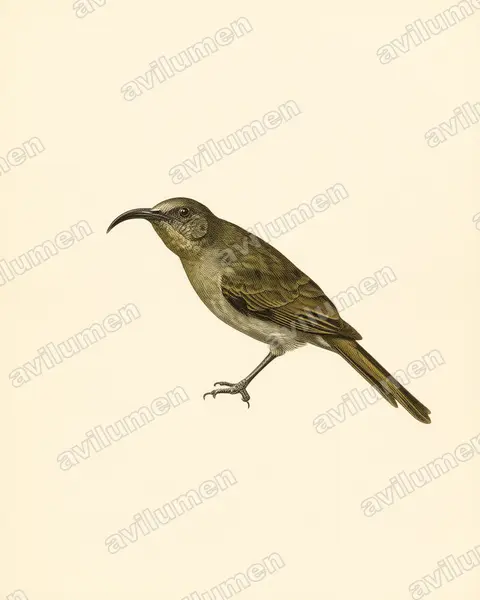
Vintage plate 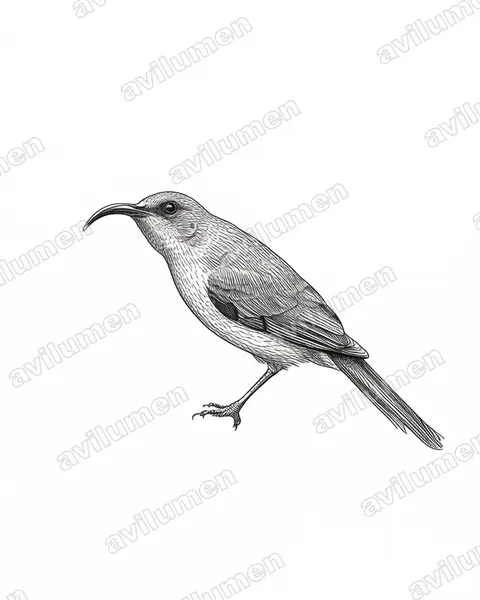
Ink 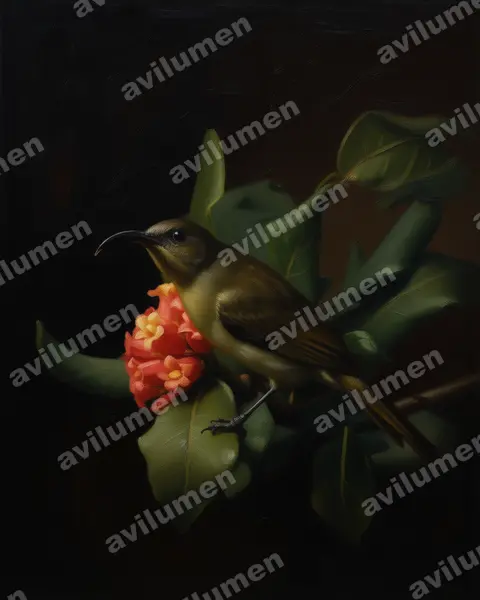
Oil 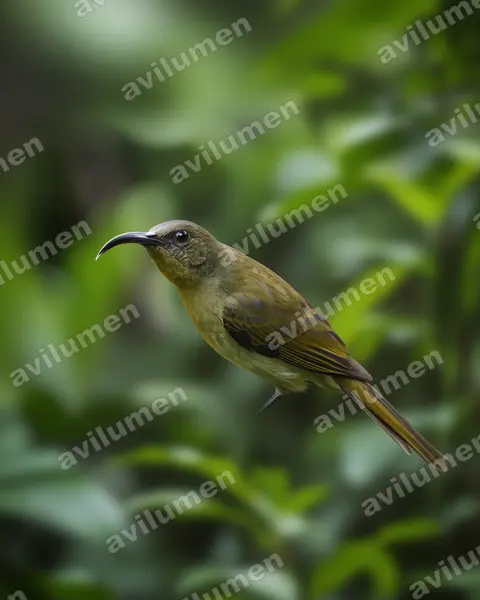
Realistic 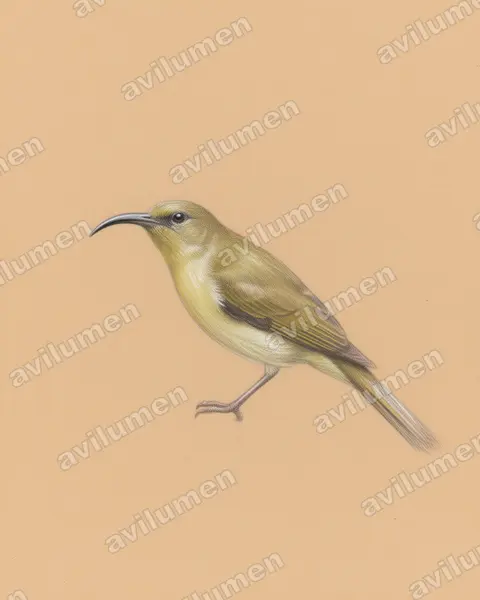
Colored pencil
Illustrations based on the photograph by Alan Manson (CC BY-SA 2.0), from Wikimedia Commons.
Digital editions
HD Digital Art Pack — Olive Sunbird
Digital download: 6 high-resolution illustrations of the Olive Sunbird (Cyanomitra olivacea), print-ready. This is a digital file; no animal or physical item is included.
AI Avatar — Olive Sunbird
Generate an avatar fusing your face with the Olive Sunbird (Cyanomitra olivacea). Delivered digitally in 8K, watermark-free. Digital product; no animals are sold or brokered.
Instant download. No live birds are sold.
Frequently asked questions
- Is Cyanomitra olivacea (Olive Sunbird) endangered?
- The IUCN Red List places Cyanomitra olivacea, commonly known as the Olive Sunbird, in the «Least concern» category. «Least concern» means it is not currently threatened.
- Where does Cyanomitra olivacea (Olive Sunbird) live?
- Cyanomitra olivacea (Olive Sunbird) is found in Africa and Burkina Faso.
- What family does Cyanomitra olivacea (Olive Sunbird) belong to?
- Cyanomitra olivacea (Olive Sunbird) belongs to the family Nectariniidae, in the order Passeriformes.
- What colour is Cyanomitra olivacea (Olive Sunbird)?
- The plumage of Cyanomitra olivacea (Olive Sunbird) combines these colours: Green and Yellow.
More from the same family
 Least concern
Handsome Sunbird
Aethopyga bella
The handsome sunbird is a species of bird in the family Nectariniidae. It is endemic to the Philippines.
from $1.99
 Least concern
Apo Sunbird
Aethopyga boltoni
The Apo sunbird is a species of bird in the sunbird family Nectariniidae. It is endemic to the island of Mindanao in the Philippines. It is found in tropical moist montane forests at elevations ranging from 820 to 2,000 metres above sea level.
from $1.99
 Least concern
Fork-tailed Sunbird
Aethopyga christinae
The fork-tailed sunbird is a bird in the family Nectariniidae. The species was first described by Robert Swinhoe in 1869.
from $1.99
 Endangered
Elegant Sunbird
Aethopyga duyvenbodei
The elegant sunbird is a large, up to 12 cm long, Australasian sunbird in the genus Aethopyga. The male has an iridescent blue-green crown, shoulder patch and uppertail coverts, yellow bar across lower back, red ear coverts, olive back, yellow throat, red neck collar and yellow below. The female has a yellowish olive upperparts, scaly crown and yellow underparts.
from $1.99