Blue-fronted lancebill
Doryfera johannae
Avilumen editorial team ·

The blue-fronted lancebill is a species of hummingbird in the family Trochilidae. It is found in Brazil, Colombia, Ecuador, Guyana, Peru, and Venezuela.
The blue-fronted lancebill (Doryfera johannae) is a species of hummingbird in the family Trochilidae. It is found in Brazil, Colombia, Ecuador, Guyana, Peru, and Venezuela.
Taxonomy and systematics
The blue-fronted lancebill has two subspecies, the nominate D. j. johannae and D. j. guianensis. It shares its genus only with the very similar green-fronted lancebill (D. ludovicae).
Description
The blue-fronted lancebill is 9.6 to 11 cm (3.8 to 4.3 in) long. Males weigh 3 to 5 g (0.11 to 0.18 oz) and females 3.3 to 6 g (0.12 to 0.21 oz). Both sexes have a long straight to slightly upcurved bill, and often hold it at an upward angle. Males of the nominate subspecies have a violet forehead ("front"), a bronze nape, and otherwise dark bronzy green upperparts. The tail is short and blue-black. The underparts are blue-black with a bluish green gloss on the throat and breast. The female differs from the male by having a greenish blue forehead and dull grayish bronzy green underparts. Both sexes of D. j. guianensis have a shorter bill than the nominate and are overall paler but similarly colored.
Distribution and habitat
The nominate subspecies of blue-fronted lancebill is found on the east slope of the Andes from east central Colombia south through eastern Ecuador to central and southeastern Peru. It inhabits wet forests of lower Andean slopes and foothills and the adjacent lowlands. It favors ravines, gorges, and rock outcroppings and usually occurs from the forest's middle strata into the lower canopy. However, it occurs down to the shrub level at forest edges. In elevation it mostly ranges between 800 and 1,200 m (2,620 and 3,940 ft). D. j. guianensis is found disjunctly in southeastern Venezuela, western Guyana, and slightly into adjoining northern Brazil. It inhabits tropical and subtropical forests on the area's tepuis, mostly at elevations between 900 and 2,000 m (2,950 and 6,560 ft), and does not occur in the lowlands between them.
Movement
The blue-fronted lancebill is assumed to be mostly sedentary but might make some seasonal elevational movements.
Feeding
The blue-fronted lancebill's diet is nectar and small arthropods. It draws the former from tubular flowers, typically those that droop or are horizontal. It does not usually defend feeding territories. It catches arthropods on the wing or by hover-gleaning from vegetation.
Breeding
The blue-fronted lancebill's breeding season varies in different parts of its range but has not been thoroughly studied. Only one nest has been described in detail. It was a cylinder made of moss and spider silk with a cup at the top and was suspended from a rock overhang in a shallow cave.
Vocalization
The blue-fronted lancebill's song has not been described and apparently has not been recorded. While foraging it makes "thin, dry, chittering notes...e.g. 'chuert'."
Status
The IUCN has assessed the blue-fronted lancebill as being of Least Concern, though its population size is unknown and believed to be decreasing. Much of the range of the nominate subspecies has been deforested but that of D. j. guianensis is largely intact. It is "uncommon to fairly common in good forest habitat"' and it appears to somewhat tolerate local disturbance such as selective logging.
Text adapted from Wikipedia · CC BY-SA 4.0
Where it lives
Plumage colours
Distribution

Taxonomy
- Order
- Apodiformes
- Family
- Trochilidae
- Genus
- Doryfera
- Conservation status
- Least concern
Listen to its call
No recording yet
Illustration gallery
6 illustrations of Doryfera johannae (Blue-fronted lancebill) in different styles, true to its real plumage. Shown watermarked; the art pack includes the high-resolution originals, ready to print.
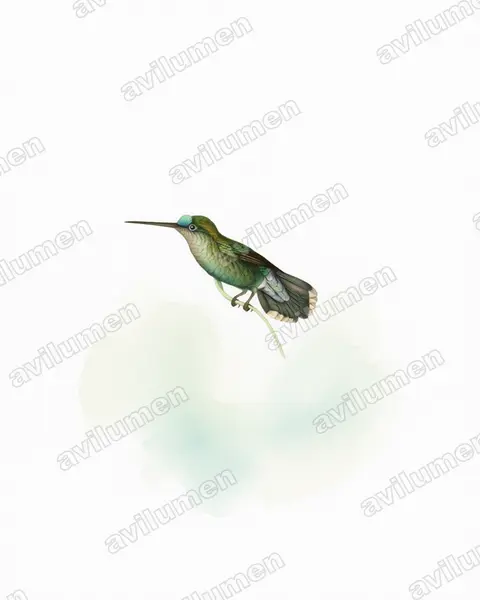
Watercolor 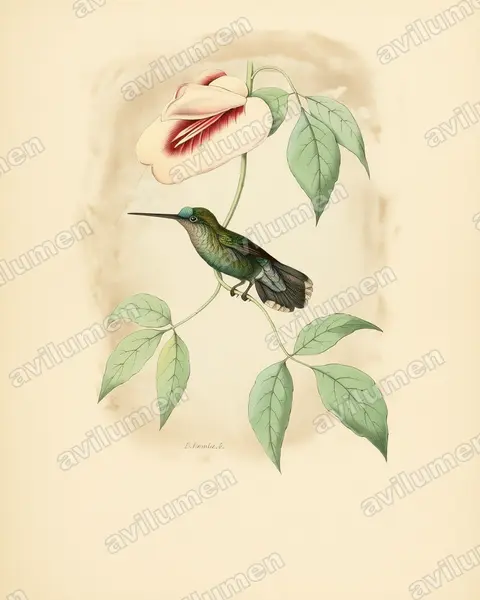
Vintage plate 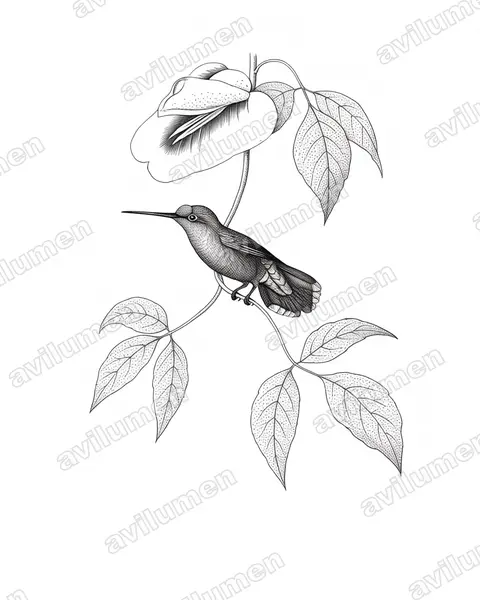
Ink 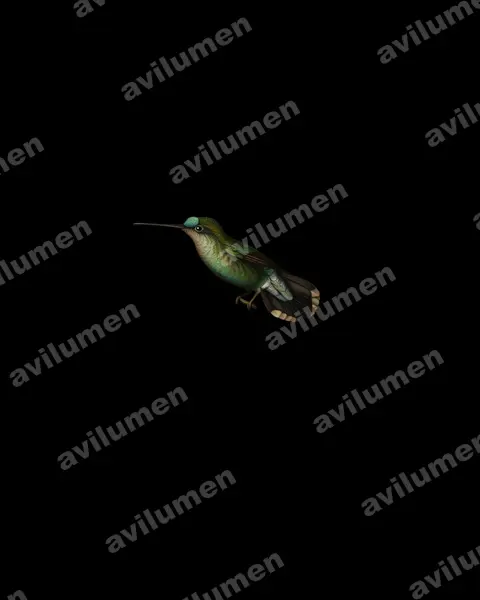
Oil 
Realistic 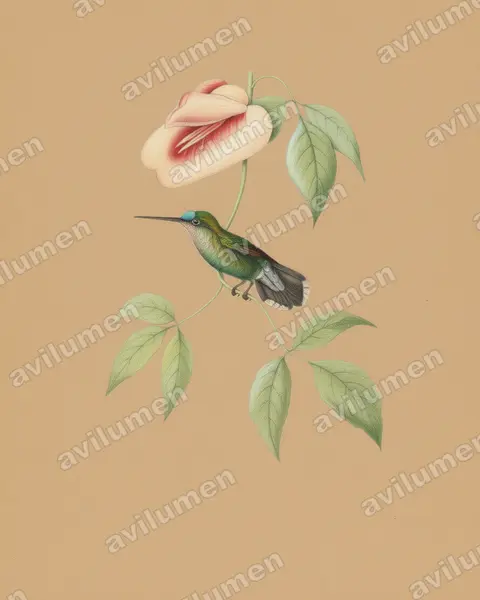
Colored pencil
Illustrations based on the photograph by Louis Victor Bevalet (1808-) (Public domain), from Wikimedia Commons.
Digital editions
HD Digital Art Pack — Blue-fronted lancebill
Digital download: 6 high-resolution illustrations of the Blue-fronted lancebill (Doryfera johannae), print-ready. This is a digital file; no animal or physical item is included.
AI Avatar — Blue-fronted lancebill
Generate an avatar fusing your face with the Blue-fronted lancebill (Doryfera johannae). Delivered digitally in 8K, watermark-free. Digital product; no animals are sold or brokered.
Instant download. No live birds are sold.
Frequently asked questions
- Is Doryfera johannae (Blue-fronted lancebill) endangered?
- The IUCN Red List places Doryfera johannae, commonly known as the Blue-fronted lancebill, in the «Least concern» category. «Least concern» means it is not currently threatened.
- Where does Doryfera johannae (Blue-fronted lancebill) live?
- Doryfera johannae (Blue-fronted lancebill) is found in Brazil and South America.
- What family does Doryfera johannae (Blue-fronted lancebill) belong to?
- Doryfera johannae (Blue-fronted lancebill) belongs to the family Trochilidae, in the order Apodiformes.
- What colour is Doryfera johannae (Blue-fronted lancebill)?
- The plumage of Doryfera johannae (Blue-fronted lancebill) combines these colours: Green.
More from the same family
 Least concern
Emerald-chinned Hummingbird
Abeillia abeillei
The emerald-chinned hummingbird is a species of hummingbird in the "emeralds", tribe Trochilini of subfamily Trochilinae.
from $1.99
 Least concern
Speckled hummingbird
Adelomyia melanogenys
The speckled hummingbird is a species of hummingbird. It is the only member of the genus Adelomyia. It inhabits Neotropical montane cloud forests at elevations of 1,000–2,500 meters and is confined to the Andes of Argentina, Bolivia, Peru, Ecuador, Colombia and Venezuela; as well as to some isolated montane forests in western Ecuador and Venezuela.
from $1.99
 Vulnerable
Purple-backed sunbeam
Aglaeactis aliciae
The purple-backed sunbeam is a bird species in the family Trochilidae. It is found only in Peru.
from $1.99
 Near threatened
White-tufted sunbeam
Aglaeactis castelnaudii
The white-tufted sunbeam is a species of hummingbird in the family Trochilidae. It is found only in Peru. Its natural habitats are subtropical or tropical moist montane forest and subtropical or tropical high-altitude shrubland.
from $1.99