White-tailed emerald
Elvira chionura
Avilumen editorial team ·

The white-tailed emerald is a species of hummingbird in the "emeralds", tribe Trochilini of subfamily Trochilinae. It is native to the Talamancan montane forests.
The white-tailed emerald (Microchera chionura) is a species of hummingbird in the "emeralds", tribe Trochilini of subfamily Trochilinae. It is native to the Talamancan montane forests.
Taxonomy and systematics
The white-tailed emerald was formerly placed with the coppery-headed emerald in the genus Elvira. A molecular phylogenetic study published in 2014 found that these two species were closely related to the snowcap in the then-monospecific genus Microchera. The International Ornithological Committee and the Clements taxonomy placed the three species together in Microchera which has priority. However, BirdLife International's Handbook of the Birds of the World retains them in Elvira.
The white-tailed emerald is monotypic.
Description
The white-tailed emerald is 7.5 to 8 cm (3.0 to 3.1 in) long. Males weigh about 3.3 g (0.12 oz) and females 3.1 g (0.11 oz). Both sexes have an almost straight black bill whose mandible has a pinkish base. The adult male has bronzy green upperparts that becomes dark copper-bronze on the uppertail coverts. Its central two pairs of tail feathers are copper-bronze and the other three pairs white with black tips. It has a glittering green throat and chest and white belly, vent, and undertail coverts. The adult female also has bronzy green upperparts. Its central two pairs of tail feathers are bronzy and the other three pairs white with a black band near the tip. Its underparts are dull white with bronzy green flanks. The immature male is similar to the adult but with duller underparts that have grayish buff fringes to the feathers. Immature females have grayer underparts than the adult.
Distribution and habitat
The white-tailed emerald is found in the highlands of the Pacific slope from south-central Costa Rica to central Panama and also locally on the Caribbean slope in Panama. It inhabits the edges and interior of moist to humid montane forest and secondary forest, and also plantations and gardens. In the forest interior males are often found in the canopy and females in the understory. In elevation it ranges from 750 to 2,000 m (2,500 to 6,600 ft) but in Costa Rica breeds mostly between 1,000 and 1,700 m (3,300 and 5,600 ft).
Movement
The white-tailed emerald's movements are not fully understood. In Costa Rica some individuals move both upslope and down outside the breeding season.
Feeding
The white-tailed emerald feeds on nectar from a variety of flowering plants at both the edges and interior of the forest. In addition to nectar, it captures small arthropods by hawking from a perch.
Breeding
The white-tailed emerald's breeding season extends from June to November. Males court females at leks in small groups. Nothing else is known about the species' breeding phenology and its nest has not been described.
Vocalization
The white-tailed emerald's song is "a prolonged, thin scratchy twittering mixed with buzzing or gurgling notes". It also makes "soft scratchy chipping notes" when foraging and "high-pitched, buzzy notes" when chasing.
Status
The IUCN has assessed the white-tailed emerald as being of Least Concern. Its population is estimated to be at least 20,000 mature individuals and stable. No immediate threats have been identified. It is considered locally common in some protected areas, but "deforestation [is] extensive and continuing in at least the lower part of its altitudinal range".
Text adapted from Wikipedia · CC BY-SA 4.0
Distribution

Taxonomy
- Order
- Apodiformes
- Family
- Trochilidae
- Genus
- Elvira
- Conservation status
- Least concern
Listen to its call
No recording yet
Illustration gallery
6 illustrations of Elvira chionura (White-tailed emerald) in different styles, true to its real plumage. Shown watermarked; the art pack includes the high-resolution originals, ready to print.
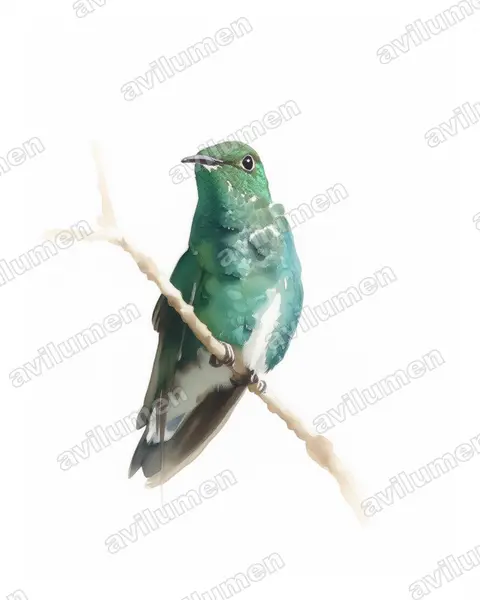
Watercolor 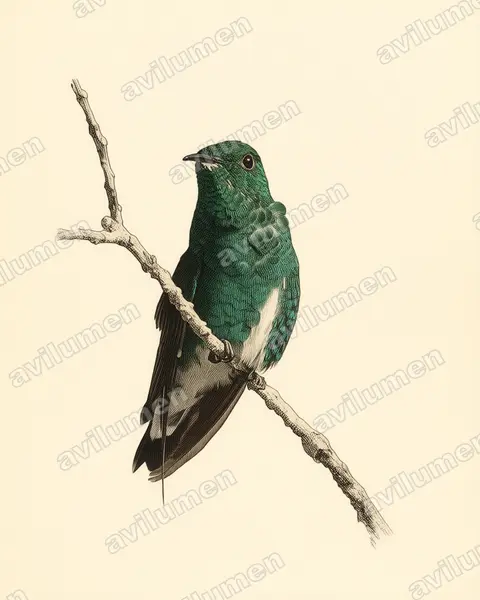
Vintage plate 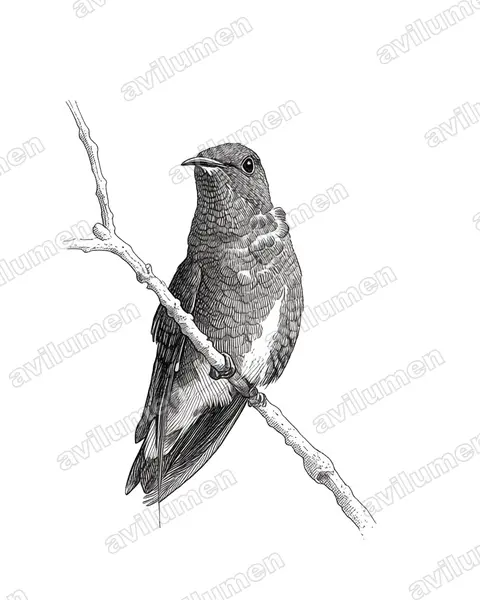
Ink 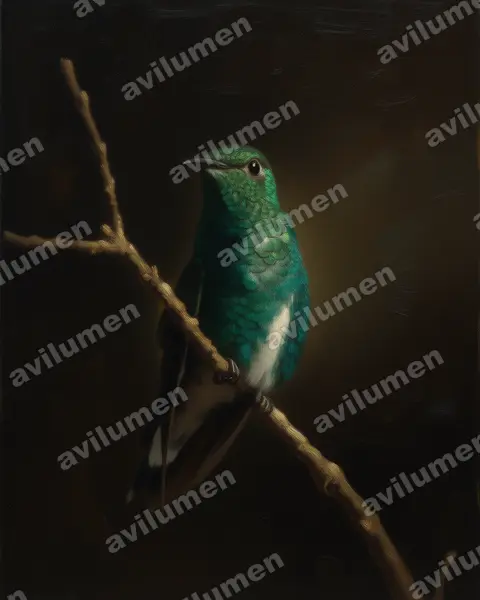
Oil 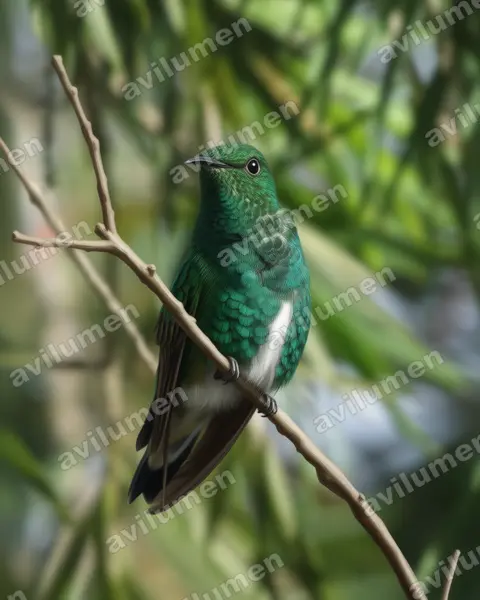
Realistic 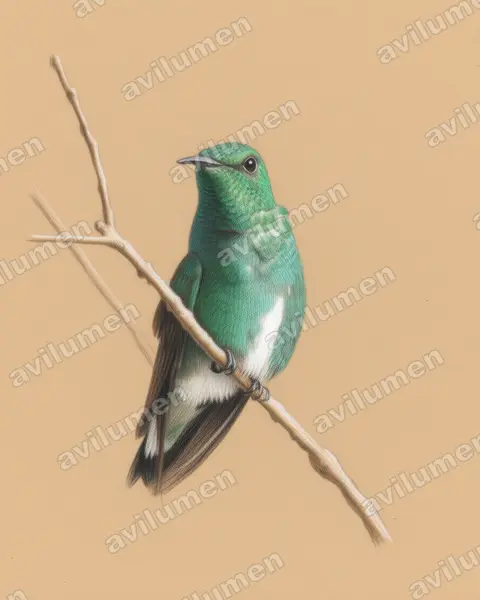
Colored pencil
Illustrations based on the photograph by (c) noverholtz, some rights reserved (CC BY-SA) (CC BY-SA 4.0), from Wikimedia Commons.
Digital editions
HD Digital Art Pack — White-tailed emerald
Digital download: 6 high-resolution illustrations of the White-tailed emerald (Elvira chionura), print-ready. This is a digital file; no animal or physical item is included.
AI Avatar — White-tailed emerald
Generate an avatar fusing your face with the White-tailed emerald (Elvira chionura). Delivered digitally in 8K, watermark-free. Digital product; no animals are sold or brokered.
Instant download. No live birds are sold.
Frequently asked questions
- Is Elvira chionura (White-tailed emerald) endangered?
- The IUCN Red List places Elvira chionura, commonly known as the White-tailed emerald, in the «Least concern» category. «Least concern» means it is not currently threatened.
- What family does Elvira chionura (White-tailed emerald) belong to?
- Elvira chionura (White-tailed emerald) belongs to the family Trochilidae, in the order Apodiformes.
- What colour is Elvira chionura (White-tailed emerald)?
- The plumage of Elvira chionura (White-tailed emerald) combines these colours: Green and White.
More from the same family
 Least concern
Emerald-chinned Hummingbird
Abeillia abeillei
The emerald-chinned hummingbird is a species of hummingbird in the "emeralds", tribe Trochilini of subfamily Trochilinae.
from $1.99
 Least concern
Speckled hummingbird
Adelomyia melanogenys
The speckled hummingbird is a species of hummingbird. It is the only member of the genus Adelomyia. It inhabits Neotropical montane cloud forests at elevations of 1,000–2,500 meters and is confined to the Andes of Argentina, Bolivia, Peru, Ecuador, Colombia and Venezuela; as well as to some isolated montane forests in western Ecuador and Venezuela.
from $1.99
 Vulnerable
Purple-backed sunbeam
Aglaeactis aliciae
The purple-backed sunbeam is a bird species in the family Trochilidae. It is found only in Peru.
from $1.99
 Near threatened
White-tufted sunbeam
Aglaeactis castelnaudii
The white-tufted sunbeam is a species of hummingbird in the family Trochilidae. It is found only in Peru. Its natural habitats are subtropical or tropical moist montane forest and subtropical or tropical high-altitude shrubland.
from $1.99