Tawny-breasted parrotfinch
Erythrura hyperythra
Avilumen editorial team ·

The tawny-breasted parrotfinch is a species of estrildid finch found in Indonesia, Malaysia and the Philippines. It is found in tropical montane moist forests, grassy clearings and forest edges. The IUCN has classified the species as being of least concern.
The tawny-breasted parrotfinch (Erythrura hyperythra) is a species of estrildid finch found in Indonesia, Malaysia and the Philippines. It is found in tropical montane moist forests, grassy clearings and forest edges. The IUCN has classified the species as being of least concern.
Description and taxonomy
It is emerald green, with an orange face and chest. Both sexes have a blue forehead patch, though this is brighter and more pronounced in males than in females.
Subspecies
Five subspecies are currently recognised, though recent genetic analysis has shown that there may be a phylogenetic split between the Javan and Philippine populations.
E. h. hyperythra – Found in Java with unconfirmed reports on Bali;
E. h. microrhyncha – Found in Sulawesi; paler and duller with less blue on the head and is smaller
E. h. borneensis – Found in the mountains of the Malay Peninsula and Borneo; blue on the forehead more extensive and reaches to the hindcrown
E. h. brunneiventris – Found in Luzon, Mindoro and Panay; shorter bill, hindcrown all the way to the rump and tail is bright green, underparts are also paler and flanks with blue tinges
E. h. intermedia – Found in Lombok, Sumbawa and Flores; uppertail coverts are green with an orange wash
Ecology and behavior
This species feeds on the seeds of grasses including bamboo, as well as the seeds of Persicaria chinensis. Insects make up a small part of its diet, as do the fruits of some species of Ficus. It typically forages on the ground in bamboo forests, but is also seen foraging in clearings, along forest edges, or in rice fields. Foraging can occur alone or in pairs, though small flocks are more common.
This species is known to breed from February to March in Java, and in May to June on Flores. Nests have been found in the crowns of trees. Nesting material includes grasses, ferns, and roots, which are fashioned into an enclosed nest with an entrance. Surrounding features such as branches, epiphytic orchids, or mosses have been used to obscure the nest entrance.
It lays 4 to 6 eggs with an incubation period of 14 days. Both parents contribute to nest-building and the feeding of young. The period from hatching to fledging is 3 to 4 weeks, though parents continue to feed the young for a further two weeks after fledging.
Habitat and conservation status
Its habitat varies depending on locality. Habitats include montane forests and scrublands, bamboo forests, edge habitat, broadleaf evergreen forests, as well as grassy clearings and agricultural development. The elevations of these habitats fall anywhere within 600-3300m across their whole range.
This species has been assessed as IUCN Red List as a Least-concern species. Across most of its range, it is described as rare, especially in the Philippines, Bali, Peninsular Malaysia, Borneo. It is more common in Wallacea. This species has a wide range and its preference for montane habitat means that a large area of habitat is more secure from deforestation due to inaccessibility.
Text adapted from Wikipedia · CC BY-SA 4.0
Taxonomy
- Order
- Passeriformes
- Family
- Estrildidae
- Genus
- Erythrura
- Conservation status
- Least concern
Listen to its call
No recording yet
Care guide
Canary and Finch Care Guide: Diet, Housing and Breeding
How to care for canaries, zebra finches, Gouldian finches and other finches: diet, flight cage setup, health, song and breeding. A guide for bird keepers.
Read the guide →Illustration gallery
6 illustrations of Erythrura hyperythra (Tawny-breasted parrotfinch) in different styles, true to its real plumage. Shown watermarked; the art pack includes the high-resolution originals, ready to print.
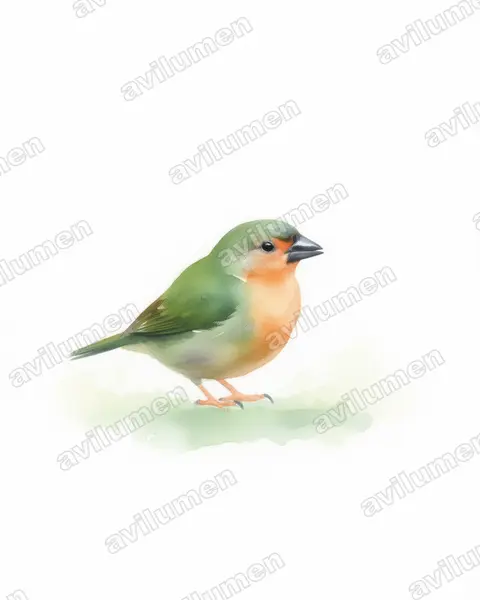
Watercolor 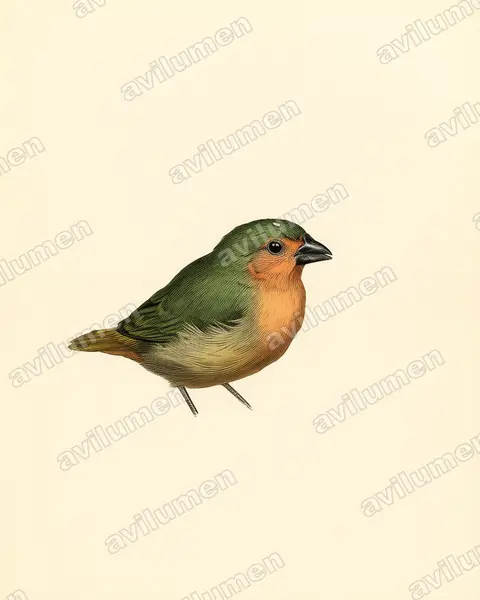
Vintage plate 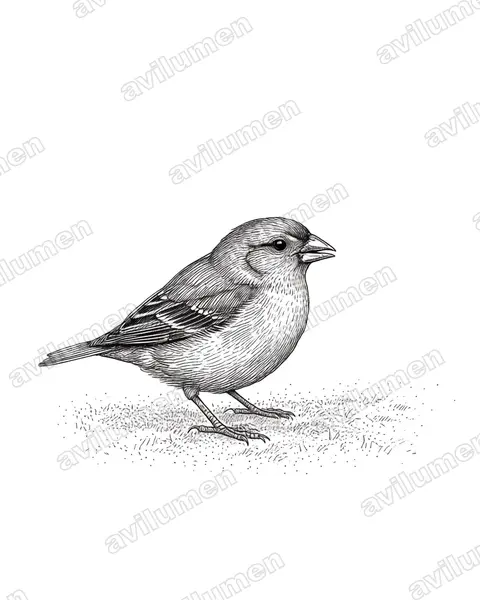
Ink 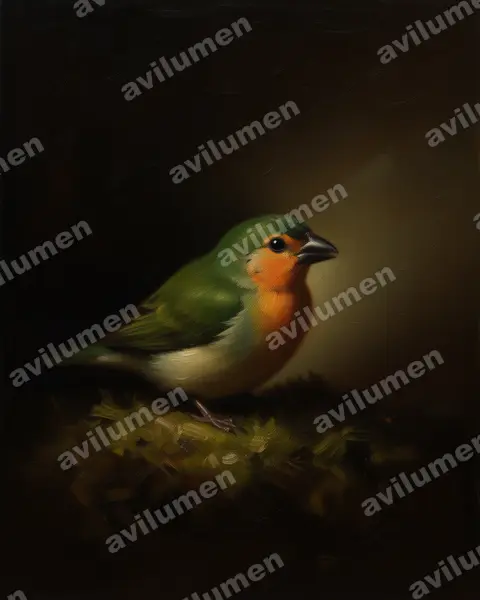
Oil 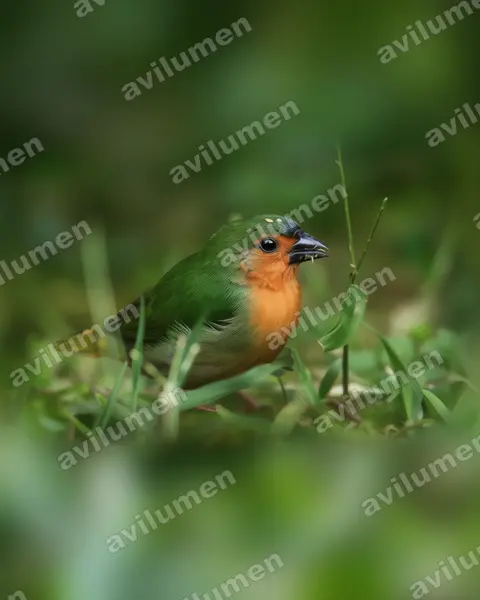
Realistic 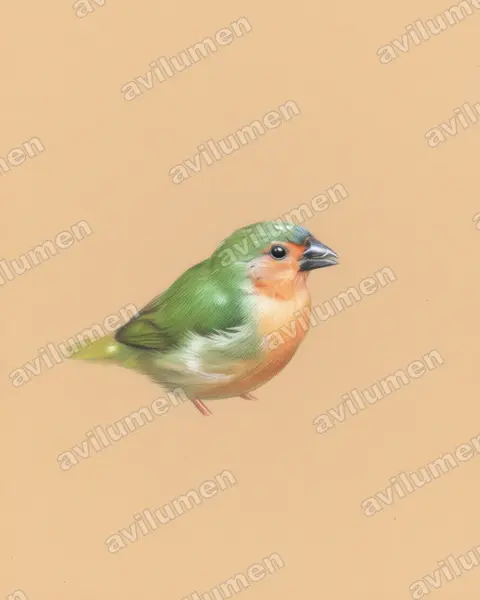
Colored pencil
Illustrations based on the photograph by Shah Jahan (CC BY-SA 3.0), from Wikimedia Commons.
Digital editions
HD Digital Art Pack — Tawny-breasted parrotfinch
Digital download: 6 high-resolution illustrations of the Tawny-breasted parrotfinch (Erythrura hyperythra), print-ready. This is a digital file; no animal or physical item is included.
AI Avatar — Tawny-breasted parrotfinch
Generate an avatar fusing your face with the Tawny-breasted parrotfinch (Erythrura hyperythra). Delivered digitally in 8K, watermark-free. Digital product; no animals are sold or brokered.
Instant download. No live birds are sold.
Frequently asked questions
- Is Erythrura hyperythra (Tawny-breasted parrotfinch) endangered?
- The IUCN Red List places Erythrura hyperythra, commonly known as the Tawny-breasted parrotfinch, in the «Least concern» category. «Least concern» means it is not currently threatened.
- What family does Erythrura hyperythra (Tawny-breasted parrotfinch) belong to?
- Erythrura hyperythra (Tawny-breasted parrotfinch) belongs to the family Estrildidae, in the order Passeriformes.
- What colour is Erythrura hyperythra (Tawny-breasted parrotfinch)?
- The plumage of Erythrura hyperythra (Tawny-breasted parrotfinch) combines these colours: Green, Orange, and Blue.
More from the same family
 Least concern
Red-headed finch
Amadina erythrocephala
The red-headed finch is a common species of estrildid finch found in Africa. It has an estimated global extent of occurrence of 1,600,000 km2 (620,000 sq mi). It is found in Angola, Botswana, Lesotho, Namibia, South Africa and Zimbabwe.
from $1.99
 Least concern
Cut-throat finch
Amadina fasciata
The cut-throat finch is a common species of estrildid finch found throughout Africa; it is also known as the bearded finch, the ribbon finch, the cut throat, and the weaver finch.
from $1.99
 Least concern
Red avadavat
Amandava amandava
The red avadavat, red munia or strawberry finch, is a sparrow-sized bird of the family Estrildidae. It is found in the open fields and grasslands of tropical Asia and is popular as a cage bird due to the colourful plumage of the males in their breeding season. It breeds in the Indian subcontinent in the monsoon season.
from $1.99
 Vulnerable
Green avadavat
Amandava formosa
The green avadavat or green munia is a species of Estrildid finch with green and yellow on the body, a bright red bill and black "zebra stripes" on the flanks. They are endemic to the Indian subcontinent and were formerly popular as cagebirds. The name "avadavat" is a corruption of the name the city of Ahmedabad in Gujarat, India, which was a centre of bird trade.
from $1.99