Buff-tailed Sicklebill
Eutoxeres condamini
Avilumen editorial team ·

The buff-tailed sicklebill is a species of hermit hummingbird from the lower Andes and adjacent west Amazonian lowlands from southern Colombia and northern Ecuador to Peru and Bolivia.
Epimachus albertisi, a bird-of-paradise from New Guinea, is also sometimes called "buff-tailed sicklebill".
The buff-tailed sicklebill (Eutoxeres condamini) is a species of hermit hummingbird from the lower Andes and adjacent west Amazonian lowlands from southern Colombia and northern Ecuador to Peru and Bolivia.
Description
With a total length of 5–6 in (13–15 cm) and weighing 0.28–0.44 oz (7.9–12.5 g), it is a relatively large hummingbird. Males and females are virtually identical, differing only in size (especially wing measurements), with the females being some 20% smaller.
Its upperparts are iridescent dull greenish, while the underparts are whitish, densely streaked with dusky. The neck-side has a relatively faint blue patch. The tips of the rectrices (tail feathers) are white, and there is a naked stripe on top of the head (but this is usually concealed). The most conspicuous features, however, are those the common name refers to: the bill is strongly decurved, and the outer three rectrices on each side are deep buff, best visible from below.
Immature birds have light-tipped remiges (pinions), hardly any blue on the neck, and lack the naked crown stripe. Hatchlings have black skin and grey down.
There are two subspecies which are not very distinct and almost form a continuous cline, with an extensive intergradation zone in northern Peru:
Eutoxeres condamini condamini (Bourcier, 1851) – northern buff-tailed sicklebill
Colombia and Ecuador. Bill longer, lower belly much streaked
Eutoxeres condamini gracilis Berlepsch & Stolzmann, 1902 – southern buff-tailed sicklebill
Central Peru to Bolivia. Bill shorter, lower belly less streaked
The buff outer remiges are the most reliable trait for separating the buff-tailed sicklebill from the only other member of the genus Eutoxeres, the white-tipped sicklebill (E. aquila), which has a more northerly distribution. The Eutoxeres species are somewhat sympatric however, for example in the foothills of Putumayo around Mocoa, Colombia.
Ecology
It is restricted to the undergrowth of humid forested and wooded habitats, recorded from 590–10,800 ft (180–3,290 m) ASL. It will tolerate more habitat disturbance than its congener, regularly occurring in plantations, bamboo stands and open habitat where populations are healthy, though it still prefers natural vegetation. Nothing precise is known about its movements, though it is presumed that the birds are non-migratory. The peculiar bill is an adaption to the shape of certain flowers, namely of the genera Centropogon and Heliconia. It feeds mainly by trap-lining. In addition to nectar, it will also catch small arthropods.
The two white eggs are laid in a nest which is attached to the underside of a leaf, a few yards/meters above ground. In the southern Cordillera Oriental of Colombia, nest construction was observed in July or August, and in the lowlands of Ecuador's Napo Province in January. Birds with enlarged gonads were found in Peru from September to November. Only the female incubates; the incubation period is 16–18 days and the young fledge 22–24 days after hatching. They start to breed when they are 1–2 years old.
Generally fairly common though inconspicuous and easily overlooked, it is considered a species of Least Concern by the IUCN. This species is most easily seen in the mixed habitat of old and young forest and small-scale logging at the Napo River in eastern Ecuador.
Text adapted from Wikipedia · CC BY-SA 4.0
Where it lives
Distribution

Taxonomy
- Order
- Apodiformes
- Family
- Trochilidae
- Genus
- Eutoxeres
- Conservation status
- Least concern
Listen to its call
No recording yet
Illustration gallery
6 illustrations of Eutoxeres condamini (Buff-tailed Sicklebill) in different styles, true to its real plumage. Shown watermarked; the art pack includes the high-resolution originals, ready to print.

Watercolor 
Vintage plate 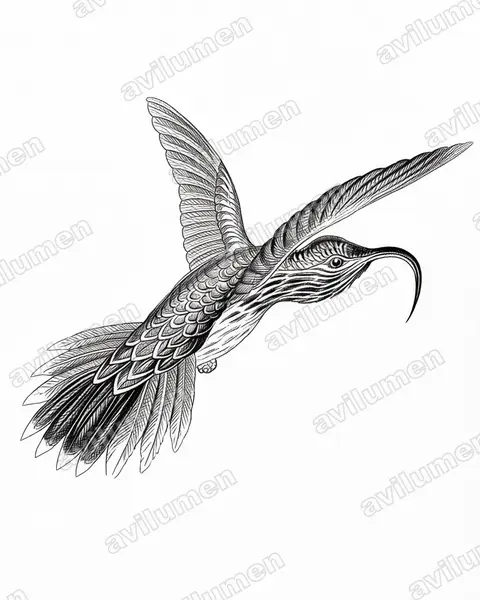
Ink 
Oil 
Realistic 
Colored pencil
Digital editions
HD Digital Art Pack — Buff-tailed Sicklebill
Digital download: 6 high-resolution illustrations of the Buff-tailed Sicklebill (Eutoxeres condamini), print-ready. This is a digital file; no animal or physical item is included.
AI Avatar — Buff-tailed Sicklebill
Generate an avatar fusing your face with the Buff-tailed Sicklebill (Eutoxeres condamini). Delivered digitally in 8K, watermark-free. Digital product; no animals are sold or brokered.
Instant download. No live birds are sold.
Frequently asked questions
- Is Eutoxeres condamini (Buff-tailed Sicklebill) endangered?
- The IUCN Red List places Eutoxeres condamini, commonly known as the Buff-tailed Sicklebill, in the «Least concern» category. «Least concern» means it is not currently threatened.
- Where does Eutoxeres condamini (Buff-tailed Sicklebill) live?
- Eutoxeres condamini (Buff-tailed Sicklebill) is found in Peru and South America.
- What family does Eutoxeres condamini (Buff-tailed Sicklebill) belong to?
- Eutoxeres condamini (Buff-tailed Sicklebill) belongs to the family Trochilidae, in the order Apodiformes.
- What colour is Eutoxeres condamini (Buff-tailed Sicklebill)?
- The plumage of Eutoxeres condamini (Buff-tailed Sicklebill) combines these colours: Green and Brown.
More from the same family
 Least concern
Emerald-chinned Hummingbird
Abeillia abeillei
The emerald-chinned hummingbird is a species of hummingbird in the "emeralds", tribe Trochilini of subfamily Trochilinae.
from $1.99
 Least concern
Speckled hummingbird
Adelomyia melanogenys
The speckled hummingbird is a species of hummingbird. It is the only member of the genus Adelomyia. It inhabits Neotropical montane cloud forests at elevations of 1,000–2,500 meters and is confined to the Andes of Argentina, Bolivia, Peru, Ecuador, Colombia and Venezuela; as well as to some isolated montane forests in western Ecuador and Venezuela.
from $1.99
 Vulnerable
Purple-backed sunbeam
Aglaeactis aliciae
The purple-backed sunbeam is a bird species in the family Trochilidae. It is found only in Peru.
from $1.99
 Near threatened
White-tufted sunbeam
Aglaeactis castelnaudii
The white-tufted sunbeam is a species of hummingbird in the family Trochilidae. It is found only in Peru. Its natural habitats are subtropical or tropical moist montane forest and subtropical or tropical high-altitude shrubland.
from $1.99