Violet-capped hummingbird
Goldmania violiceps
Avilumen editorial team ·

The violet-capped hummingbird is a Near Threatened species of hummingbird in the "emeralds", tribe Trochilini of subfamily Trochilinae. It is found in Panama and far northwestern Colombia.
The violet-capped hummingbird (Goldmania violiceps) is a Near Threatened species of hummingbird in the "emeralds", tribe Trochilini of subfamily Trochilinae. It is found in Panama and far northwestern Colombia.
Taxonomy and systematics
The violet-capped hummingbird is monotypic. It shares it genus with the Pirre hummingbird.
Description
The violet-capped hummingbird is 8.5 to 9.5 cm (3.3 to 3.7 in) long. Males weigh 3.8 to 4.4 g (0.13 to 0.16 oz) and females 3.4 to 3.9 g (0.12 to 0.14 oz). Both sexes have a straight bill that is mostly black with a pink base to the mandible. The male's crown is iridescent violet-blue and most of the rest of the body is metallic green. Its tail is slightly forked and maroon with wide white edges to the feathers. The female has green upperparts and whitish underparts with gray spots on the throat and green ones along the side. Its tail feathers are maroon with white tips.
Distribution and habitat
The violet-capped hummingbird is found in several unconnected mountainous areas in central and eastern Panama and extreme northwestern Colombia. It inhabits the edges and interior of humid forest between the elevations of 600 and 1,200 m (2,000 and 3,900 ft) and is most common at around 900 m (3,000 ft).
Movement
The violet-capped hummingbird is a year-round resident throughout its range.
Feeding
The violet-capped hummingbird forages for nectar in dense undergrowth, feeding mainly on low flowering shrubs like Salvia, Pachystachis, Palicourea and Psammisia.
Breeding
The violet-capped hummingbird's breeding season was for a time thought to span from December to March. Nests discovered in 2021 and 2022 suggest that the season spans from December to August. The nests were small cups made from lichen, fern fibers, and dry moss held together with spider web and lined with additional spider web. One was attached to the end of a fern frond about 1 m (3 ft) above the ground and the other to a shrub branch about 4 m (13 ft) above the ground. Both contained two white eggs. The female alone incubated the eggs. At the one nest later observed with a nestling the female provided all the care.
Vocalization
The violet-capped hummingbird's song is "a low, rapid chirping." Its call is "a series of irregularly repeated, very nasal and fairly low-pitched notes, 'kyek...kyek-kyek-kyek...kyek...'" that is typically given while hovering or feeding.
Status
The IUCN originally assessed the violet-capped hummingbird as being of Least Concern but since 2017 has rated it Near Threatened. It has a small range; its population size is not known and is believed to be decreasing. "A slow amount of deforestation may be threatening this species, but much of this habitat has not been affected by man yet." It is considered fairly common to locally common.
Text adapted from Wikipedia · CC BY-SA 4.0
Where it lives
Distribution

Taxonomy
- Order
- Apodiformes
- Family
- Trochilidae
- Genus
- Goldmania
- Conservation status
- Near threatened
Listen to its call
No recording yet
Illustration gallery
6 illustrations of Goldmania violiceps (Violet-capped hummingbird) in different styles, true to its real plumage. Shown watermarked; the art pack includes the high-resolution originals, ready to print.
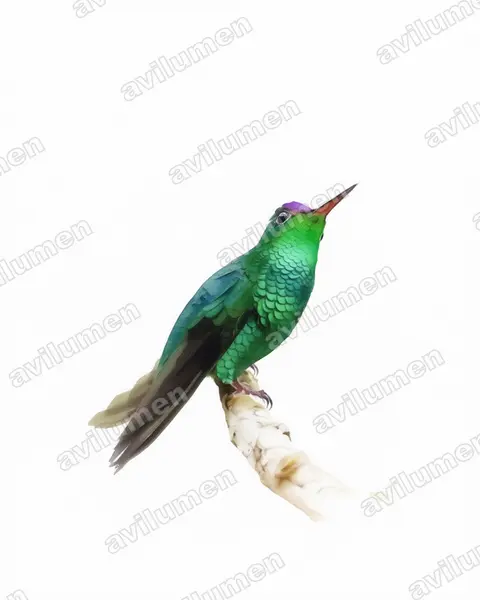
Watercolor 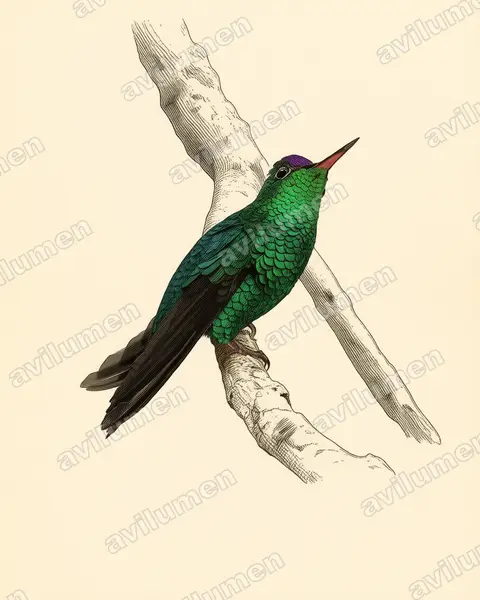
Vintage plate 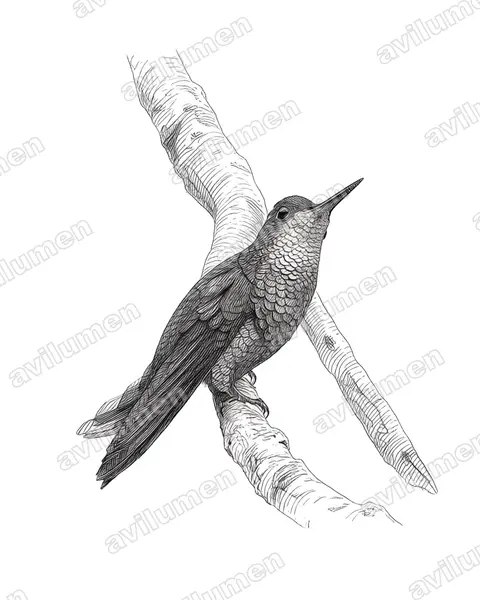
Ink 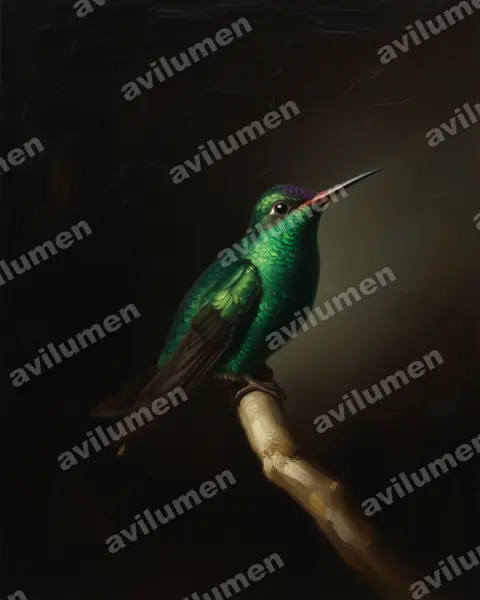
Oil 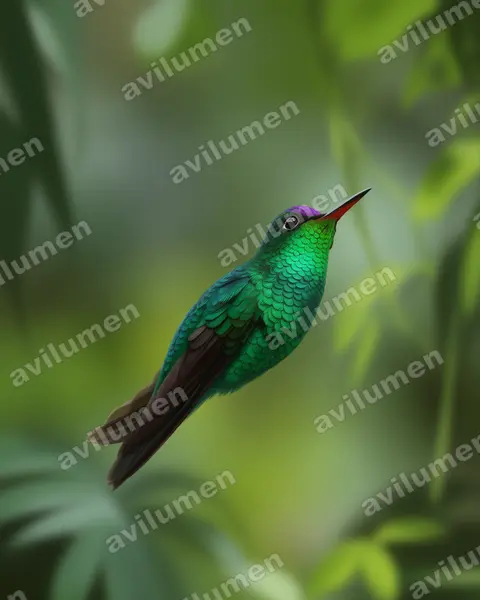
Realistic 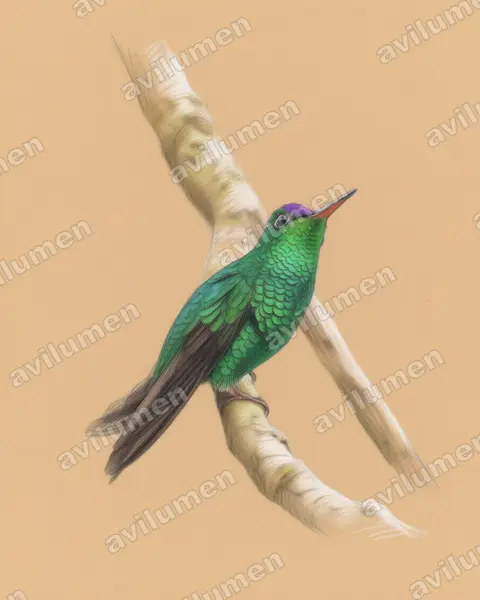
Colored pencil
Illustrations based on the photograph by Aitor (CC BY 4.0), from Wikimedia Commons.
Digital editions
HD Digital Art Pack — Violet-capped hummingbird
Digital download: 6 high-resolution illustrations of the Violet-capped hummingbird (Goldmania violiceps), print-ready. This is a digital file; no animal or physical item is included.
AI Avatar — Violet-capped hummingbird
Generate an avatar fusing your face with the Violet-capped hummingbird (Goldmania violiceps). Delivered digitally in 8K, watermark-free. Digital product; no animals are sold or brokered.
Instant download. No live birds are sold.
Frequently asked questions
- Is Goldmania violiceps (Violet-capped hummingbird) endangered?
- The IUCN Red List places Goldmania violiceps, commonly known as the Violet-capped hummingbird, in the «Near threatened» category. «Near threatened» means it is not threatened yet, but is close to becoming so.
- Where does Goldmania violiceps (Violet-capped hummingbird) live?
- Goldmania violiceps (Violet-capped hummingbird) is found in South America.
- What family does Goldmania violiceps (Violet-capped hummingbird) belong to?
- Goldmania violiceps (Violet-capped hummingbird) belongs to the family Trochilidae, in the order Apodiformes.
- What colour is Goldmania violiceps (Violet-capped hummingbird)?
- The plumage of Goldmania violiceps (Violet-capped hummingbird) combines these colours: Violet and Green.
More from the same family
 Least concern
Emerald-chinned Hummingbird
Abeillia abeillei
The emerald-chinned hummingbird is a species of hummingbird in the "emeralds", tribe Trochilini of subfamily Trochilinae.
from $1.99
 Least concern
Speckled hummingbird
Adelomyia melanogenys
The speckled hummingbird is a species of hummingbird. It is the only member of the genus Adelomyia. It inhabits Neotropical montane cloud forests at elevations of 1,000–2,500 meters and is confined to the Andes of Argentina, Bolivia, Peru, Ecuador, Colombia and Venezuela; as well as to some isolated montane forests in western Ecuador and Venezuela.
from $1.99
 Vulnerable
Purple-backed sunbeam
Aglaeactis aliciae
The purple-backed sunbeam is a bird species in the family Trochilidae. It is found only in Peru.
from $1.99
 Near threatened
White-tufted sunbeam
Aglaeactis castelnaudii
The white-tufted sunbeam is a species of hummingbird in the family Trochilidae. It is found only in Peru. Its natural habitats are subtropical or tropical moist montane forest and subtropical or tropical high-altitude shrubland.
from $1.99