Sandhill crane
Grus canadensis
Avilumen editorial team ·

The sandhill crane is a species of large crane of North America and extreme northeastern Siberia. The common name of this bird refers to its habitat, such as the Platte River, on the edge of Nebraska's Sandhills on the American Great Plains. Sandhill cranes are known to frequent the edges of bodies of water.
The sandhill crane (Antigone canadensis) is a species of large crane of North America and extreme northeastern Siberia. The common name of this bird refers to its habitat, such as the Platte River, on the edge of Nebraska's Sandhills on the American Great Plains. Sandhill cranes are known to frequent the edges of bodies of water. The central Platte River Valley in Nebraska is the most important stopover area for the nominotypical subspecies, the lesser sandhill crane (A. c. canadensis), with up to 450,000 of these birds migrating through annually.
Taxonomy
In 1750, British naturalist George Edwards included an illustration and a description of the sandhill crane in the third volume of his A Natural History of Uncommon Birds, referring to the species as the 'Brown and Ash-colour'd Crane'. Edwards based his hand-colored etching on a preserved specimen that had been brought to London from the Hudson Bay area of Canada by James Isham. When in 1758, Swedish naturalist Carl Linnaeus updated his Systema Naturae for the 10th edition, he placed the sandhill crane with herons and cranes in the genus Ardea. Linnaeus included a brief description, coined the binomial name Ardea canadensis, and cited Edwards' work.
The sandhill crane was formerly placed in the genus Grus, but a molecular phylogenetic study published in 2010 found that the genus, as then defined, was polyphyletic. In the resulting rearrangement to create monophyletic genera, four species, including the sandhill crane, were placed in the resurrected genus Antigone that had originally been erected by German naturalist Ludwig Reichenbach in 1853.
The specific epithet canadensis is the modern Latin word for "from Canada".
Five subspecies are recognised:
A. c. canadensis (Linnaeus, 1758) – northeast Siberia through Alaska and northern Canada to Baffin Island
A. c. nesiotes (Bangs & Zappey, 1905) – Cuba and Isla de la Juventud (Isle of Pines)
A. c. pratensis (Meyer, FAA, 1794) – Georgia and Florida
A. c. pulla (Aldrich, 1972) – Mississippi
A. c. tabida (Peters, JL, 1925) – southern Canada and west-central United States
A 2025 study showed a deep genetic divide between the sandhill crane populations, with geographic barriers resulting in minimal gene flow between inland and coastal populations. The inland and coastal populations of sandhill cranes show consistent morphological differences in size, colour, and facial structure that can be observed in field conditions. The two populations also differ in behavior and preferred habitat. The authors of the study argue that the diversity within the species must be better reflected in conservation efforts in order to protect vulnerable populations.
Description
Adults are gray overall; during breeding, their plumage is usually much worn and stained, particularly in the migratory populations, and looks nearly ochre. The average weight of the larger males is 4.57 kg (10.1 lb), while the average weight of females is 4.02 kg (8.9 lb), with a range of 2.7 to 6.7 kg (6.0 to 14.8 lb) across the subspecies. Sandhill cranes have red foreheads, white cheeks, and long, dark, pointed bills. In flight, their long, dark legs trail behind, and their long necks keep straight.
Immature birds have reddish-brown upper parts and gray underparts. The juveniles do not have the characteristic red foreheads, making distinguishing the young from the parents possible, even when they are the same height.
The sexes look alike. Sizes vary among the different subspecies; the typical height of these birds is around 80 to 136 cm (2 ft 7 in to 4 ft 6 in). Their wing chords are typically 41.8–60.0 cm (16.5–23.6 in), tails are 10.0–26.4 cm (3.9–10.4 in), the exposed culmens are 6.9–16 cm (2.7–6.3 in) long, and the tarsi measure 15.5–26.6 cm (6.1–10.5 in). Wingspan is 200 cm (78.7 in).
These cranes frequently give a loud, trumpeting call that suggests a rolled "r" in the throat, and they can be heard from a long distance. Mated pairs of cranes engage in "unison calling". The cranes stand close together, calling in a synchronized and complex duet. The female makes two calls for every one from the male.
Sandhill cranes' large wingspans, typically 1.65 to 2.30 m (5 ft 5 in to 7 ft 7 in), make them very skilled soaring birds, similar in style to hawks and eagles. Using thermals to obtain lift, they can stay aloft for many hours, requiring only occasional flapping of their wings, thus expending little energy. Migratory flocks contain hundreds of birds, and can create clear outlines of the normally invisible rising columns of air (thermals) they ride.
Sandhill cranes fly south for the winter. In their wintering areas, they form flocks over 10,000. One place this happens is at Bosque del Apache National Wildlife Refuge, 100 miles (160 km) south of Albuquerque, New Mexico. An annual Sandhill Crane Festival is held there in November.
Fossil record
Sandhill cranes have one of the longest fossil histories of any extant bird. A 10-million-year-old crane fossil from Nebraska is said to be of this species, but this may be from a prehistoric relative or ancestor of sandhill cranes, of a genus other than Grus and Antigone. The oldest unequivocal sandhill crane fossil is 2.5 million years old, older by half than the earliest remains of most living species of birds, primarily found from after the Pliocene/Pleistocene boundary some 1.8 million years ago. As these ancient sandhill cranes varied as much in size as present-day birds, those Pliocene fossils are sometimes described as new species. Grus haydeni may have been a prehistoric relative, or it may comprise material of a sandhill crane and its ancestor.
Subspecies and evolution
Sandhill cranes vary considerably in size (much of which is clinal) and in migratory habits. A female of A. c. canadensis averages 3.46 kg (7.6 lb) in weight, 94 cm (37 in) in length, and 1.6 m (5 ft 3 in) in wingspan. A male of A. c. tabida averages 5 kg (11 lb), 119 cm (47 in), and 2.12 m (6 ft 11 in) in comparison. The southern subspecies (along with A. c. rowani) are intermediate, roughly according to Bergmann's rule.
Three subspecies are resident: A. c. pulla of the Gulf Coast of the U.S., A. c. pratensis of Florida and Georgia, and A. c. nesiotes of Cuba. The northern populations exist as fragmented remains in the contiguous U.S. and a large and contiguous population from Canada to Beringia. These migrate to the Southwestern United States and Mexico. These cranes are rare vagrants to China, South Korea, and Japan and very rare vagrants to Western Europe.
Six subspecies have been recognized in recent times:
Lesser sandhill crane, A. c. canadensis
Cuban sandhill crane, A. c. nesiotes – ESA: endangered
Florida sandhill crane, A. c. pratensis
Mississippi sandhill crane, A. c. pulla – ESA: endangered
Canadian sandhill crane, A. c. rowani
Greater sandhill crane, A. c. tabida
The Florida sandhill crane was listed as EC or easily confused to facilitate an attempted reintroduction of the whooping crane (Grus americana) into Florida. The attempt failed, but the listing remained. The current list of endangered subspecies includes only two birds, A. c. nesiotes and A. c. rowani, with A. c. pratensis no longer listed. Sandhill cranes occur in pastures, open prairies and freshwater wetlands in peninsular Florida from the Everglades to the Okefenokee Swamp.
Some authorities no longer recognize Canadian sandhill crane as a distinct subspecies, as insignificant genetic differentiation and minimal morphological differentiation exist between the greater sandhill crane and it. The others can be somewhat more reliably distinguished in hand by measurements and plumage details, apart from the size differences already mentioned. Unequivocal identification often requires location information, which is often impossible in migrating birds.
Analysis of control-region mtDNA haplotype data shows two major lineages. The arctic and the subarctic migratory population includes the lesser sandhill cranes. The other lineages can be divided into a migratory and some indistinct clusters, which can be matched to the resident subspecies. The lesser and greater sandhill cranes are quite distinct, their divergence dating to roughly 2.3–1.2 million years ago, sometime during the Late Pliocene or Early Pleistocene. Glaciation seemingly fragmented off a founder population of lesser sandhill cranes, because during each major ice age, its present breeding range was frozen year-round. Still, sandhill cranes are amply documented from fossil and subfossil remains right to the modern era. Conceivably, they might be considered distinct species already, a monotypic A. canadensis and the greater sandhill crane, A. pratensis, which would include the other populations.
The scant differences between southern Canadian and western U.S. populations appear to result from genetic drift, due to the recent reduction in population and range fragmentation. Until the early 20th century, the southern migratory birds occupied a much larger and continuous range. Thus, the subspecies A. c. rowani may well be abandoned.
The two southern U.S. resident populations are somewhat more distinct. The Cuban population has been comparatively little studied, but appears to have been established on the island for a long time. They and the migratory greater sandhill cranes proper may form a group of lineages that diverged much later from a range in the southern U.S. and maybe northern Mexico, where they were resident. The southern migratory population would then represent a later re-expansion, which (re)evolved their migratory habits independent from the northernmost birds, the geographically separated populations expanding rapidly when more habitat was available as the last ice age ended.
Behavior
Sandhill cranes are fairly social birds that usually live in pairs or family groups through the year. During migration and winter, unrelated cranes come together to form "survival groups" that forage and roost together. Such groups often congregate at migration and winter sites, sometimes in the thousands.
Diet
Sandhill cranes are mainly herbivorous, but eat various types of food, depending on availability. They often feed with their bills down to the ground as they root around for seeds and other foods, in shallow wetlands with vegetation or various upland habitats. Cranes readily eat cultivated foods such as corn, wheat, cottonseed, and sorghum. Waste corn is useful to cranes preparing for migration, providing them with nutrients for the long journey. Among northern races of sandhill cranes, their diet is most varied, especially among breeding birds. They variously feed on berries, small mammals, insects, snails, reptiles, and amphibians.
Breeding
Sandhill cranes raise one brood per year. In nonmigratory populations, laying begins between December and August. In migratory populations, laying usually begins in April or May. Both members of a breeding pair build the nest using plant material from the surrounding area. Nest sites are usually marshes, bogs, or swales, though occasionally on dry land. Females lay one to three (usually two) oval, dull brown eggs with reddish markings. Both parents incubate the eggs, for about 30 days. The chicks are precocial; they hatch covered in down, with their eyes open, and able to leave the nest within a day. The parents brood the chicks for up to three weeks after hatching, feeding them intensively for the first few weeks, then gradually less frequently until they reach independence at 9 to 10 months old.
The chicks remain with their parents until one to two months before the parents lay the next clutch of eggs the following year, remaining with them for 10–12 months. After leaving their parents, the chicks form nomadic flocks with other juveniles and nonbreeders. They remain in these flocks until they form breeding pairs between two and seven years old.
It is possible for sandhill cranes to hybridize with whooping cranes, a critically endangered species. Offspring resulting from these pairings are sterile and inherit intermediate characteristics of both parents. The monogamous habits of both species means that crossbreeding can threaten conservation efforts, and direct intervention may be needed used to prevent hybridization.
Text adapted from Wikipedia · CC BY-SA 4.0
Plumage colours
Distribution

Taxonomy
- Order
- Gruiformes
- Family
- Gruidae
- Genus
- Grus
- Conservation status
- Least concern
Listen to its call
No recording yet
Illustration gallery
6 illustrations of Grus canadensis (Sandhill crane) in different styles, true to its real plumage. Shown watermarked; the art pack includes the high-resolution originals, ready to print.
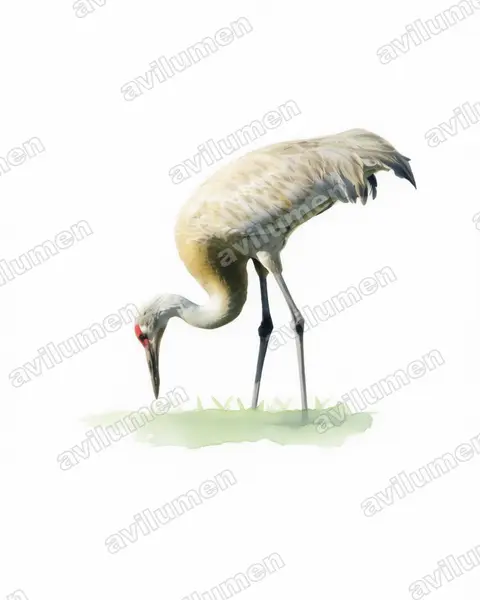
Watercolor 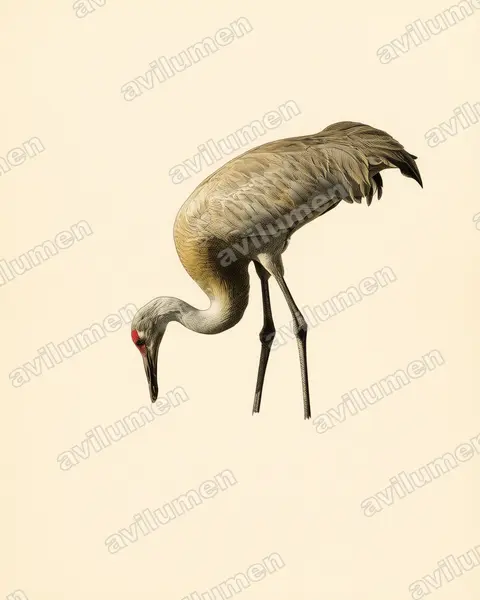
Vintage plate 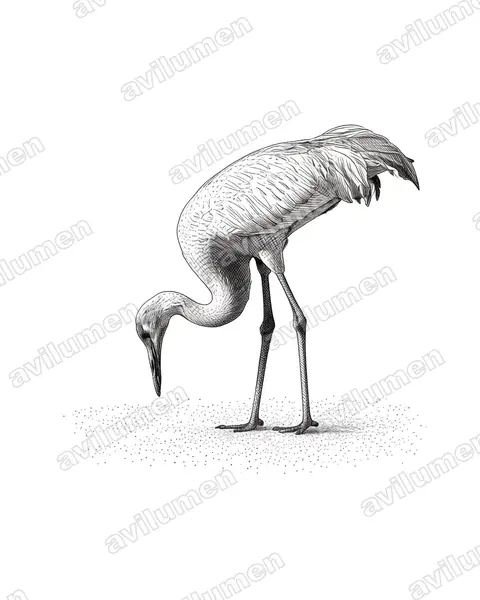
Ink 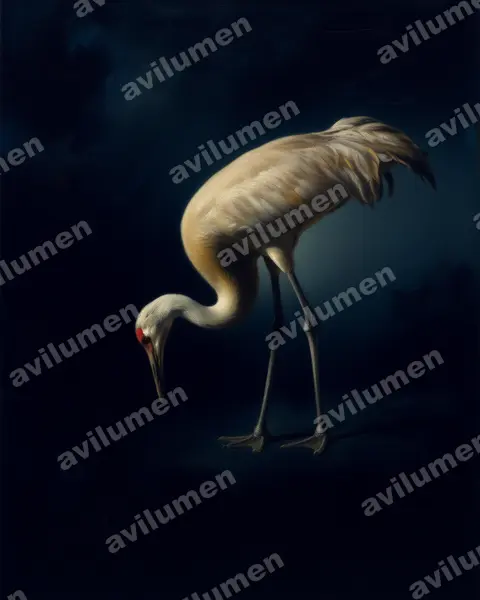
Oil 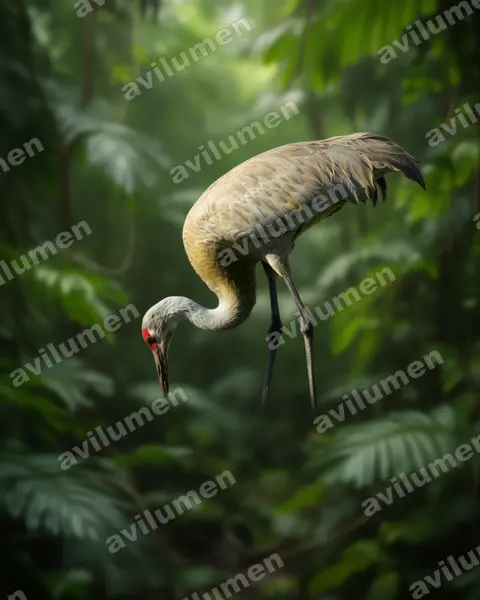
Realistic 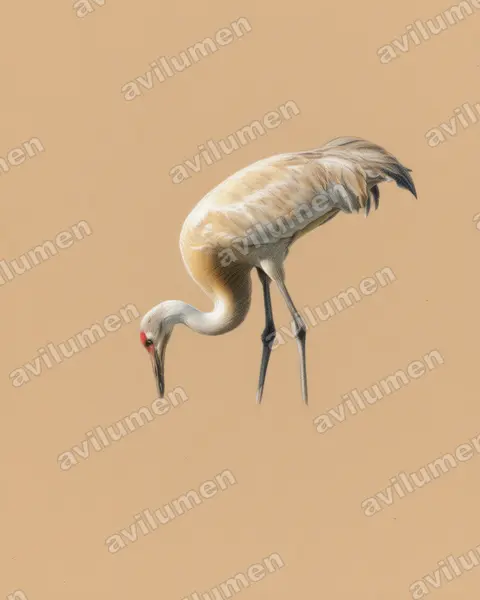
Colored pencil
Illustrations based on the photograph by Kyletracysrs (CC BY-SA 3.0), from Wikimedia Commons.
Digital editions
HD Digital Art Pack — Sandhill crane
Digital download: 6 high-resolution illustrations of the Sandhill crane (Grus canadensis), print-ready. This is a digital file; no animal or physical item is included.
AI Avatar — Sandhill crane
Generate an avatar fusing your face with the Sandhill crane (Grus canadensis). Delivered digitally in 8K, watermark-free. Digital product; no animals are sold or brokered.
Instant download. No live birds are sold.
Frequently asked questions
- Is Grus canadensis (Sandhill crane) endangered?
- The IUCN Red List places Grus canadensis, commonly known as the Sandhill crane, in the «Least concern» category. «Least concern» means it is not currently threatened.
- What family does Grus canadensis (Sandhill crane) belong to?
- Grus canadensis (Sandhill crane) belongs to the family Gruidae, in the order Gruiformes.
- What colour is Grus canadensis (Sandhill crane)?
- The plumage of Grus canadensis (Sandhill crane) combines these colours: Grey.
More from the same family
 Vulnerable
Blue crane
Anthropoides paradiseus
The blue crane, also known as the Stanley crane and the paradise crane, is the national bird of South Africa. The species is listed as Vulnerable by the IUCN.
from $1.99
 Least concern
Demoiselle crane
Anthropoides virgo
The demoiselle crane is a species of crane found in central Eurosiberia, ranging from the Black Sea to Mongolia and Northeast China. There is also a small breeding population in Turkey. These cranes are migratory birds. Birds from western Eurasia will spend the winter in Africa while the birds from Asia, Mongolia and China will spend the winter in the Indian subcontinent.
from $1.99
 Not evaluated
Sarus crane
Antigone antigone
The sarus crane is a large nonmigratory crane found in parts of the Indian subcontinent, Southeast Asia, and northern Australia. The tallest of the flying birds, standing at a height of up to 1.8 m, they are a conspicuous species of open wetlands in South Asia, seasonally flooded Dipterocarpus forests in Southeast Asia, and Eucalyptus-dominated woodlands and grasslands in Australia.
from $1.99
 Not evaluated
White-naped crane
Antigone vipio
The white-naped crane is a bird in the crane family, Gruidae. It breeds in shallow wetlands and wet meadows in northeastern Mongolia, northeastern China, and adjacent areas of southeastern Russia. It is a large bird measuring 112–125 cm (44–49 in) long, about 130 cm (4.3 ft) tall, and weighing about 5.6 kg (12 lb), with pinkish legs, a grey-and-white-striped neck, and a red face patch.
from $1.99